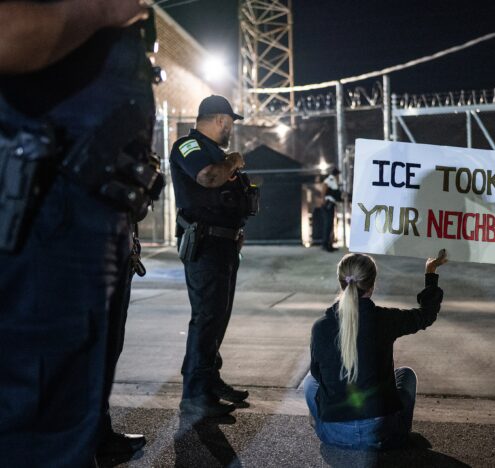













For a century, the weapons industry has helped shape St. Louis — from the McDonnell Douglas fighters that once symbolized American air power to Boeing’s sprawling factories today. But when thousands of machinists walked off the job this year, something cracked in “Fighterland, USA.”
In this episode, we head to the picket line to hear from the workers who build America’s bombs and jets — those struggling to afford rent, groceries, and daycare while assembling weapons worth more than their annual salaries. Reporter Sophie Hurwitz takes us inside a city reckoning with its identity: Can St. Louis really become the “Silicon Valley of defense” when the jobs it’s banking on are shrinking? What happens when an economy built on war no longer guarantees stability? And what does labor power look like in an industry whose products help shape conflicts worldwide?
While some in town are fighting to keep defense dollars flowing, others want St. Louis to imagine a different future. This is the story of a strike, a city, and a century-long relationship with the military-industrial complex now reaching its breaking point.
Guests:
Sophie Hurwitz, Reporting Fellow, Inkstick Media; Breanna Donnell, Rick Perdue, Mason, and other Boeing Machinists; Stephen Quackenbush, Professor and Director of Defense and Strategic Studies, University of Missouri; Maxi Glamour, 3rd Ward Committeeperson, St. Louis
Additional Resources:
“How One Dissenter Left Boeing,” Sophie Hurwitz, Inkstick Media
“The Year Arms Contractors Stopped Supporting Pride,” Sophie Hurwitz, Inkstick Media
Transcript:
Sound of picketers chanting: “What do we want? Contract! When do we want it? Now!”
LAICIE HEELEY: Hi, I’m Laicie Heeley. And today, we’re taking you to a strike just outside St. Louis, Missouri.
Cheering.
BREANNA DONNELL: Woo!!
LAICIE HEELEY: Machinist Breanna Donnell has just seen the planes she helps build flying overhead.
BREANNA DONNELL: That was spectacular. I’m always inside work, making new parts for the F-18 or the 777X. And when I finally get to see the aircraft that the pieces I make go into… when I see it flying, that motivates me. That keeps me going. I’m ecstatic and very happy about that. And that’s definitely what I’m fighting for.
LAICIE HEELEY: When we talked to her in October, Breanna and her colleagues had been walking the picket line since August 4th. And after all that time away from the assembly line, she just wanted to get back to work.
BREANNA DONNELL: My life before Boeing… I was living check to check. And, you know, shit was kind of hard. Sorry for that. I’m sorry for the language.
LAICIE HEELEY: But she was sticking it out because other workers had it worse.
BREANNA DONNELL: As I started reading the contract and got more understanding of how it was treating our senior citizens, I did not agree with it. I love what I do. I enjoy what I do. And, you know, if we’d settled with the first contract, I would’ve been happy. But I’m happy that I’m sticking it out with the union and that we are going to receive the best outcome.
LAICIE HEELEY: St. Louis has been tied to war-making for a long time — from Civil War ironclad riverboats that helped Ulysses S. Grant rise to prominence, to the jet age. Most recently, Boeing got a contract for a new plane, the F-47. But military experts like Iraq Army veteran Stephen Quackenbush say the city’s relationship with Boeing is at a crossroads.
STEPHEN QUACKENBUSH: The F-18E and F Super Hornet program is coming to an end. Production is supposed to stop in 2027. The F-15EX isn’t going to last forever. So the real question is: What is that next generation going to be? That’s the question about the future of Boeing in St. Louis.
LAICIE HEELEY: After more than a hundred days on strike, on November 13th, Breanna and her colleagues reached a settlement with Boeing — one that granted higher wages and a signing bonus, but altogether less than they’d hoped, and not far from the company’s original offer.
Boeing had been hiring permanent, non-union replacement workers. Meanwhile, members were worn out, worried about the upcoming holidays, and said the company simply had more money to wait them out.
Across the country, people like Breanna depend on these jobs — even when they struggle to gain the respect they feel they deserve. But what does it mean when whole communities depend on them too?
Today on Things That Go Boom… St. Louis was once known as “Fighterland, USA.” As some in the community fight to bring that moniker — and the business that came with it — back, others aren’t so happy with their role in waging war.
SOPHIE HURWITZ: When I visited the picket line, I noticed a theme. Just like Breanna said she was sticking it out for the old-timers, it was the people on the cusp of retirement who said they were striking for the newest union members.
RICK PERDUE: You just can’t say, “I got mine, get yours.” That’s not right. Because I’m a union man from the start to the end.
SOPHIE HURWITZ: The older guys said, “Oh, I’m here for the younger guys.” The younger guys said, “I’m here for the older guys, so they get a better wage progression.”
LAICIE HEELEY: For Sophie, St. Louis has always been home.
SOPHIE HURWITZ: I was born in St. Louis. I love the parks. The museums are free. We have the confluence of the Missouri and Mississippi Rivers. I love the food — you can get almost any cuisine for like twenty bucks. People say the barbecue is really good — I don’t know, I’m vegetarian — but I love how much my friends get into it.
LAICIE HEELEY: These days, though, there’s another St. Louis Sophie has been getting to know — the one behind the factory walls.
SOPHIE HURWITZ: I’m a reporting fellow for Inkstick. I spend a lot of time thinking about Boeing. But that wasn’t always the case. Even my parents didn’t know Boeing was making warplanes and missiles in town. People just talked about it as a place that had good jobs. You can live your whole life here and not know Boeing is a military contractor.
LAICIE HEELEY: Sophie says that in their reporting, they’ve seen the city’s relationship to the industry — and what it makes — changing.
SOPHIE HURWITZ: The awareness that Boeing is a military contractor is growing. And the number of jobs Boeing is able to provide seems to be decreasing. People are starting to question whether this is really a good deal for us.
STEPHEN QUACKENBUSH: In the early 1900s, St. Louis was one of the biggest, most important cities in the world. The 1904 Olympics. The World’s Fair. The ice cream cone was supposedly invented here. There’s debate about that, but still.
LAICIE HEELEY: Before Boeing came to St. Louis, plane building belonged to McDonnell Aircraft — later McDonnell Douglas.
STEPHEN QUACKENBUSH: When I was a kid in the 80s, there was an ad in Air Force Magazine for the McDonnell Douglas F-15E. You could mail in for a poster. I had it hanging on my wall. I’d never been to St. Louis, but I knew that’s where McDonnell Douglas was, and it seemed like a great place.
LAICIE HEELEY: Mr. McDonnell, the founder, wasn’t from these parts.
STEPHEN QUACKENBUSH: He came from Milwaukee. St. Louis had the people, the music — it was the place to be. McDonnell started making parts during World War II. Then, as the Cold War came, they made their first planes.
LAICIE HEELEY: The F-1H Phantom. The F-2. The F-3. The F-101 Voodoo. Then in 1954, the F-4 — one of the most mass-produced fighter aircraft of all time.
STEPHEN QUACKENBUSH: McDonnell put St. Louis on the map. But by the 1990s, the company had been bought out twice. First by Douglas Aircraft. Then, in 1997, by Boeing.
He pauses.
STEPHEN QUACKENBUSH: Personally, I’m saddened. Fighters are the coolest aircraft. McDonnell Douglas focused on fighters. Boeing was always more bombers, cargo aircraft, airliners.
LAICIE HEELEY: After the Cold War, the future looked bleak for fighter jets. Commercial aviation seemed safer. McDonnell Douglas hoped the merger with Boeing would bring stability and more opportunity. And for a while, that looked true — until it didn’t.
In recent years, Boeing’s commercial side has been rocked by safety issues, federal fines, and executive turmoil. Its defense workers — people like Breanna and Rick — have been holding the company upright.
Sophie says that history hung in the background of the strike.
SOPHIE HURWITZ: The last time workers here went on strike, it was McDonnell Douglas, right before the merger. Back then, about 6,000 unionized machinists went on strike. Now it’s closer to 3,000. That number alone shows that while Boeing still calls itself the biggest exporter in the US, the number of regular people here benefiting from that money is shrinking.
Workers talk about side jobs they’re taking: packing, FedEx driving, making sandwiches, Uber.
BOEING WORKER: In two and a half days driving Uber, I make about 800 bucks. I make 750 in five days at Boeing.
SOPHIE HURWITZ: Really?
BOEING WORKER: Yep. I’m a missile inspector.
BRIAN BRYANT: When the company says “Midwest wages” — what the hell are Midwest wages? There’s not that much difference between here and Seattle. Not enough to justify workers saying they can’t afford rent.
SOPHIE HURWITZ: Organized labor isn’t just about cost of living; it’s about getting a share of the value you create. Workers here produce systems worth billions. But they’re being told they’re only 2% of the workforce — and worth less.
JODY BENNET: Seattle set the tone. But you’ve proven your worth through your skills and the defense systems you build. Bar none, they’re the best in the world.
Workers talk among themselves about safety hazards during past strikes.
BOEING WORKER: Last strike, an F-4 fell from the sky and two people lost their lives.
The strike caught national attention. Bernie Sanders and Missouri Republican Senator Josh Hawley both called on Boeing to negotiate.
BRIAN BRYANT: Are the best damn fighter power mechanics and missile builders in the house? Absolutely.
SOPHIE HURWITZ: A lot of workers see themselves as essential support for the US military. But there’s also a minority who consider themselves anti-war and hope to build labor power to eventually influence what contracts the company takes.
MAXI GLAMOUR: I’m Maxi Glamour. I’m the anti-fascist fairy. St. Louis all the way.
MAXI GLAMOUR: I got kicked out of my house at 17 for dressing in drag. I lived out of my car. I drove my drag mother, who was a sex worker, around the city, and we stayed in motels. I survived the underbelly of St. Louis. After the pandemic, after I got on television, I wanted something different.
LAICIE HEELEY: Maxi is best known for their role on The Boulet Brothers’ Dragula, but they’ve taken on many other identities since then. These days, they’re a ward committeeperson in St. Louis, they run a nonprofit for LGBTQ housing, and they’re planning to apply for a PhD in philosophy.
MAXI GLAMOUR: I try to take all these things and throw them into the world and make some peace out of chaos.
LAICIE HEELEY: For Maxi, queerness is tied directly to their anti-war work. One place that became especially clear was the fight over Boeing’s involvement in St. Louis Pride.
MAXI GLAMOUR: Last year they were the main sponsor of the Pride Parade. They’ve always been a sponsor, but they were the main sponsor during an ongoing genocide.
We organized a protest. We created a campaign. We created lots of media and made lots of phone calls and let people know there’s no pride in genocide… and that Pride should rethink its relationship to queerness.
LAICIE HEELEY: And did it work?
MAXI GLAMOUR: No. Not at all. They acted like they didn’t know there was a genocide happening. They acted like they didn’t know Boeing was responsible. And they said there was nothing they could do because they’d already spent the money.
So instead of Pride saying, “Actually, we have too much ethics for you,” what happened was Boeing divested from Pride themselves.
LAICIE HEELEY: The corporate winds had shifted in line with the White House’s DEI policies. But Maxi says the deeper issue goes beyond that.
MAXI GLAMOUR: We don’t need to pinkwash our campaign anymore because we’re living in a fascist state, so no one cares. They can keep manufacturing weapons of war and not do any image laundering because no one cares about images.
And now Pride, without that funding, is charging people for admittance.
LAICIE HEELEY: Sophie says St. Louis has a long history as a military economy. But it also has a history of people pushing for something else.
SOPHIE HURWITZ: Since the start of Israel’s bombardment of Gaza in October 2023, the spotlight has really been on Boeing. They’re one of the primary suppliers of military gear to the Israeli army. And we saw that reflected in the student encampments at Washington University.
Wash U has tons of entanglements with Boeing: continuing education programs, buildings named after them, sponsorships. The encampment was framed around severing ties with Boeing.
And on the legislative level, there’s a movement to oppose or eliminate tax exemptions for military manufacturers. Locally, it’s called the “Not Another Nickel” campaign.
So there are pressure points where people are asking whether this is worth it.
LAICIE HEELEY: Those voices also have a history. Sophie has been working to uncover a report from the 1990s written by Rutgers scholars and St. Louis locals.
SOPHIE HURWITZ: It’s called Changing the Future. It was produced in 1993, which was this weird archival gap when nobody was digitizing things. I think we’re the first people to have a digitized version.
It laid out how St. Louis could convert its defense plants to make other things. There have been moments when pivoting away from militarism was seen as possible — and economically beneficial — because relying on endless war is maybe not sustainable.
LAICIE HEELEY: But even among anti-war activists, supporting striking defense workers is complicated.
SOPHIE HURWITZ: The local DSA branch passed a resolution supporting the workers. They joined the picket line while also handing out anti-war pamphlets. It’s a tricky balance.
Some activists think supporting defense unionism is a waste of time entirely.
MAXI GLAMOUR: St. Louis is a rowdy space. A dialectical, revolutionary place. And in revolutions, you have conflict.
We have people who want business here because we’ve been so divested from. St. Louis has lost more of its population from its peak than any major city in the country. We have hypervacancy. People want industry.
And on the other side, we have people who don’t want to be complicit in genocide. These two ideas clash. This is not a monolithic city.
Nowhere is that clash more obvious than when I look at the Machinists strike and ask questions people would prefer unasked.
People say, “You need to be supportive of them. They can’t just quit their job.” My rationale is: they can. There will be consequences, but you can always quit your job.
I’ve gotten pushback from socialist organizations focused on labor rights at Boeing. They say, “These workers are fighting for better treatment.” And I’m like: I don’t think you should have that job.
LAICIE HEELEY: But over time, Maxi says they’ve been pushed to see another perspective.
MAXI GLAMOUR: They humbled me. They added different perspectives. Even though I still don’t agree with organizing around better conditions for weapons-making, they explained how the labor unions work. So we showed support.
I used to think revolution was instantaneous. But it’s more like a garden — you plant the bulbs, and maybe next year you see some foliage.
I need to step back and ask what will really help. How do we let people at Boeing self-actualize? How do we allow culture inside the union to shift organically, so people question war through the labor movement?
And I’ll just be the annoying little sibling saying, “Okay, but what about war now?”
If the union said, “We are organizing to sabotage the system,” that would be different. But right now, they’re asking for more pay and better benefits. That helps only the people already selling their souls to make weapons.
LAICIE HEELEY: Of course, it’s not that easy. To build a more critical presence in the union, you have to get elected. Build relationships. You can’t walk in and say, “I don’t think we should be doing this.”
And the resistance isn’t just aimed at Boeing.
MAXI GLAMOUR: There’s a movement in St. Louis against ICL — formerly Israel Chemicals Limited — which is expanding here.
They have been reported as one of the worst ecological offenders in Israel. They supplied the US Army with white phosphorus, which causes organ failure and burns that can’t be extinguished with water.
ICL has two plants in south St. Louis near my house. And now they were allowed to open a third in an already disinvested Black neighborhood on the north side.
People are scrambling to push back. It’s an uphill battle. But sometimes liberation means being Sisyphus — pushing the boulder up the hill, again and again.
LAICIE HEELEY: The push to attract heavy industry like ICL and expand defense tech is part of a larger plan to reinvent the St. Louis economy.
SOPHIE HURWITZ: There are many smaller contractors that subcontract to Boeing. And there’s an effort to make St. Louis a defense tech hub.
LAICIE HEELEY: It’s become a cliché of post-industrial cities — trying to become the “Silicon Valley of” something.
SOPHIE HURWITZ:An article just came out saying St. Louis could be the “Silicon Valley of defense.”
There are folks who want that.
But it looks like a toxic relationship. The less St. Louis gets, the harder it tries.
People who want Boeing to stay feel pressure to make that happen — through tax breaks and incentives.
Many of St. Louis’s other industries have shrunk or disappeared. Brick making, shipping, the beer industry — Anheuser-Busch was bought by InBev. And now the main legacy industry left is war-making. “Fighterland, USA.”
Boeing is even trying to bring the nickname back in their marketing.
To me, it’s indicative of an attempt to make St. Louis more defense-dependent — not less.
Ending music begins.
LAICIE HEELEY: Things That Go Boom is distributed by Inkstick Media and PRX. Come find us on social at @inkstickmedia.
Thank you to everyone who’s been leaving such nice reviews — it helps new listeners find the show.
This episode was produced by Katie Toth, Sophie Hurwitz, and me. It was edited by Nikki Galteland and Christina Stella. Additional production support from Nikki Galteland.
Our music is composed by Darien Shulman, and Robin Wise makes our show sound its best.
Thank you to the supporters and foundations who make our work possible: the Carnegie Corporation of New York, the Colombe Foundation, Ploughshares Fund, and Inkstick’s supporters, including the Reva and David Logan Foundation, Craig Newmark Philanthropies, Prospect Hill Foundation, and the Jubitz Family Foundation.
SOPHIE HURWITZ: Our local beers are really good, by the way. Way better than pretty much anywhere else I’ve been. Even though our beer giants got bought out, the local stuff is great.