


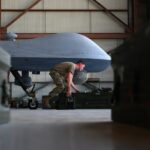











As United States President Donald Trump’s administration escalates its threats of military action in Iran, Greenland, and beyond, the Pentagon has gone all in on artificial intelligence (AI), both as a military tool and as a PR instrument in the quest for ever more of your tax dollars.
The Pentagon is accelerating the use of artificial intelligence across all of its mission areas, touting it as a revolutionary component of the emerging US military posture. The drive to apply AI as quickly as possible is behind the Pentagon’s campaign to eviscerate the oversight, procurement, and data-sharing controls that would normally govern the introduction of a new technology. These maneuvers are framed as being absolutely necessary for maintaining the US technological advantage over China, but the haste with which regulations are being cast aside raises serious questions about performance, price, accountability, and the danger of an accelerated AI arms race.
Last month, the Department of Defense issued a memorandum directing the Pentagon to become an “AI-first” warfighting institution. A press release announcing an “AI Acceleration Strategy” followed on Jan. 12, the same day Secretary of Defense Pete Hegseth delivered a speech outlining a sweeping overhaul of the department’s systems for researching, developing and purchasing new weapon systems. Together, these steps formalize an innovation effort spearheaded by the Pentagon’s Chief Technology Officer, designed to produce next-generation technology and new ways of fighting at “wartime speed,” with AI serving as the first major proving ground.
At the center of the strategy are seven “Pace-Setting Projects,” or PSPs, designed to push AI into warfighting, intelligence, business, and data processing functions within months rather than years. These initiatives range from AI-enabled battlefield decision support and simulation tools to systems intended to convert intelligence into military action in hours, not years. The projects will be overseen by a refocused Chief Digital and AI Office, with progress reported monthly to senior Pentagon leadership.
The memorandum signals a broader institutional shift. Delays, risk aversion, and procedural safeguards are framed as liabilities; officials are instructed to prioritize deployment speed over all else. One section notes, “we must accept that the risks of not moving fast enough outweigh the risks of imperfect alignment.”
“Success is measured not by reliability or performance but by the rate at which new technologies are adopted and deployed.”
Working in close concert with private firms is central to the new strategy. The memo calls for leveraging commercial AI investment, forming new partnerships with technology firms, and ensuring military systems can incorporate the latest technology within weeks. Procurement decisions will favor vendors capable of updating existing systems as quickly as possible.. The shift in approach is already under way: the Army just awarded Salesforce a $5.6 billion, ten-year contract to provide AI-enabled systems for the Department of War, which the company says will “increase mission readiness” by consolidating fragmented data sources into “one interoperable platform,” allowing warfighters to make “quicker, more effective decisions.” To accelerate adoption of the new technology, the memo calls for a sharp reduction in internal data controls.
Taken together, these measures redefine authority inside the Pentagon, centralizing decision-making and compressing traditional checks. Non-statutory requirements can be waived, authorizations expedited, and contracting or testing bottlenecks bypassed.
While the focus on speed is front and center, the memo offers no detailed guidance on compliance with other crucial priorities like observing the laws of armed conflict, allowing time for adequate congressional oversight, or coordinating with allies. Success is measured not by reliability or performance but by the rate at which new technologies are adopted and deployed — benchmarks that are more commonly associated with commercial product development than with military planning.
By positioning AI as the foundation for US military dominance going forward, the new approach reflects a timeworn myth that has dominated US planning since World War II, an approach that equates technological advancement with security. Never mind that past technological “miracles,” from the electronic battlefield in Vietnam to the reliance on networked warfare and precision guided strike capabilities in Iraq and Afghanistan, have failed to achieve US strategic objectives while causing immense civilian harm in the target nations.
The purported technological miracle of the Vietnam era was described by the New York Times as follows: “Gen. William C. Westmoreland, Army Chief of Staff, believes that the new electronics technology has brought the Army to the threshold of a new concept of the battlefield that may be as revolutionary in warfare as the introduction of the helicopter or the tank.” In the real world, the quest for the “electronic battlefield” did not prompt the revolution predicted by Gen. Westmoreland. The Viet Cong developed a series of relatively simple countermeasures, and the new surveillance and targeting systems did not turn the tide in the war.
Even in the 1991 Persian Gulf War, when the use of precision-guided munitions was credited with playing a central role in evicting Saddam Hussein’s invading forces from Kuwait, the story was more complicated. The coalition victory against Hussein’s forces had more to do with the volume of munitions dropped and the relative weakness of the Iraqi armed forces than it did with networked warfare or precision strikes. An extensive analysis of the air war in the 1991 conflict by what was then known as the General Accounting Office (now known as the Government Accountability Office) pointed out that “the claim by DoD and contractors of a one-target, one-bomb capability for laser-guided munitions was not demonstrated in the air campaign, where, on average, 11 tons of guided and 44 tons of unguided munitions were delivered on each successfully destroyed target.”
Without firm policy guardrails, AI may amplify risk rather than reduce it, putting more emphasis on hitting targets quickly than on why those targets are being chosen in the first place. The result could be more failed wars and more unnecessary suffering, not the much touted revolution in US capabilities based on the rapid deployment of next generation technologies.
The Pentagon has made its urge to deploy AI for any and every purpose as soon as possible abundantly clear. Whether common sense controls over its deployment or a realistic strategy governing its use become part of the mix remains to be seen. Without a new approach to defining US interests and a sounder understanding of the limits of military force, rushing new technologies to the battlefield will only yield a more dangerous, less stable world. Before going all in on AI, the US government should think more carefully about the human consequences of the current, deeply counterproductive strategies and actions it is being deployed to advance.