







Around 13 kilometers (eight miles) from Syria’s border with Iraq, the air is thick with tension and anticipation. Smoke billows in the background, as men, women and children clamor at the gates of the Al-Hol prison camp. For many, this is the closest they’ve reached in a long time to anything resembling a chance at getting out.
“We don’t have any internet connectivity,” the women shouted. “We don’t have anything in here.” Some raise their cellphones to film. Behind them, a handful of children dance, celebrating the retreat of the Syrian Democratic Forces (SDF), a Kurdish-led militia which controlled most of northeastern Syria before January 2026. Most of them plead to be released. Their new guards, members of the Syrian government’s security services, appear sympathetic. They apologize. There is nothing they can do, they are under orders to keep the gates locked, the prisoners inside.
According to SyriaTV, the network of SDF’s prisons and detention centers will be restructured within a unified judicial and penal framework overseen by the Ministry of Justice, perhaps signaling Damascus’s intention to end years of political limbo.
This comes following a major confrontation between the Syrian government and the SDF, the country’s two most powerful armed groups. After the fall of Bashar al-Assad’s authoritarian regime in 2024, the Syrian government, now headed by President Ahmed al-Sharaa, and the SDF, under Mazloum Abdi, signed an agreement in March 2025 to integrate Syria’s two armed blocs. In the months that followed, talks largely stalled as low-level clashes sporadically erupted on the edges of SDF-controlled neighborhoods in Aleppo and across a 710-kilometer (441-mile) stretch of the Euphrates that served as a dividing frontier between the two groups.

An end-of-year deadline for integration passed without success in December, and on Jan. 8, the Syrian government seized Aleppo’s Kurdish-majority neighborhoods of Ashrafieh and Sheikh Maqsoud from the SDF before advancing on SDF-controlled towns in eastern Aleppo province. Less than two weeks later, many Arab tribal groups across Deir Ezzor and Raqqa — two Arab populated provinces formerly under SDF control — defected from the SDF to the government, forcing the SDF to retreat to its three last remaining provinces of Kobani, Qamishli, and parts of Hasakah, where its grassroots support among the Kurdish population is much stronger.
The Al-Hol prison camp’s future had long been a sticking point in negotiations between Damascus and Abdi. Home to over 25,000 people, many of whom have been accused of being affiliated with ISIS, they have been stuck in a legal and social limbo for years.
Maria* is a Moroccan resident of Al-Hol camp. She’s draped head to toe in black, as are those around her. She came to Syria in 2015 and spent most of her time in the country in Raqqa — the capital of ISIS’s so-called “caliphate.” “I had no intention of coming to Syria, [but] my husband said he had a job in Turkey,” she says. “I found myself on Syrian land suddenly, and I’m still suffering here. I’m tired of captivity.”
Many prisoners in Al-Hol say the SDF framed them or their family members as ISIS-affiliates — an easy excuse, in their telling, to arrest or detain them. They claim the SDF has long propagated a system of discrimination against the Arab population under its control. Meanwhile, the Syrian government has clearly sought to exploit this discontent, with Sheikh Jihad Issa Sheikh, the head of the government’s newly created “Office of Tribes and Clans,” reportedly spending the last few months courting tribal leaders in the northeast. Yet, Hachem Al-Bashir, head of the Begara tribe, a former ally of the SDF and one of the largest tribes in Deir Ezzor, denies that there had been any coordination with the government.
“I found myself on Syrian land suddenly, and I’m still suffering here.” – Maria*
His son, Abu Hachem, explains their tribe’s sudden defection: “When you compare the Assad regime and the SDF, you choose to work with the latter. But now that we have a government, of course we’re going to work with them.”
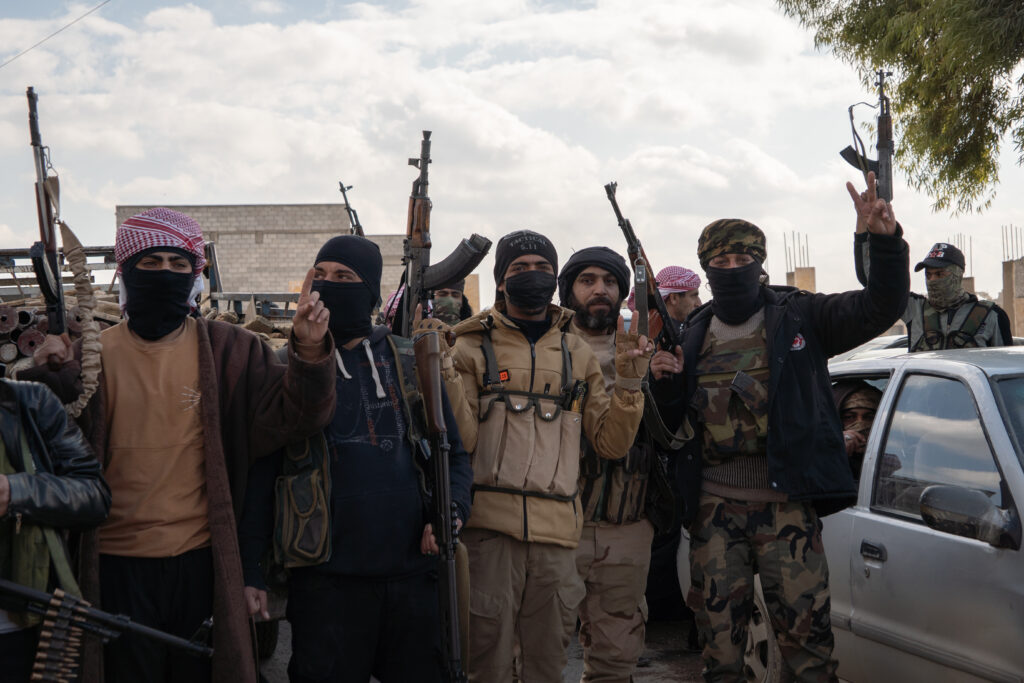
One day after the government takeover of Deir Ezzor, there were scenes of exhilaration at the pontoon bridge which once connected government territory to the SDF’s statelet on the far bank. Tribesmen donned in galabiyes and shmaghs crossed over the bridge, armed to the teeth, posing for cameras as they saw them.
Osama, a member of the Ougeidat tribe, explains that he was part of the fighting that helped “liberate” the northeast from the SDF. “Whatever you did, they’d just decide you were part of ISIS and take you — they took half the people of the Jazira,” he says, using a colloquial term that means island and refers to the stretch of territory between the Euphrates and Tigris rivers.
Alexander McKeever, a researcher, and author of the This Week in Northern Syria newsletter based in Damascus, explains that the tribespeople’s defections were “vital” in the government’s military operations. “Tribesmen made up the bulk of the local SDF in these areas [which] allowed for the government to move in across the river without having to launch an actual offensive,” he says. “That would both be logistically complicated due to the limited number of intact bridges and would potentially draw some form of ire from the US.”
On Jan. 18, a 14-point deal that would result in the cessation of hostilities and integrate the SDF into the Syrian state was announced, though fighting on the ground continued as tribal elements pushed further north, dislodging the SDF from parts of Hasakah. The SDF’s territory was essentially split in two. The province of Kobani had been left isolated and besieged, cut off from SDF-controlled territory in Hasakah and Qamishli.
A new ceasefire deal was announced on Jan. 20 and largely held up despite limited violations by both parties. This deal gave the SDF four days for “internal consultations” on how to practically integrate their forces into the Syrian military. A few hours after its expiration on Saturday, Jan. 24, Syria’s defense ministry announced that it would be extended for an additional 15 days, “in support of US operations to transfer ISIS detainees from SDF prisons to Iraq.”

On Jan. 30, the ceasefire between the government and the SDF developed into an agreement wherein Kurdish military forces would be integrated into the Syrian military. In the first week of February, the latter entered the SDF-strongholds of Qamishli and Hasakah, in a largely symbolic move. Since then, there has been phased implementation of the agreement, as both the SDF and government militaries withdrew from front line positions, and mixed elements — containing both SDF and government fighters — of the internal security forces have deployed in their stead.
Since the ceasefire extension, UN humanitarian convoys have been bringing much-needed supplies into the besieged enclave of Kobani. Although according to a Ahmad*, a resident of Kobani city, “the amount remains very little.”
“I haven’t been able to access anything personally, as there are many people more in need than me,” he says. He has struggled to find baby-formula for his five-month old child. “[Displaced] people are sleeping in their cars in sub-zero temperatures. Everyone is terrified.”
As the situation further deteriorates, the Kurdish Red Crescent recently announced that five children had died in Kobani due to the cold, warning that “the continuation of the siege poses a serious and direct danger to the lives of children, the sick, and the elderly.”
Senior military officials say that humanitarian crossings have been opened to allow citizens to leave the region, but many residents inside deny this, and it is clear that many still feel too scared to use them.
During the Aleppo offensive, the Syrian army also opened humanitarian corridors on multiple occasions to minimize civilian casualties. At the Al-Zahoor crossing point, large crowds of families fled to safety. Many carried as much of their belongings with them as they possibly could.
“Thank God we made it to safety by the grace of God,” said one resident. “By God, we will go to Afrin now. It is where we are from before we were displaced.” In 2018, the Turkish military and the Turkish-backed militia the Syrian National Army captured Afrin from the SDF in Aleppo Province, displacing 200,000 people.
The fighting up until this point appears to have been relatively bloodless, though neither the SDF nor the Syrian military responded to a request about official numbers. Elsewhere, the SDF claims to have lost 11,000 fighters in its war against ISIS. It spent almost five months of grueling urban combat to capture ISIS’ capital of Raqqa — a city it lost in a single day on Jan. 18.
Still, as the agreement is slowly implemented in phases, tensions remain high and the possibility of Syria’s fragile peace falling apart is still very real. The prospect of such an outcome terrifies Ahmad. “We are terrified there will be massacres,” he says. “These are the same people who massacred thousands on the coast and in Sweida. We hope for a deal, but honestly I don’t expect it. I think they want to come and kill us.”
*Indicates the use of a pseudonym for safety purposes.