













RTX, a defense department contractor formerly known as Raytheon, underperformed on job creation projections at a new North Carolina plant by more than 100 positions but was allowed to claim about half a million dollars worth of local taxpayer subsidies anyway due to a loophole in its economic development contract, public records obtained by Inkstick reveal.
Other new records show that the company applied for and received approval for a new round of millions of dollars in state grants under Hurricane Helene disaster legislation that allowed RTX and local officials to bypass local public hearing requirements. Only one company — RTX — applied for and received Job Development and Investment Grants under the 2024 “Temporary Moratorium for Certain JDIG Requirements,” the North Carolina Department of Commerce told Inkstick Media.
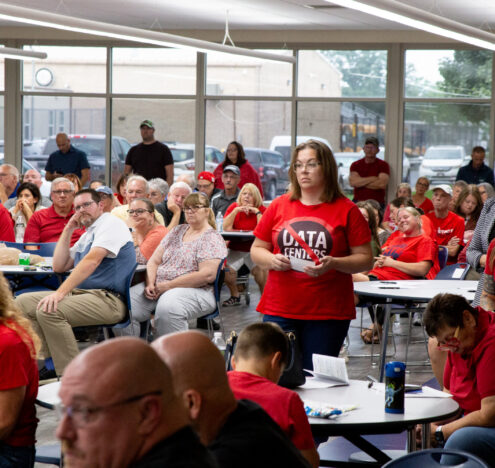
Claiming grants under the moratorium allowed the company and local officials to avoid what could have been vocal outcry to the subsidies, since the company produces the engine that powers the F-35 fighter jet that the Israeli military has used in what has widely been described as genocide in Gaza. A required public comment period in 2020 devolved into a bruising hearing in which locals accused their county commissioners of “getting into bed with one of the largest war profiteers in the world.” Protests against the plant and US support for Israel’s assault on Gaza have been frequent in the area around the plant.

“There’s definitely hundreds, if not thousands, of people [in Buncombe County] who are concerned,” said Anne Craig, an activist with the Asheville chapter of Jewish Voice for Peace, an advocacy group that calls for the United States to stop arming Israel. Residents have raised the company’s contributions to the F-35 in local anti-war rallies and teach-ins over the past two years, she said, adding that she and colleagues have met with local and state politicians to express opposition to both Israel’s assault on Gaza and to the plant. “We don’t think holistically about how things are interconnected,” Craig said. “Think globally, act locally.”
The local economic development records are filed, processed, and then released with a two-year delay, meaning the most recent reports available on the 2020 deal document company performance in calendar year 2023. The records show that Pratt & Whitney, a division of RTX that makes military and civilian aircraft engines, created only 136 jobs in 2022, when their economic development agreement required them to create 250 for full tax breaks. However, a loophole in the contract allowed “an automatic extension of up to one (1) year to achieve the previous year’s Performance Commitments” in order to then receive the “full Incentive,” a tax rebate corresponding to the previous year.
The loophole allowed RTX to claim about half a million dollars extra in tax refunds for jobs that did not exist in 2022 in addition to claiming a new round of subsidies, $2.6 million, when it got back on track with hiring projections in 2023. (See county records regarding Pratt & Whitney’s 2022 performance here and here. See county records regarding 2023 performance here and here. See the company’s JDIG applications here.)
Ken Jones, a retired professor in Swannanoa who has long criticized the deal, said he was disappointed but not surprised about the loophole, which he and other opponents of the deal noticed in the original incentives contract, and that he’d rather the funds be spent on other local priorities. “Look at all that foregone tax money that might have been used to help local businesses and infrastructure, maybe provide subsidies for solar energy and other good things for us,” he said.
The loophole is at odds with statements from public officials emphasizing that the company would only receive the tax refunds if it created the jobs outlined in the contract. “Our agreement is performance based. So, if Pratt fails to achieve the number of jobs identified in the agreement, the amount they receive from the county is adjusted downward in a pro-rated manner to reflect that,” former Buncombe County Commission Chairman Brownie Newman told this reporter in an email in 2021. His fellow commissioner, Anthony Penland, similarly told the Asheville Citizen-Times in 2020 that the incentives were based on “meet[ing] certain parameters” and “that doesn’t mean we’re just handing it out.” In a heated public meeting over the county’s economic development incentives in 2020, Buncombe County Intergovernmental Relations Director Tim Love described a “pro-rated” formula to reduce payouts when milestones are not met.
Newman and Penland, who have since left the county commission, did not respond to emailed requests for comment from Inkstick. Inkstick also contacted current commissioners about the loophole and continuing tax breaks to a company implicated in Israel’s war on Gaza; none provided answers.
In 2020, Buncombe County residents learned for the first time that their county commission was offering $27 million in tax refunds to RTX. Their only chance to comment on the deal came just a few weeks after it was made public after having been negotiated behind closed doors for more than a year. The commissioners held a virtual call-in session for locals due to the pandemic; speakers called in to their masked, social-distanced commissioners and accused them of supporting an “evil warmongering corporation” and “collaborating with arms dealers.” One constituent asked the commissioners to renegotiate a deal in which the factory made parts only for civilian aircraft.
Some officials also expressed misgivings. Chairman Newman told the participants that he shared the public’s concerns about foreign wars, but said: “If I thought the decisions made by our local government would have a direct bearing on those issues, I would think about it differently.” Commissioner Al Whitesides told the meeting that he had also “wrestled” with the issue but that the plant’s manufacturing jobs would provide a “generational change” in the local economy. In all, 21 members of the public spoke out at the commission meeting, with all but one opposed to the deal. The commissioners — six Democrats and one Republican — approved it unanimously.
Frustrated over what felt like a deal done without meaningful public input, opponents banded together under the banner “Reject Raytheon AVL.” They began carrying out protests and marches on the plant site, waving banners like, “Honk for Humane Jobs!” and “Raytheon Profits from Genocide in Gaza.”
“Look at all that foregone tax money that might have been used to help local businesses and infrastructure, maybe provide subsidies for solar energy and other good things for us.” – Ken Jones
Pratt & Whitney’s products include the engine for the F-35, which has been used by the Israeli and US militaries to attack sites across the Middle East and Afghanistan. Last year, Danish reporters documented the use of an F-35 to drop 2,000-pound bombs on the Israeli-designated “safe zone” of al-Mawasi, killing at least 90 people. The F-35 has also long exasperated Pentagon and fiscal watchdogs, as spiraling costs over decades have made it the most expensive weapons program in US history. Defects and delays in repairing aircraft make it combat-ready only about a third of the time. Former House Armed Services Committee Chairman Adam Smith, a Democrat from Washington, has called the warplane a “rat hole” of taxpayer dollars.
Asheville site manager Dan Field has said that the new plant, which opened in 2022, is needed to produce parts for the engine of the F-35 and Airbus passenger aircraft; RTX company spokespeople did not respond to Inkstick’s questions about whether the Asheville plant has produced any engine parts used by the Israeli military. All F-35 engines, however, are produced by Pratt & Whitney, which has facilities similar to the one in Asheville in Connecticut.
Having gotten back on track with and then exceeding hiring projections, Pratt & Whitney returned to the state government this January with a request for a new package of JDIG grants, for what the company told Inkstick would be an expansion from its current 900-employee headcount to 1,200 by 2027.
The grants ordinarily come with a requirement for North Carolina’s “tier 3” wealthier counties like Buncombe to also offer subsidies to the company, a requirement that stems from complaints from rural lawmakers that such grants were disproportionately going to the state’s urban, higher-income counties, according to Allan Freyer, a public policy specialist in North Carolina. Those county incentives are subject to public hearing requirements that the state-level JDIG grants are not.
The origin of the moratorium is mysterious. It is unclear which legislator introduced this amendment into the relief bill. It didn’t appear until the conference committee, when there is no longer a public record of who did what. The narrowly written provision applied to only a small handful of counties, and Buncombe was the only one with an employer that took advantage of it. However, three state lawmakers representing the area told Inkstick’s partner Carolina Public Press that they were unfamiliar with the measure and had no idea where it came from.
One clue may lie in a legislative maneuver that followed the moratorium’s introduction. Records show that the moratorium was extended by state Senator David Craven, a Republican whose district is located east of Charlotte, in an area that was not directly hit by Helene. In a sign that his politics may align with the interests of RTX, which profits from US taxpayer-funded weapons packages to the Israeli military, Craven visited Israel alongside the widely disgraced former North Carolina Lieutenant Governor Mark Robinson in 2023. The trip was funded by the NC Faith and Freedom Coalition, who said its goal was “to expose current and future state-level leaders to the complexities faced by Israel.”
Carolina Public Press repeatedly reached out to Senator Craven but did not receive a reply from his office.
Jones, the local critic of the original deal between RTX and Buncombe County, said that such a hearing would have been contentious. “There is absolutely an awareness here that P&W profits from the genocide,” Jones said. He added that the new round of grants came at a time when many locals were still in “trauma mode” from Hurricane Helene, either still personally reeling from its destruction or volunteering to help neighbors, and that he’s unsure how much outcry the new tax breaks would have generated as people focused on their day-to-day needs. “But some of us would certainly have made our comments, despite our experience in 2020 that what we had to say didn’t matter to the decision-makers, that the deal was already done behind closed doors,” he added.
Pat Garofalo, who studies economic development deals across the country as the director of state and local policy at the anti-monopoly American Economic Liberties Project, said a “legitimate” explanation of the moratorium measure would be that a disaster-impacted county would be cash-strapped for funds to offer their own tax breaks to the company. A less generous interpretation, he said, is that cutting out local participation is “also just another way to speed the money out the door.”
Garofalo also said that offering a new round of JDIG grants to the company once it’s met the job creation targets in its first contract with the state underscores that such deals can be less about getting a new plant on its feet than about a long-term expectation of state support.
“The economic theory at work in most economic development deals is that you provide some sort of level of initial support, be it infrastructure or initial job creation or whatever, and then eventually you’re going to be able to take the supports away and this thing will stand on its own forever,” Garofalo said. “That’s not what ever happens. It’s: They want to just keep taking and taking and taking.”
The records reveal that the North Carolina state government considers company ethics among its criteria for selecting recipients. The Department of Commerce asks applicants for JDIG grants, “Do or will the Applicant and the Proposed Grantee have ethics policies?”
The company responded to the prompt in the affirmative and provided a link to its Ethics and Compliance webpage. Its Human Rights Policy states: “We recognize that the human rights issues associated with our defense products and services are a dynamic and complex subject. As a result, we monitor and evaluate our impact on human rights through due diligence and other measures and take actions designed to mitigate any adverse impacts.”
A spokesperson for RTX did not respond to Inkstick’s questions about whether the company had monitored and evaluated its impact on human rights through the use of its F135 engine by the Israeli military or whether it had taken any measures or actions designed to mitigate any adverse effects. A spokesman for North Carolina’s Commerce Department also did not answer Inkstick’s questions about whether a company’s adherence to its own stated Human Rights Policy affect its eligibility for JDIG grants.
The moratorium that allowed RTX to bypass public comment may not have been “nefarious” or intentionally anti-transparent, in Freyer’s opinion. “The economic developer mindset is like: ‘How do I remove as many barriers as possible to make this deal happen?’ And to the extent that anyone thought about the public comment — this is me speculating — they were probably glad they didn’t have to do one,” he said. “But it’s important to say: They weren’t required under state law to do that. And I think it’s reasonable to ask, ‘Well, should they be?’”
This article was reported alongside Carolina Public Press. See their piece here.