







Skip to content

How to Demilitarize a Shipyard

After months of protests, a drone manufacturer lost its lease at the Brooklyn Navy Yard. But can activists permanently demilitarize one of New York’s most storied industrial sites?

Pictures: Sophie Hurwitz
Date:

The Brooklyn Navy Yard was built at the turn of the 19th century to “launch America’s mightiest warships.” During the Second World War, 70,000 people worked there, outfitting and repairing battleships. The Navy Yard was decommissioned afterwards and hasn’t been a military installation since 1966. It went into decline: by 1987, the Yard was post-apocalyptic-looking enough to serve as the backdrop for the sci-fi movie Robot Holocaust

These days, it’s been through several rounds of attempted renewal as a “mission-driven industrial park” owned by New York City. Isolated by the Brooklyn-Queens Expressway, it’s a place where companies can get hefty tax breaks from the city. It’s marketed as a supportive space for minority- and women-owned small businesses, offering below-market rents thanks to taxpayer subsidies. 

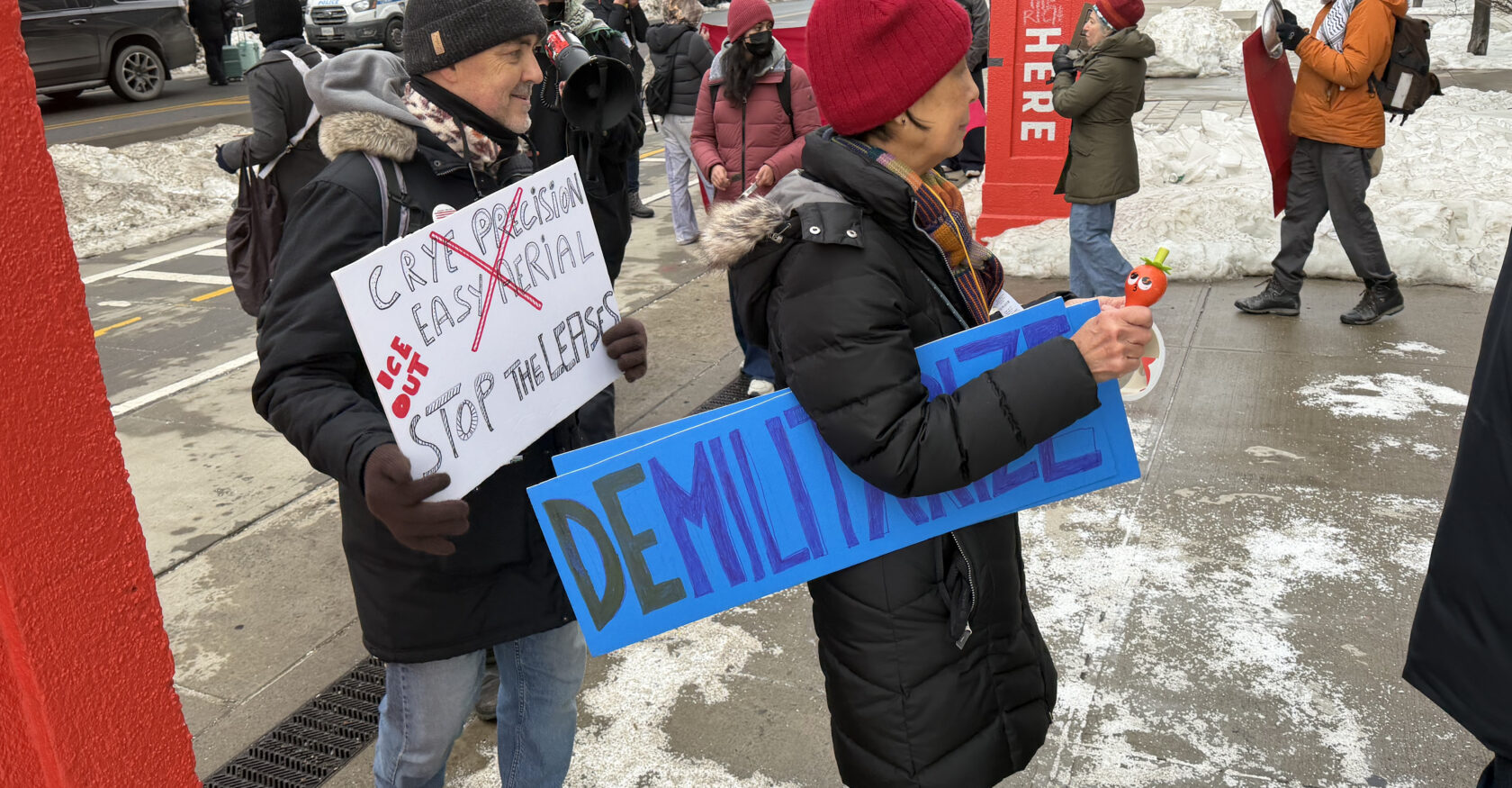
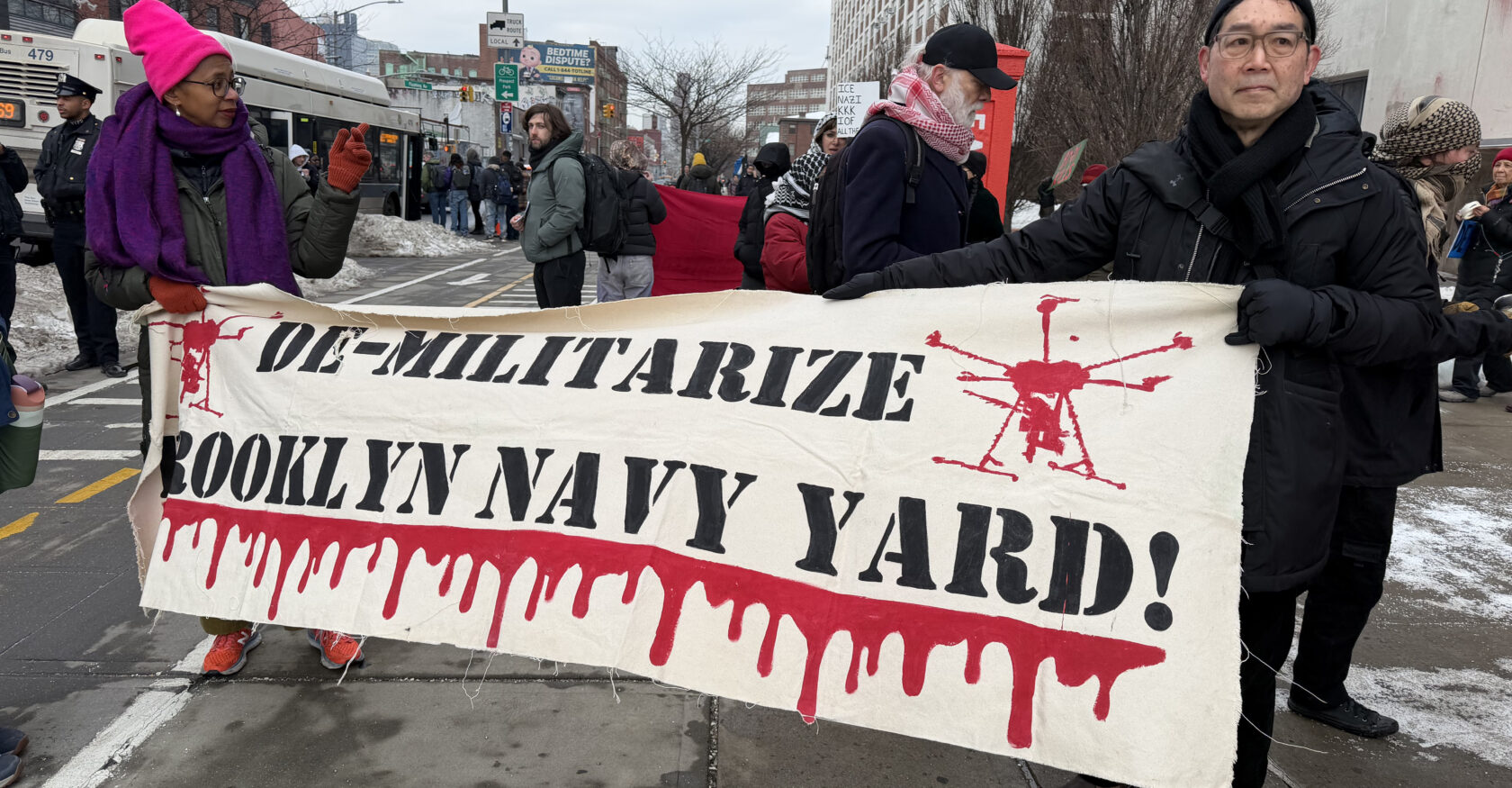
But the city hasn’t always been picky about what exactly those tenant companies do, and two of them, Crye Precision and Easy Aerial, are military suppliers. For the past 17 months, rain or shine, Brooklynites have picketed outside the Navy Yard demanding their ouster. And on the afternoon of Feb. 11, they celebrated a partial victory: Easy Aerial, a drone manufacturer, would not have its lease renewed.

A spokesperson for the Brooklyn Navy Yard Development Corporation — the city-owned nonprofit that manages the Brooklyn Navy Yard — stated that Easy Aerial’s lease was terminated “for business reasons related to operational and campus compliance matters,” but did not clarify what those business reasons were. 

“There were no other factors in our decision,” the Navy Yard Development Corporation representative said.

Easy Aerial, which contracts with the Israeli and American militaries, has claimed their technology played a “pivotal role” in Israel’s invasion of Gaza, as The Intercept reported in September. After Oct. 7, they had a moment in the Wall Street Journal’s spotlight, too, when the Israeli army put in orders for “drones, as many as possible, as soon as possible.” They’ve also competed for US Border Patrol contracts, pitched their products to the New York Police Department in 2022, and have reportedly received over $9 million from the Department of Defense and related entities. 

The local activist group Demilitarize Brooklyn Navy Yard claimed Easy Aerial’s impending eviction as a “vindication” of their protests outside the Navy Yard’s imposing concrete and steel facade. “Crye Precision is next!!!!” one organizer posted after the news broke. 
After months of protests, a drone manufacturer lost its lease at the Brooklyn Navy Yard. But can activists permanently demilitarize one of New York’s most storied industrial sites? How to demilitarize a shipyard.
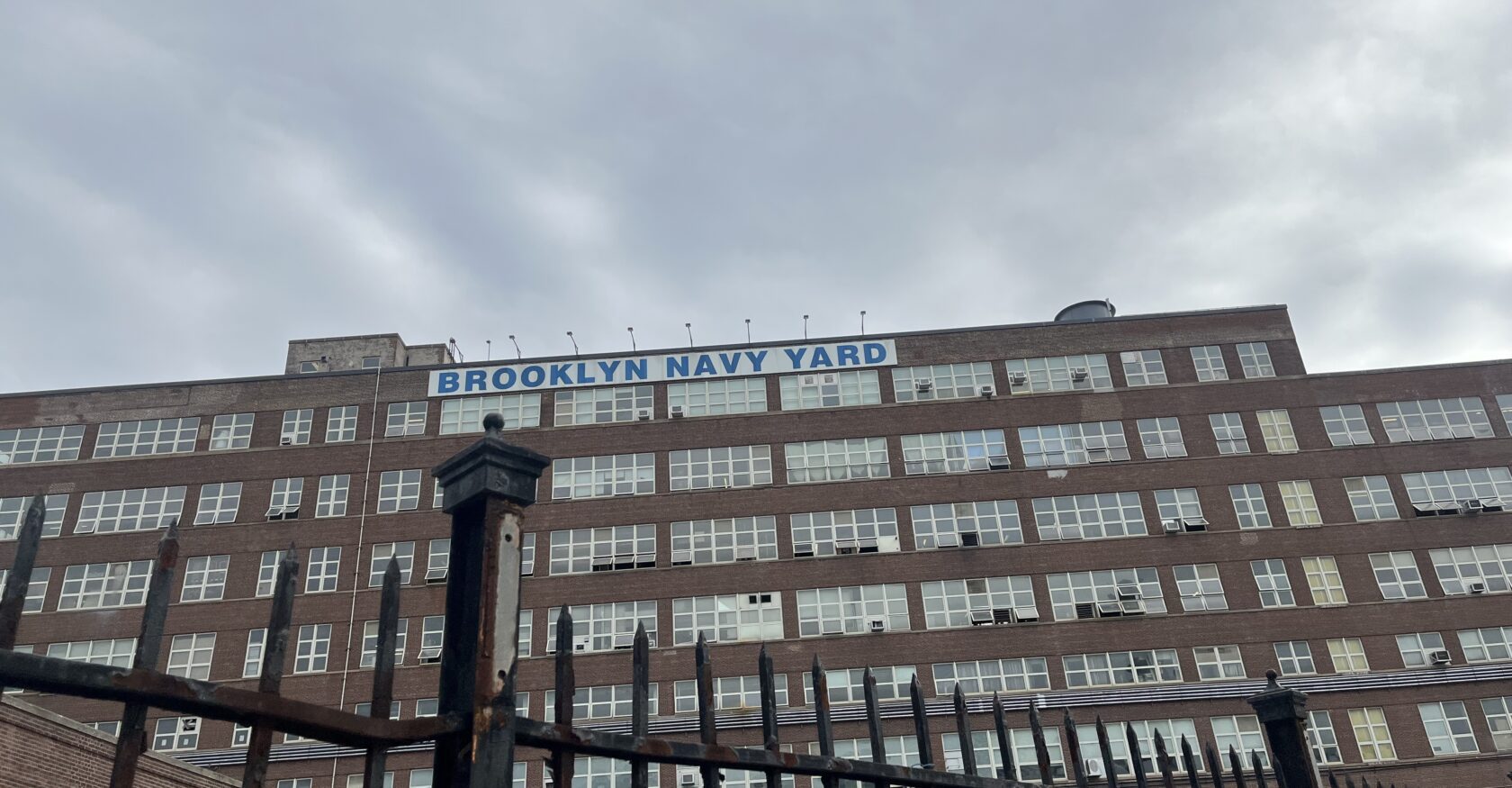
Brooklyn Navy Yard, a 300-acre industrial park, is home to over 500 businesses — including, until recently, two businesses supplying armies and police forces in the US and abroad. Sept. 17, 2025
After months of protests, a drone manufacturer lost its lease at the Brooklyn Navy Yard. But can activists permanently demilitarize one of New York’s most storied industrial sites? How to demilitarize a shipyard.
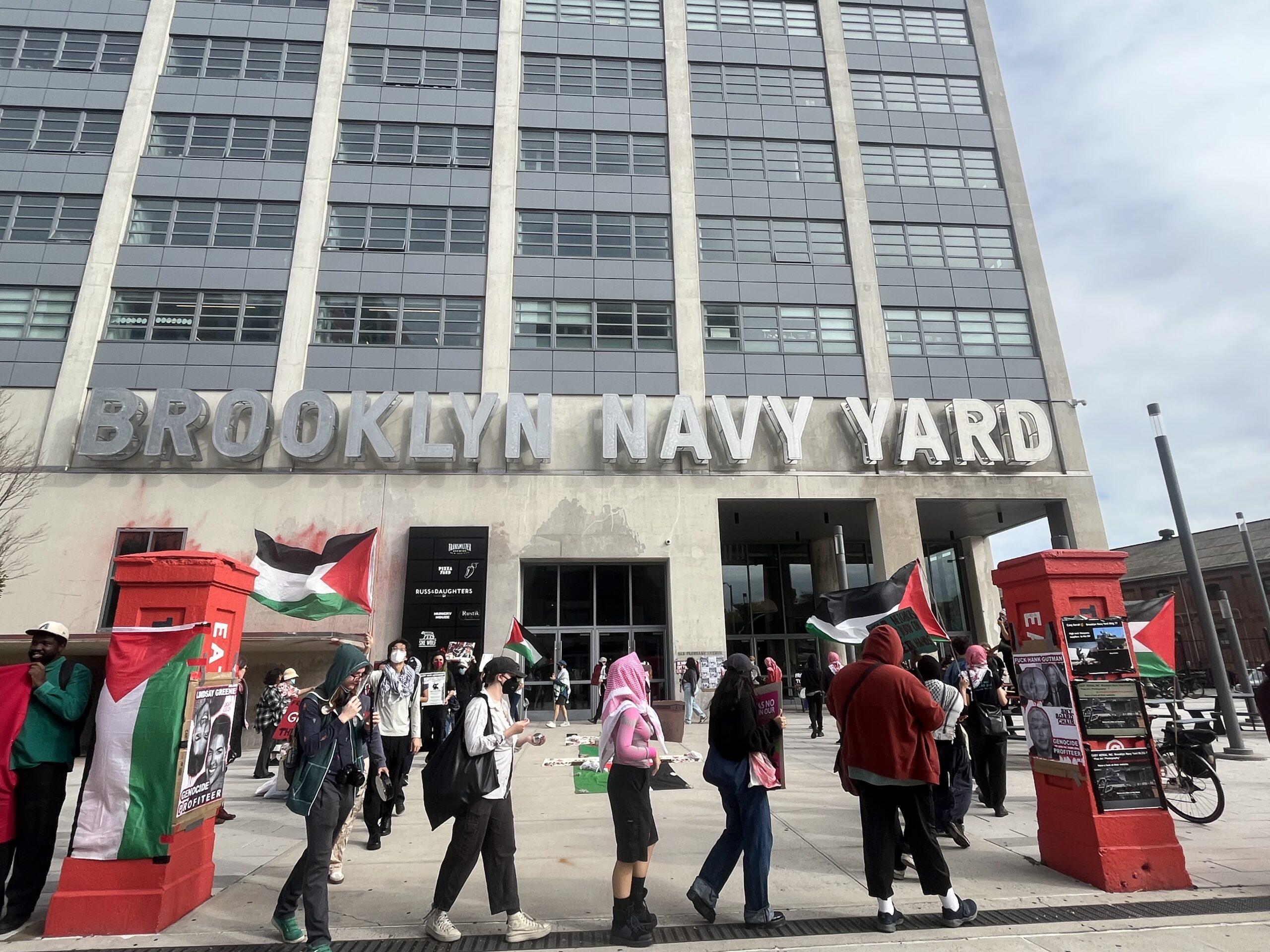
Members of the Demilitarize Brooklyn Navy Yard collective stage a picket outside a Navy Yard Building on Feb. 11, urging the publicly-owned property to cut ties with defense contractors.
After months of protests, a drone manufacturer lost its lease at the Brooklyn Navy Yard. But can activists permanently demilitarize one of New York’s most storied industrial sites? How to demilitarize a shipyard.
At weekly protests, Brooklynites gathered to demand that defense contractors Easy Aerial and Crye Precision cease operating on city property. Feb. 11, 2026.
After months of protests, a drone manufacturer lost its lease at the Brooklyn Navy Yard. But can activists permanently demilitarize one of New York’s most storied industrial sites? How to demilitarize a shipyard.
At weekly protests, Brooklynites gathered to demand that defense contractors Easy Aerial and Crye Precision cease operating on city property. Feb. 11, 2026.
After months of protests, a drone manufacturer lost its lease at the Brooklyn Navy Yard. But can activists permanently demilitarize one of New York’s most storied industrial sites? How to demilitarize a shipyard.
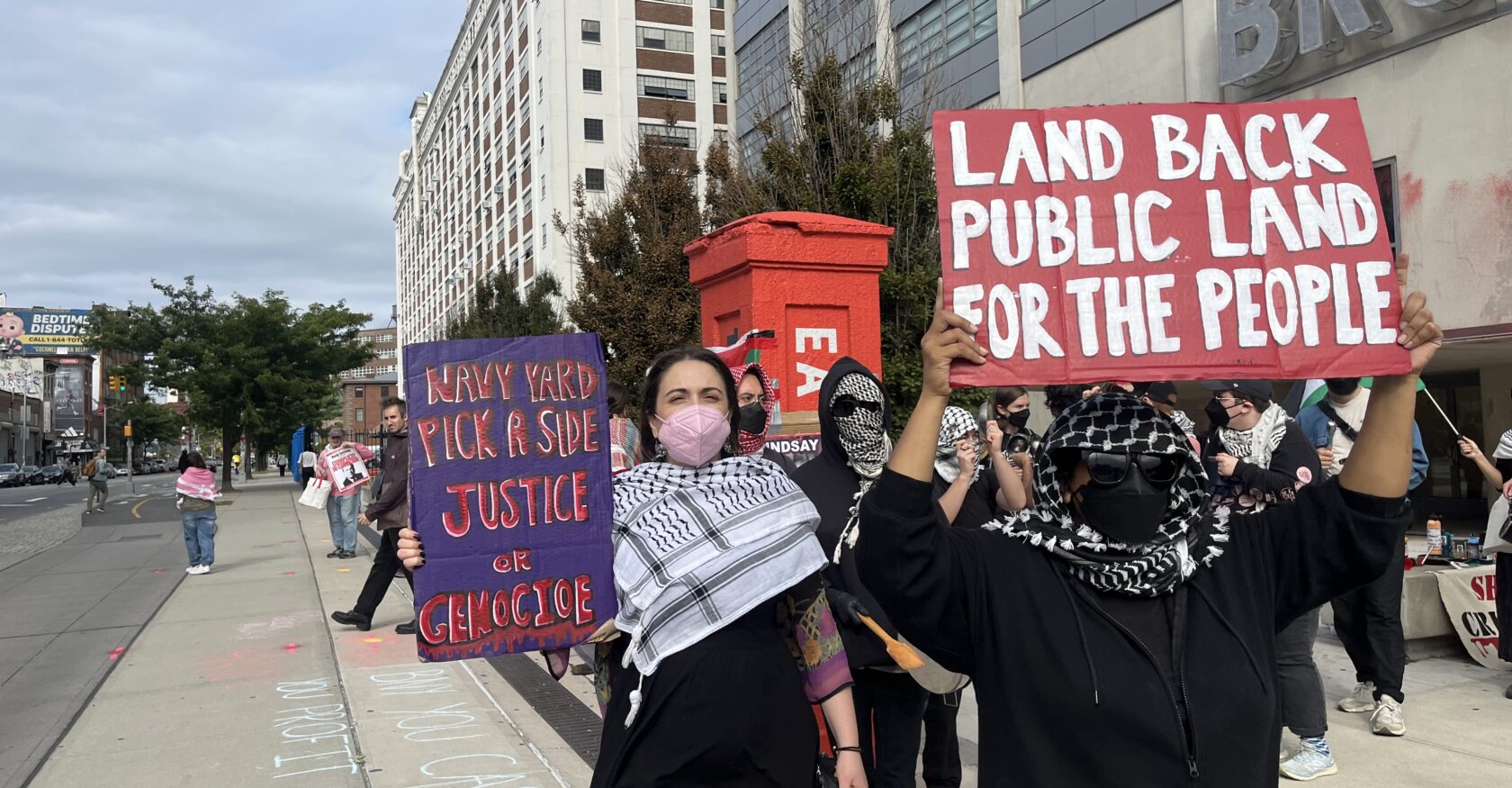
Members of the Demilitarize Brooklyn Navy Yard collective stage a picket outside a Navy Yard Building on Sept. 17, 2025 urging the publicly-owned property to cut ties with defense contractors.

At the weekly picket, keffiyeh-clad New Yorkers march in a circle banging pots, pans, and metal spoons — implements which, a year and a half in, are so bent and scraped they’re no longer recognizable as something one might use to cook. Some protesters cover their faces, but carry signs identifying themselves as Navy Yard employees. They, too, march and chant and hand out pamphlets demanding the two companies’ removal.

Maisha Morales, a local community board member, joined the protests eight months ago when she saw an Instagram post showing that Brooklyn Navy Yard — a project she’d previously been a “big fan of” — was leasing space to military contractors. 

“I was highly disappointed,” Morales said. She’d supported Brooklyn Navy Yard’s initiatives to provide manufacturing space to minority and women-owned small businesses. When she learned that some of the businesses housed there were in fact multimillion-dollar military contractors, she felt compelled to speak up. And now that Easy Aerial is gone, she doesn’t plan to stop protesting. “We still have Crye Precision there, right?” she said. “The work continues.” 

Crye Precision, a supplier of tactical gear — think military-grade clothing, bulletproof vests, magazine storage — boasts a 100,000-square-foot headquarters at the Brooklyn Navy Yard and 250 employees. The distinctive camo they manufacture has been seen on Immigration and Customs Enforcement and Customs and Border Patrol agents for years. One of the Border Patrol agents who shot and killed Alex Pretti in January was reportedly wearing a Crye Precision JPC 2.0 plate carrier armored vest — though it’s not clear whether that was something he bought himself, or was issued by the Border Patrol. 

Crye Precision doesn’t seem likely to give up its lease in the immediate term. But the activists of Demilitarize Brooklyn Navy Yard are not without political allies: State Sen. Jabari Brisport spoke at their weekly picket in September, and City Council Member Chi Ossé produced a video boosting their campaign. 

“We know who you are, we know what you do, and you will be removed from the Brooklyn Navy Yard, whether you like it or not,” Brisport said in September. 

New Yorkers have evicted one defense contractor. But another might be coming to replace it: Radical AI, a materials science company, went public with plans this February to build their new $4 million headquarters in the complex, where they will develop “new classes of materials” for the aerospace and defense industries. Six months ago, they announced a million-dollar contract with the US Air Force

That a new military contractor may be replacing the recently evicted Easy Aerial will be a challenge for New York’s recently elected Mayor Zohran Mamdani. Right-wing tabloid headlines in the wake of Easy Aerial’s eviction claimed that the decision was somehow tied to his leadership — despite the fact that the members of the Navy Yard Development Corporation, who voted not to renew Easy Aerial’s lease, entered office long before Mamdani did. 

“It is important that our community know it was them that brought this to fruition,” said Maisha Morales. “Not elected officials. Community members spent almost two years organizing.” And, Morales said, her fight isn’t done yet: not until all military contractors are removed from this historic military installation, and the Navy Yard’s bylaws are changed to become more selective about the companies signing leases there. 

The real victory, Morales said, would be “making sure that these types of companies never come back to the Navy Yard again.” 

Sophie Hurwitz

Sophie Hurwitz is a reporter and fact-checker working from St. Louis and New York City. Previously, Sophie covered education and the criminal-legal system for the St. Louis American, and worked as a fact-checker for New York magazine. Sophie writes about the ways defense contractors are shaping their hometown and beyond. Say hello and send story ideas to shurwitz@inkstickmedia.com.

LEARN MORE

Hey there!

You made it to the bottom of the page! That means you must like what we do. In that case, can we ask for your help? Inkstick is changing the face of foreign policy, but we can’t do it without you. If our content is something that you’ve come to rely on, please make a tax-deductible donation today. Even $5 or $10 a month makes a huge difference. Together, we can tell the stories that need to be told.

SIGN UP FOR OUR NEWSLETTERS