








The New Year came to Gaza with the sound of wind and bombings, not fireworks. On the edge of the camp east of Deir al-Balah, where the sand turns to mud with the first hard rain, Sabreen Abu Jriban’s tent shook all night. The plastic sheeting above her head snapped and rattled, the ropes strained, and the floor turned to a shallow, brown pool. She lay awake, listening to thunder from the sea and shelling from the east, trying to decide which noise was closer. “The rain comes from the sky,” she said, “and from the ground.”
The earth under her is clay. It doesn’t absorb anything. When the winter storm hit, water pushed up through the floor as if the land itself were leaking. The children woke shivering, their clothes and blankets soaked through. “They wake in the middle of the night and their clothes are full of water,” the 35-year-old mother of three boys and two girls said. “They get sick like this.”
This New Year’s Eve, she did not sleep at all. Each time the thunder rolled, she checked the kids, touching their feet, lifting the blankets to make sure nothing new was wet. Outside, shards of shrapnel from a nearby strike had passed in front of the tent. The sound stayed with her.
A few years ago, Sabreen’s last night of December looked nothing like this. “We used to spend New Year’s Eve at home, in a family atmosphere,” she said. “My daughters each made a kind of dessert. We gathered and ate all kinds of sweets. We waited for midnight to hear the fireworks and see lights filling the sky. We were so happy then.”
She doesn’t say “once upon a time.” It hasn’t been that long, though it feels like a different life.
“I welcomed the New Year with bad news.”
Sabreen Abu Jriban
“This year arrived while filled with sadness,” she said. “I am far from my house.”
Her tent stands on land that isn’t hers. The man who owns it has given them one month to leave. No one has told her where to go next. “I welcomed the New Year with bad news,” she added. A major conflict broke out between her daughter and her son-in-law. Her daughter left her husband’s house, angry and torn apart, and came back to live with Sabreen. “Now she is here in the same tent,” Sabreen said. “We are all together.”
She says together in a tone that holds both comfort and exhaustion.
Finding warmth is the most difficult part. They don’t have enough blankets; what they do have is constantly wet. “When the covers get soaked, I spend the whole day trying to dry them to use them again at night,” she said. She has invented small tricks. “I try to warm their socks by putting them between the covers so they are warm, then at night they wear them to sleep.” Charities have given them a few blankets, but not enough for five children through a Gaza winter.
When someone in the tent falls ill, she walks to the nearest medical point. “They tell us medicine is scarce,” she said. “All I get is two Panadol tablets.” Other drugs she takes on credit from a pharmacy. When she can, she pays later. Doctors advise hot drinks as a substitute for the prescriptions they don’t have.
Education, she says, is “almost nothing.” The United Nations agency for Palestinian refugees, UNRWA, has moved much of its teaching online. “I don’t have a modern phone to follow my son’s lessons,” Sabreen said. The learning points set up in some areas are far away and lack basic things: no proper desks, no toilets, no privacy. “Last year, my daughter was in Tawjihi,” she said, referring to the national high school exit exam in Palestine. “She couldn’t sit her exams because we had no phone and no internet. Some friends helped her submit the test from their phone last month. Now we are just waiting for the result.”
She says this while refolding a damp blanket, as if the exam and the fabric belong to the same fragile category: things that might still somehow be saved. And yet, despite everything, she insists the tent is not nothing. “Even with its bad conditions,” she said, “being with my family in the tent gives me a feeling like the house. A bit of safety. I am okay as long as my family is complete and I feel them around me, gathering over food together.”
Then her voice changes. “We need reconstruction in Gaza,” she said. “First of all for the schools, and in the border areas, so we can go back to our places and homes.” But the despair lingers in her next words. She does not say when they reconstruct Gaza. She says if.
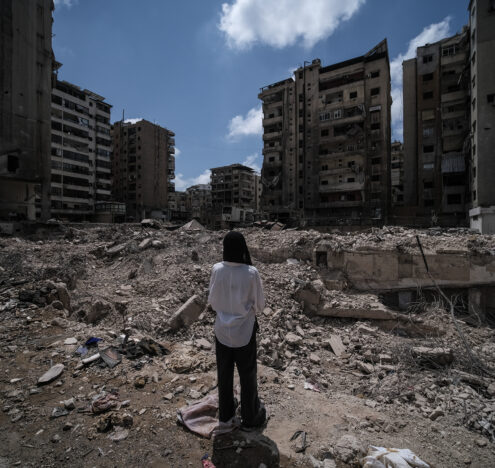
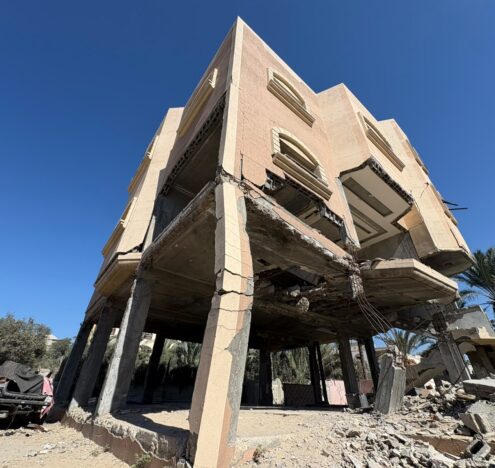
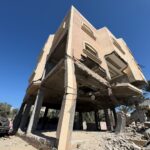
Across Deir al-Balah, in a rented apartment, the night felt different but no less heavy. Nadera Weshah, 42, lives in a small flat with stone walls and a proper roof. She pays rent for it with her husband because the alternative — a tent — terrifies her. In the apartment now are her parents, her married brother and his two children, and her own six: four daughters and two sons. The place is full. She is grateful for that, and yet sleep doesn’t come easily.
“I suffer from the cold,” she said. “And I cannot sleep because of it. I keep thinking about my relatives who are in tents, about their situation.”
They did not celebrate New Year’s in the Western sense before the war. “We are Muslims; we don’t celebrate it as a holiday,” she said. “But we used to use it to renew our determination — to set new goals, wish new wishes for our children. We dreamed of their graduation, their success, their marriages.”
This year, though, she sat awake, crying. “This year was hard,” she said. “I was in a state of depression and sadness for our future that is gone. I stayed the whole night crying over the memories and dreams and the house that disappeared in the blink of an eye.”
For her, the turn of the year is no longer about fresh starts or lists of goals. “The New Year renews only one thing in us,” she said. “Hope for God’s mercy. That He will mend our brokenness and compensate us for the pain we have lived.”
Day to day, her challenges are more concrete: fuel and gas. There is no regular supply of either. “We use firewood and open fire,” she said. “It affects my physical and mental health.” Smoke fills the small rooms. The cold never really leaves. “We suffer from the severe cold all night,” she said, explaining that though the children are growing and need new clothes each year, their income remains minimal. “We barely manage the main meals,” she said. They cut expenses and budget intensively to be able to pay the rent.
The New Year renews only one thing in us. Hope for God’s mercy. That He will mend our brokenness and compensate us for the pain we have lived.
Nadera Weshah
“I am afraid for my daughters from the life of tents,” she said. “Afraid of losing privacy, safety.” At night, she arranges them so they sleep pressed against each other. “So I can cover them in a way that helps them keep warm.”
When someone in the family falls sick, they go to the UNRWA clinics. “They are supposed to be responsible for refugees,” she said, “but there is no real treatment there.” Doctors write prescriptions for outside pharmacies — and with them comes the same problem everyone mentions now: no cash, high fees on bank cards and transfers.
At the same time, she constantly worries about education. Three of her children are in university. “We suffer a lot from internet problems,” she said. She tried to install a connection in the house so they would not need to study in crowded shared spaces. “Students have the right to study in a suitable environment,” she added, “with desks and a board. I find it an insult to the student to sit in the sand to study. An insult to childhood. I hope schools come back as they were — beautiful and clean — so students can study without distractions.”
She looks around the rented apartment — cracked paint, too many people for the space, thin mattresses on the floor — and still calls it a blessing. “Being in a safe house made of stone, with a roof, with my husband and children next to me — this, for me, is stability and the feeling of home.”
Her priority for any reconstruction, if it ever comes, is clear. “Rebuilding the houses must be first,” she said. “So we feel stability, reassurance, privacy. To protect my children from environments that do not fit them or their thinking or our customs.” After that, she says, hospitals and clinics, then the education system.
She has little patience for the talk of “peace plans” coming from abroad. “Israel and America are not interested in peace plans,” she said. “They are only pursuing their own interests.”
She lists how that looks from her kitchen window: They block caravans that could replace tents, so people can’t return to stable lives. They restrict even tents, dictate what food is allowed in, raise coordination fees that push prices even higher for consumers. They limit medicine for the wounded. They refuse to open crossings so people stuck outside can return and families can be whole again. They even block batteries and solar energy systems that could give people some electricity.
“And the aid that does come in,” she added, “is not distributed fairly.”
Then she mentioned the images that sometimes circulate on social media — opened cafés, a restaurant here and there, a new shop in a less-damaged areas. “I want to send a message to the world,” she said. “Life in Gaza is not what you see from a restaurant opening or a shop. All that is limited to a very small group. The reality is there are people who still long for a single piece of bread. We wish for our homes back, with all their details — the ones we spent our lives building and then had to leave, with all their beautiful details.”
Not far away, in Deir al-Balah, Abdullah Abu al-Kass’s tent shook under the same storm that kept Sabreen awake. The 45-year-old father of five has been displaced from Shujaiya, once a large neighborhood outside Gaza City, for almost two years now. His tent is old and frayed, a patchwork of fabric and nylon on a stretch of sand that turns to muck with every rain. Winter nights are the worst. “When night comes, the cold is cutting,” he said.
Insects and rodents sneak in under the canvas. He spends much of the night awake, guarding the tent from the water. “I dig channels in the sand around it,” he said, “so the rain will flow away.” He tightens ropes so the wind doesn’t rip it open. “It’s an old tent, and we’ve lived in it since the start of the war.”
Before the war, New Year’s Eve for him was simple joy. “I used to go out to a café with my friends,” he recalled. “We spent good times full of laughter, talk, natural joking. Or we gathered on someone’s land, lit a fire for warmth, and made the atmosphere nice to welcome the New Year.”
Now, he says, the date means nothing. “Since Oct. 7, the days are all the same,” he said. “They are just years being taken from our lives. No achievements. None of the basic elements of life.”
On this New Year’s Eve, the storm was what he remembers most. “The cold was eating our bodies,” he said. “All night I was tightening the ropes of the tent, putting nylon over it to protect my family from the rain.”
Privacy does not exist here. “One of the hardest challenges is the lack of privacy in tent life,” he said, “and losing the feeling of sitting in a warm house.” He remembers his previous winters clearly: “In my house, I sat on my bed and the heater pumped hot air to all the rooms. We didn’t feel the cold.”
Now, he fills rubber bottles with hot water at night and tucks them near his children’s feet. “So they can feel some warmth,” he said. “Because their age, their future, is being wasted without achievements.”
When they fall sick, his neighbor — a doctor — treats them when he can, for free. Otherwise, they go to the hospital. Abdullah has high blood pressure. The medicine he needs has been unavailable for about three months. “Sometimes I find it on stalls in the street and I buy it,” he said.
In his eyes, the education system has collapsed. “These learning points don’t replace schools,” he said. “To me they are like soup kitchens. No system, no follow-up. Schools must come back properly, and the war must end for that to happen.”
He says he sometimes feels a strange comfort when he closes the tent flap at night. “When I close the door of the tent,” he explained. “I feel like I am in a house, in a place that shelters me.” Then he stops himself. “But this is not safe housing. It doesn’t have the elements of life. The tent doesn’t protect from winter cold or summer heat.”
“The days are all the same. They are just years being taken from our lives. No achievements. None of the basic elements of life.”
Abu al-Kass
If reconstruction ever starts, he believes it should begin in the areas now cut off by what everyone calls the Yellow Line. “Rebuilding the houses that are inside the area behind the Yellow Line must be first,” he said, “so we can feel secure. Then public facilities and hospitals, so life can come back.”
Still, he doesn’t hide his doubt. “I think that is fair,” he said simply.
Since the Trump-suggested ceasefire took effect on Oct. 10, 2025, the Israeli military maps mark the Yellow Line as the redeployment boundary — a jagged curve cutting east to west, placing roughly half (and by some analyses nearly 58%) of the Strip under direct Israeli control. Concrete markers with yellow poles have been planted along parts of it; in other places, satellite imagery shows outposts pushed deeper inside the enclave than the agreed line.
Under the deal, this was supposed to be temporary — a seam line, not a border. But Israeli officials now speak of it as a new defensive border, and troops have been told that anyone approaching the line will be met with gunfire. For residents, there are no signs telling them where it actually runs.
In reality, the line has become a wall you cannot see but can die for crossing.
As for the peace plans everyone abroad seems to pin their hopes on, he has already made up his mind. “I don’t believe in peace plans,” Abdullah said. “Every time we expect something, it doesn’t happen. On the ground, these plans ignore bringing enough aid, ignore opening the crossings, and ignore ending the war completely.”
He has one request for people outside the Strip: “I want to send a message to the world,” he said. “Stand with us to end this war. Have compassion for the people in the tents who don’t have enough covers or clothes. Who lack all the basics.”
While Sabreen checks damp socks, while Nadera counts money for rent and medicine, while Abdullah tightens ropes in the dark, American and Israeli officials talk about “phases” of a Trump-linked peace plan and a ceasefire that was supposed to transform the situation.
Since the ceasefire took effect, Israeli attacks have killed more than 400 Palestinians and wounded north of 1,000, according to health officials in Gaza. For people in Gaza, ceasefire is just another word whose meaning has been emptied. The war has not ended; it has only changed shape.
The plans being negotiated abroad speak in big paragraphs about governance, security arrangements, and future “economic opportunities.” They say almost nothing about the questions that keep people awake at night: Who will rebuild the first classroom? Who will fix the clinic’s roof? Who will open the crossing so a student can return for her final year? Who will pay for the battery that can keep one lightbulb on through a storm?
The New Year asks people to think about next year. To imagine something better. To set intentions. But in Gaza next year is not a calendar; it is many question marks.
When the first morning of 2026 finally arrived, the storm had moved on. In Sabreen’s camp, the sky cleared just enough for a weak sun to come through. She stepped outside, carrying an armful of heavy, damp blankets, and hung them on a line strung between two bent poles. All around her, other families did the same — tents opened, bedding dragged out, shoes placed upside down to dry.
The wind was still cold, colder than the hearts filled with the agony of two years of loss.