The DNR, along with the Luhansk People’s Republic (LNR), were not recognized by any UN member state until 2022, when Russia announced it would recognize them as independent states three days before launching the full-scale invasion of Ukraine. Although originally from Donetsk, Zelenina never viewed the statelets as legitimate. Both “republics” have now been annexed by the Russian Federation.
I didn’t cross any border. I was simply traveling across my own land.
Natasha Zelenina
Shortly after the 2022 invasion was launched, Russian forces assumed control of the prison and the treatment of prisoners became much harsher, according to Zelenina. Prisoners were kept in isolation and restricted from communicating with family on the outside, while being subjected to various forms of emotional and psychological abuse, as well as threats of physical violence.
“Every day the door would open, and we had to stand with our backs to the exit and shout: ‘Glory to Russia!’ three times at 6 am and 6 pm,” she explained. “They banned care packages. They banned visits. They banned phone calls. Right away, you know, when you can’t hear your loved ones…it would’ve been better to get beaten and still be allowed to call. We had girls break down emotionally. Real breakdowns.”
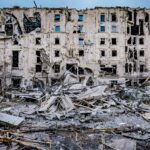
The repression of political dissent is a thoroughly documented pillar of the Putin regime and has become a defining feature of life in the occupied regions of Ukraine. An estimated three to five million Ukrainians currently live in the 19% of the country occupied by Russian forces. Though Russian propaganda frames the brutal invasion as “liberation,” affected regions are often left in utter destruction, with dozens of cities and hundreds of villages destroyed or heavily damaged by fighting, and tens of thousands of civilians killed and injured in the process.
In autumn of 2022, Putin declared Russia had annexed Donetsk, Kherson, Luhansk, and Zaporizhzhia oblasts after facilitating a sham referendum marked by intimidation and coercion within the occupied zones. Attacks on symbols of Ukrainian identity and sovereignty are central to the occupation, with the Russians imposing their own legal system and educational curricula, while using violence to counter resistance and instill fear. Instances of torture, sexual violence, killings, and forced disappearances have been documented, as well as cases of men being forcibly mobilized into Russian and proxy forces to fight against their home country. Russian banks are also offering subsidized home loans to encourage Russian citizens to move to the occupied territories.
Additionally, roughly 20,000 Ukrainian children have reportedly been relocated to Russia and placed in re-education camps, leading the International Criminal Court (ICC) to issue arrest warrants for both Putin and Maria Alekseyevna Lvova-Belova, Russia’s Presidential Commissioner for Children’s Rights. A research lab at Yale University dedicated to investigating the abductions, which has since lost funding under Trump, has documented cases of children being placed in adoption after being separated from their Ukrainian parents, while re-education camps seek to eliminate any vestiges of an ethnic or cultural Ukrainian identity.
The impunity with which these abuses occur has created a climate of fear for both those who remain, and their relatives who have fled or reside in non-occupied Ukraine. For those with relatives serving in Ukraine’s armed forces, the danger can be particularly severe.
“Those with military experience, or people who had worked in the police or with Ukraine, are targeted by the Russian Federal Security Service (FSB). My brother was detained several times,” explained 52-year-old Viktor, a lawyer and former resident of now-occupied Melitopol, who requested to withhold his last name for safety.
His brother is a former soldier who served in the 2014-2022 war and was discharged after suffering two major concussions in Donbas. “They’d come, put a sack over his head, take him away, interrogate him, asking about others, about who else was involved. They’d search his home, our parents’ home, and they would come to my house since I was his brother, asking if we were passing information to the Ukrainian army.” Viktor spoke from the city of Zaporizhzhia, which he has made his home since fleeing the occupied region in 2022.
He said that some people involved in the earlier war have disappeared in the years following the invasion. He described searches by occupation authorities and pressure from the Russian Federal Security Service, who keep tabs on families supporting Ukraine. “The pressure is intense. Not even pressure… It’s like under Soviet rule in 1937, during Stalin’s repressions,” he said. “If you disagree with the Russian authorities, if you do not accept the occupation, you will be accused of terrorism, and a case will be fabricated against you, which will end with years in prison. That’s how it works now.”
After spending seven months under occupation, Viktor and his brother managed to leave in September 2022 through a negotiated humanitarian corridor. Volunteers later helped his brother move to Poland. His home in Melitopol, meanwhile, was seized by Russian occupation authorities. Communication with their parents and relatives who stayed in the occupied region are presumed to be surveilled.
Zelenina also carefully navigates surveillance. “When I call my mom, I just ask, ‘Mom, how are you? How’s your health?’ And she replies, ‘Everything’s fine, my little daughter,’ and that’s it,” she said. “The Russians stop people in the streets and check their phones, their messages, and I don’t want my mother or other relatives to get into trouble.”
Russian propaganda narratives often frame the invasion as part a liberation of ethnic Russians and Russian speakers from a “Nazi” regime in Kyiv that subjects Russian speakers to various forms of repression. The politics of language are in fact much more nuanced, and many people actively resisting the invasion have also at one point spoken Russian as their primary language. Polls have indicated that a majority of residents do not want to live under Russian rule, with the war fueling strong resistance to Russia. A recent poll conducted by the Razumkov Center found that 76.2% of those polled in eastern Ukraine are against the annexation of the four oblasts that Russia has demanded.
“They had their own Russian TV, broadcasting from the occupied territories of Donbas,” recalled Viktor. “They filmed videos claiming to have found ‘fascist literature.’ They loved planting Mein Kampf and other such books, and filmed the supposed “findings” of hidden weapons, even though the person had no weapons at all. They arrested people and staged show trials.”
Despite majority resistance to the Russian invasion within Ukraine, the Kremlin’s revanchist talking points have occasionally found sympathetic ears abroad. Steve Witkoff, a Trump loyalist and now special envoy to the Middle East, has met with Russian leadership on numerous occasions since the administration took office in January.
In March, Witkoff told far-right commentator Tucker Carlson that he believes the four oblasts Putin is demanding “overwhelmingly” want to “be under Russian rule.” The following month, the Trump administration released its framework for a peace proposal that offered US recognition of Russia’s annexation of Crimea and “de-facto” recognition of the occupied territories. Though Ukraine agreed to adhere to a ceasefire back in March if Russia would as well, Putin has continued to refuse, choosing rather to intensify deadly attacks across the country and along the frontline.