









How is artificial intelligence reshaping international politics? Ever since generative AI tools like ChatGPT plunged into mainstream consciousness, policymakers in Washington have been left to grapple with (or completely ignore) the policy implications of this question.
February’s Reimagining US Grand Strategy roundtable brought members of the foreign policy community together to evaluate and debate how AI will define state power. Two guest speakers provided opening remarks on an assortment of trends, including what AI means for interstate competition, what military technologies AI will advance, and how AI influences private-public sector partnerships. The group then debated the opportunities and risks presented by AI and what this could mean for the distribution of power on the world stage.
Erica Lonergan, Assistant Professor, School of International and Public Affairs, Columbia University
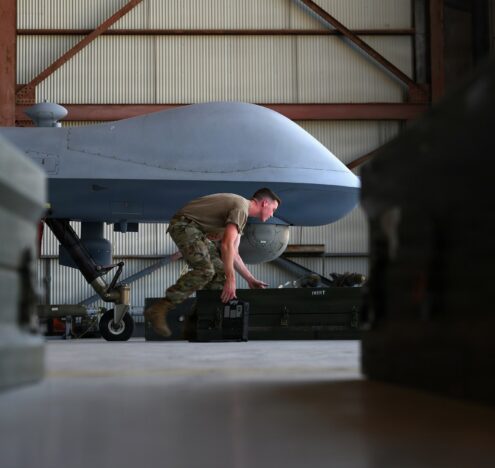
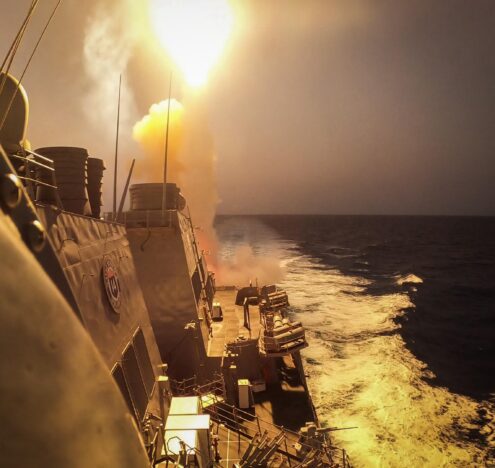
How advanced artificial intelligence tools will shape modern conflict is at the forefront of discussions among experts. These are not hypothetical debates — AI capabilities are increasingly being demonstrated on the battlefield. For example, over the past four years of war, Ukraine has integrated AI tools across a range of weapon systems and platforms, especially drones, to enhance intelligence fusion and analysis, target recognition, autonomous battlefield maneuver, and lethal strike capabilities. Israel has reportedly leveraged AI-powered decision-support systems, dubbed “Lavender” and “Gospel,” to generate potential military targets in Gaza and regional conflicts. And AI tools are an important component of the US and Israeli war in Iran. Despite the ongoing dispute between the Pentagon and Anthropic, the US military is nevertheless reportedly using Claude, Anthropic’s AI chatbot, integrated with Palantir’s Maven Smart System, to fuse intelligence information from diverse sources to generate thousands of targeting recommendations, dramatically expanding the scope, scale, and pace of strikes. The US is also said to have used Claude to assist in targeting as part of the Venezuela operation.
Perhaps not surprisingly, observers are pointing to these recent examples of AI on the battlefield as evidence of a new revolution in warfare. Examples of these conclusions abound. Anthropic’s CEO recently warned that AI-powered drone swarms could “let a single leader control a 10-million drone army.” Others warn that China is developing an AI-powered network of sensors to facilitate a “transparent ocean” that will make it impossible for US submarines to stealthily maneuver. Recent reports about China’s use of AI to automate the steps of an offensive cyber operation prompted concerns about a “groundbreaking shift in cyber espionage,” with some former national security officials describing it as “something really scary.”
The problem is that the excitement (or, to some, hyperbole) around how AI is shaping warfare paints the technology with broad brush strokes. This obscures the opportunity for more nuanced analysis about how — and whether — AI is shaping how modern militaries organize, generate capabilities, and wage warfare, and the ensuing consequences for international security.
One issue is that AI is not actually a weapon. Instead, it is a dual-use, general-purpose complex information technology, and its civilian applications are as significant (if not more so) than its military uses. As Michael Horowitz describes, AI is more like “the internal combustion engine or electricity than a weapon. It is an enabler, a general-purpose technology with a multitude of applications.”
Relatedly, there is no one “artificial intelligence.” The term is often used in ambiguous or broad ways, or to refer to different types of models or applications interchangeably. In reality, though, AI encompasses a diverse set of technologies and capabilities that have evolved over time since the mid-20th century, from symbolic AI to machine learning, deep learning, neural networks, generative AI, neurosymbolic AI, and so on.
On top of this, various AI tools have unique and distinct applications for various military capabilities and warfighting functions, such as routine logistics and administrative tasks; intelligence, surveillance, and reconnaissance capabilities; decision-support systems; offensive and defensive cyber operations; and autonomous maneuver and targeting capabilities. As there is no “one” AI technology, it is difficult to draw systemic inferences about how it will shape warfare.
Moreover, while much of the hype is focused on the nature of AI technology, social scientific research on how military organizations innovate, develop new concepts of force employment, and adopt new technologies shows that organizational and cultural variables matter. Even ostensibly “autonomous” AI capabilities are the products of the skilled personnel embedded in organizations that make decisions about how to build, apply, and refine these tools. What’s more, there is a continuous and collaborative relationship between AI capability development, deployment, and refining, making organizations crucial to how these capabilities are used. For instance, when AI-enabled warfighting capabilities are fielded on the battlefield, they undergo continuous adaptation and adjustment as new information is gleaned from ubiquitous sensor data.
Altogether, these factors suggest a degree of caution is warranted about systematic claims about the implications of AI technologies for warfare. While AI may indeed have transformative effects on the way militaries project power and apply force, how it is likely to do so and what consequences are likely to result will be contingent on a complex interaction of technological, organizational, socio-cultural, and other contextual factors.
Stephen Weymouth, Dean’s Professor of International Political Economy in the McDonough School of Business, Georgetown University
On Feb. 27, the Trump administration designated Anthropic, the maker of the AI model Claude, a “supply chain risk” to national security. This classification is normally reserved for firms linked to foreign adversaries. The confrontation had been building for weeks. In January, Defense Secretary Hegseth issued a memo requiring that all military AI contracts allow the government to use AI models for “any lawful purpose,” with no restrictions imposed by the provider.
At issue was Anthropic’s refusal to remove two conditions on Claude’s use: no mass surveillance of Americans and no fully autonomous weapons without human oversight. When the company would not budge, the administration escalated. The supply chain risk designation restricted Anthropic’s technology from use in Defense Department contracts. Trump ordered all federal agencies to phase out the company’s products. The administration also raised the possibility of invoking the Defense Production Act, threatening to compel cooperation. Anthropic has since sued, arguing that the designation amounts to retaliation.
What makes this more than a procurement dispute is that the government borrowed from the national security toolkit: a designation designed for foreign threats and an emergency statute designed for wartime production.
In a recent article for International Organization, I argued that a small number of private firms control essential inputs in the AI value chain: advanced chips, compute infrastructure, and frontier models. Governments increasingly rely on these tools, but they do not control them, leading to both economic and security vulnerabilities. States often respond by asserting illiberal forms of sovereignty.
That article focused on the inadequacies of international institutions in the AI era, but the Anthropic episode highlights domestic institutional voids as well. The concentration of indispensable AI capabilities in private firms changes the bargaining environment between the state and its suppliers, creating incentives for the state to repurpose national security designations and emergency authorities well beyond the contexts for which they were designed.
The government stretched its coercive tools well beyond their intended scope. But the picture is more complicated than state overreach. Anthropic controls capabilities that have become essential to military operations. A handful of private AI companies shape the boundaries of sovereign military power. Neither the procurement system nor any other existing institutional framework has resolved who calls the shots. As AI capabilities become more deeply embedded in military and intelligence functions, this kind of confrontation is likely to persist. The question it raises is this: What constrains the state in asserting control over technologies it cannot do without?
Sarah Godek, Research Associate, China Program, Stimson Center
As countries around the world, including the United States, race to enhance their military strategy with AI, many countries will be left behind due to US and Chinese dominance of inputs to AI. These inputs include algorithms, data, and “compute,” which is the processing power data centers use to turn data into something useful. Countries’ abilities to access these inputs could determine their strategic future.
Governments are already incorporating AI into military strategy. The US, China, Russia, and countries like India, France, and Turkey are exploring or already using AI for air defense, targeting, nuclear weapons research, intelligence and analysis of vast amounts of data, adversary movement prediction, scenario modeling, planning, and more.
In this context, advantages in algorithms, data, and compute — which all help to determine the power and accuracy of an AI model — are likely to confer strategic benefits. Most countries utilizing AI for strategic purposes would prefer the best algorithms, most comprehensive datasets, and strongest compute.
The challenge is that the US and China currently dominate these inputs. The US leads in algorithms and compute while China leads in data, with each ranking first and second, respectively, in R&D. The US publishes the most influential AI research while China publishes the most overall, with both leading in patents. Ranking first and second in commercial applications, they also have the strongest capability to export AI technology.
Yet in the strategic realm, countries would prefer to pursue their own capabilities. Uploading classified data into non-native and especially cloud-hosted models poses major risks. Some countries like France plan to build native capabilities, but France is the seventh richest country in the world. Most countries have fewer resources and will need to rely on US and Chinese data, algorithms, and especially compute, enhancing these superpowers’ leverage.
While countries can use data from the internet to train AI models, classified datasets from intelligence, surveillance, and reconnaissance (ISR) will be essential for strategic AI applications like prediction of adversary movements. Satellites are increasingly crucial to ISR, as they can provide data in contested areas unlike some other ISR assets. While China leads in data for AI models overall, the US dominates in ISR satellites; China is in second place. Access to such data is crucial for countries without their own comparable assets. The US is increasingly prioritizing its own threats in its ISR, however, weakening allies’ access to data on their strategic challenges and therefore ability to strengthen their own AI applications. For countries like Germany, diminished access to US ISR data already poses a risk. With growing strategic uses for AI like integrated data analysis, this risk will grow.
The US and China lead in algorithms, with their models scoring comparably on engineering tasks. For those with weaker algorithm capabilities, there are some workarounds. US AI companies have reported distillation attacks in which some Chinese AI labs used stronger US models to train weaker Chinese ones. China’s open sourcing of its own models also gives other countries access to strong algorithms. However, to use algorithms, countries must have the compute to do so.
Compute relies on access to data centers. Countries can either build their own or use another country’s services to access centers elsewhere. The US and China dominate cloud services, which third countries could rely on to access compute at US and Chinese data centers. To avoid uploading sensitive strategic data into non-native data centers, however, countries would need to build their own. Building is off the table for most. Beyond the required upfront costs and technical expertise, data centers have significant power demands and need freshwater resources. Centers also rely on advanced chips, the best of which are designed in the US and made in Taiwan, to process data. Advanced chips are made with the most complex manufacturing process on Earth, involving thousands of steps, cutting-edge technology, and the majority of critical minerals on the 2025 USGS list. Countries like the UAE and South Korea have attempted to build sovereign AI, but this relies on especially US companies, which are ahead of Chinese companies in contracts to this end.
The leverage created by controlling access to compute is clear. Even China, which has strong performance in other areas of AI, has suffered here: the US banned exports of the most advanced AI chips to China, resulting in bottlenecks for Chinese models and spurring attempts to build domestic chip production. These domestic attempts have made progress, but chip smuggling and reports that some leading Chinese AI models were built with export-controlled Nvidia chips highlight US chip dominance. Middle and small powers can work with major powers to access or build new compute, but this weakens their autonomy by forcing them to rely on major powers’ companies. Isolated countries like North Korea could fall even further behind due to limited ability to build domestic compute. The barriers countries face in making their own chips will make the strategic benefits countries can gain from AI further dependent on compute access.
The resulting picture for other countries’ abilities to leverage AI for strategic benefit is grim. China and especially the US dominate necessary AI inputs. A downturn in relations with either could halt crucial access to algorithms, data, and the critical chips needed for compute. The US and China will therefore have more leverage over medium and especially small powers as their own rapidly improving AI applications rocket ahead in the military domain, making control over and access to AI inputs key determinants of future strategic benefit.
“Adults in a Room” is a series in collaboration with The Stimson Center’s Reimagining US Grand Strategy program. The series stems from the group’s monthly networking events that call on analysts to gather virtually and hash out a salient topic. It aims to give you a peek into their Zoom room and a deep understanding of the issue at hand in less than the time it takes to sip your morning coffee without the jargon, acronyms, and stuffiness that often come with expertise.