












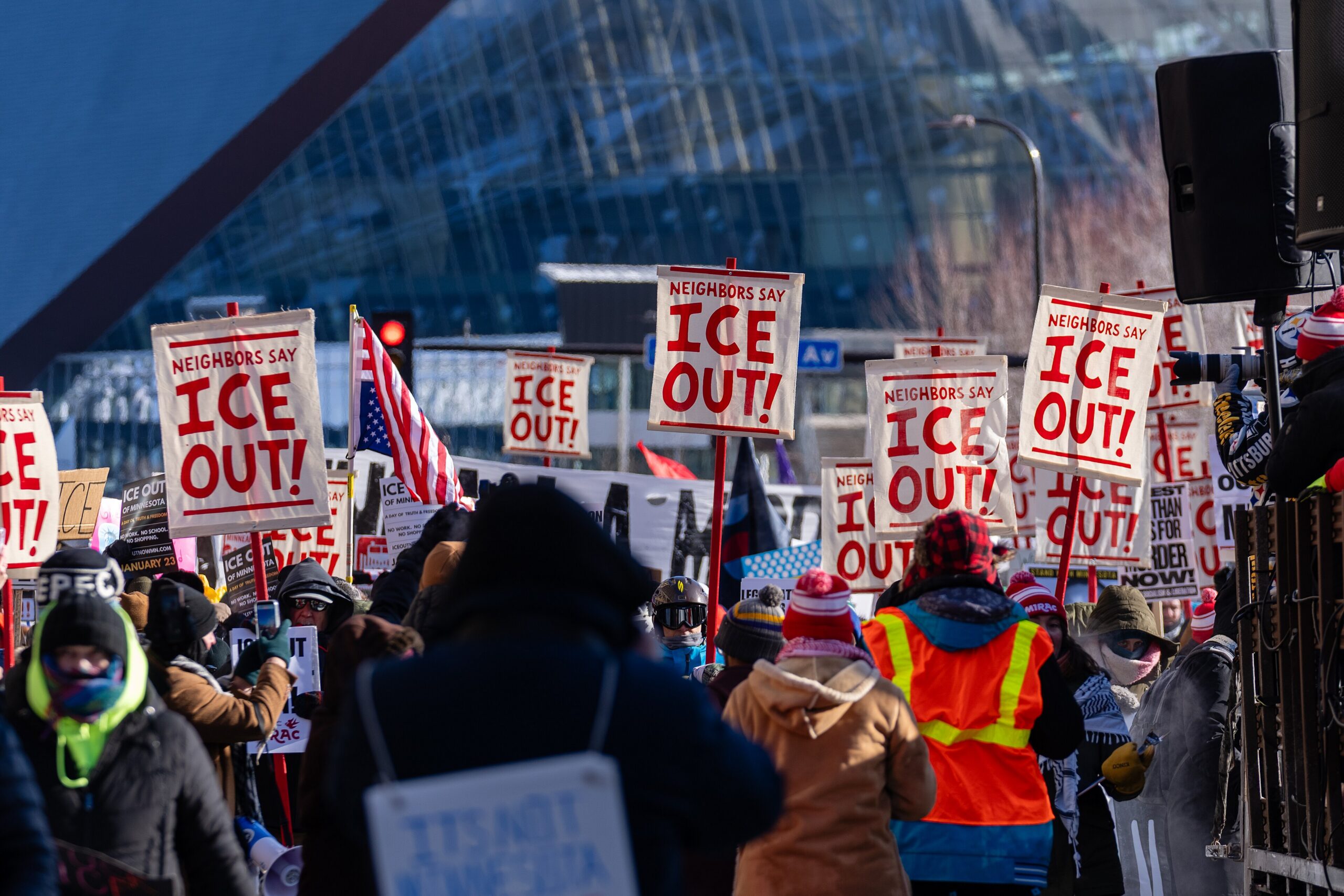
In November 2024, following his victory in the presidential election, Donald Trump officially announced that Tom Homan, former acting head of Immigration and Customs Enforcement (ICE) during Trump’s first term, would join the incoming administration as “border czar.” Homan, however, did not wait for this official statement from the president-elect, nor did he even wait for the election to take place at all before making his own statement: Months earlier, at the National Conservatism Conference in July 2024, Homan said, “Trump comes back in January, I’ll be on his heels coming back, and I will run the biggest deportation force this country has ever seen.”
Homan’s public confidence that he would secure a prominent position in immigration enforcement in the future Trump administration apparently extended to private conversations as well — particularly those discussing deals. In September 2024, during a meeting with two men he believed were business executives, Homan reportedly accepted a Cava bag filled with $50,000 cash from them in exchange for his promise to help them win government contracts if Trump should return to the White House. Discussing the business of immigration enforcement was not out of the ordinary for Homan. Since 2018, he had run Homeland Strategic Consulting, which on its website touted past work with the Homeland Security, Defense, Justice departments alongside the following statement: “We have a proven track record of opening doors and bringing successful relationships to our clients, resulting in tens of millions of dollars of federal contracts to private companies.”
Unfortunately for Homan, these prospective clients were, according to reports, undercover FBI agents who recorded the entire exchange. Had the transaction been real and not a sting, that $50,000 down payment likely would have fetched quite the return on investment for the aspiring government contractors looking to get a piece of the multi-billion-dollar industry. Homan, for his part, has denied any wrongdoing. In any case, such schemes are mere symptoms of a larger ailment, one that had long festered but became supercharged when Trump retook office and Congress approved more than $170 billion of the so-called “Big Beautiful Bill” to fund his administration’s sweeping immigration crackdown.
Now, more than a year into that crackdown, the prognosis looks more dire than ever. According to the American Immigration Council, 2025 was the deadliest non-COVID year on record for ICE detention, as the number of detention facilities doubled, number of detainees on any given day rose by 75%, and the number of people with no criminal record held in ICE detention on a given day exploded by 2,450%. The people inside those facilities have reported abysmal, unsanitary conditions, routine denial of medical care, frigid holding cells, and other horrors. Between 80 and 90% of ICE detention facilities are run by private contractors. Other functions of immigration enforcement — surveillance, interdiction, and deportation — have similarly high levels of outsourcing to private companies, along with similarly harrowing reports of abuse and mistreatment. Meanwhile, private contractors (such as the largest detention companies, GEO Group and CoreCivic) have reported record-high profits.
As it turns out, many of the companies now securing these lucrative contracts were some of the largest donors to Trump’s election campaign and lobbied Congress to triple ICE’s budget. The system that incentivizes this kind of apparent quid pro quo parallels one President Dwight D. Eisenhower famously warned of during his farewell address over 64 years ago. Worried by what he saw as a postwar “conjunction of an immense military establishment and a large arms industry,” in his last opportunity to use the bully pulpit, Eisenhower urged his fellow Americans to “guard against the acquisition of unwarranted influence, whether sought or unsought, by the military-industrial complex.” Were Eisenhower alive today, he may have swapped out the first word to rail against a related specter threatening America’s present and future: the immigration-industrial complex.
The immigration-industrial complex is not a brand new concept, though it’s not exactly a household term either. It should be. As we argue in “Deportation, Inc.: The Rise of the Immigration Enforcement Economy,” a new series of short investigative videos from Lawfare and SITU Research, US immigration enforcement has evolved into a rapidly growing multi-billion-dollar industry in which profitability increasingly dictates policy and enforcement priorities. Much like a military propped up by fortune-seeking mercenaries, an immigration system reliant on profit-driven private actors means less oversight, more abuse, and incentives aligned to perpetuate current problems rather than find their solutions.
The comparison between a military- and immigration-industrial complex is so apt that military contractors, arguably the foremost experts in the military-industrial complex, took notice of the business potential in the adjacent border security industry ahead of Trump’s second inauguration. In January, a group of military contractors pitched the incoming administration on a $25 billion proposal to help fulfill the Trump campaign’s promise to carry out the largest deportation operation in American history. One of those contractors, former Blackwater CEO Erik Prince, explained that the federal government alone couldn’t execute Trump’s plan to deport 12 million people by November 2026. But like any good salesman, Prince had just the solution: hire contractors “to supplement that capability with what the private sector does best: find a way to do something cheaper, better, and faster at greater scale.”
For anyone with experience in the public sector, this is an enticing and familiar pitch. Governments around the world routinely outsource public work to private consultants, often for innocuous reasons. And of course not every function of the immigration system is inherently evil. Just as Eisenhower recognized that a “vital element in keeping the peace is our military establishment,” because the country could “no longer risk emergency improvisation of national defense,” so too must there be courts and judges to process asylum claims, embassies to issue visas, and transportation to reunite families.
But the line between legitimate business and graft is a blurry one in a system that outsources integral parts of public administration to the private sector. When government officials are nothing more than clients looking for vendors, where does democracy end and kleptocracy begin?







#/media/File:ICE_Out_of_MN_protest,_January_24,_2026,_Minneapolis_-_13.jpg)