











The Human Rights Campaign (HRC), one of the wealthiest and most well-known LGBTQ+ advocacy organizations in the United States, no longer lists the weapons contractor Northrop Grumman among its sponsors, the group said on Nov. 11. “We are not currently sponsored by Northrop Grumman or Raytheon,” the $40-million organization told Inkstick in a prepared statement. “Our national corporate partners represent companies that have demonstrated a high level of commitment to equality.”
This is a notable departure for an organization that has long partnered with arms contractors — and has long moved in lockstep with the centrist wing of the Democratic Party. Between 2020 and 2023, Northrop Grumman was listed as an HRC “Platinum Partner,” the highest publicly listed sponsorship level (though the organization does not provide specific dollar amounts).
The LGBTQ+ advocacy group was, along with the National Defense Information Sharing and Analysis Center, one of only two 501(c)4 nonprofits that the weapons manufacturer supported financially, according to Northrop Grumman’s Human Rights Report, which ceased publication after 2023. Raytheon (now known as RTX) was also listed as a “Platinum Partner” of the LGBTQ+ equality group in 2021 and 2022. Raytheon was out by 2023, and by late August 2024, Northrop Grumman’s name was taken off that page, records kept by the Internet Archive show. Neither RTX nor Northrop Grumman responded to requests for comment.
HRC did not respond to queries about whether it dropped Northrop Grumman, or was dropped by Northrop Grumman. In its prepared statement, HRC said: “What’s happening in Gaza and throughout the region is devastating. The starvation of children and families, the violence to its people and aid workers is horrific.”
This, former HRC workers said, represents a stark contrast to how Gaza was spoken about before workers inside the nonprofit, and activists outside, began speaking up.
Founded in 1980, HRC began as a campaign fund supporting candidates who backed policies like LGBTQ+ workplace anti-discrimination law and marriage equality. It has since expanded into a massive organization, spending tens of millions of dollars each year and tapping into a network of 75 million “equality voters” across the nation. During that time, it has frequently come into conflict with the same queer and trans people it lobbies for — when the organization threw its weight behind then New York Gov. Andrew Cuomo in 2018, despite his rejection of inclusive policies, for example, or when it pushed for workplace discrimination protections that excluded trans people.
That tension between the prestigious lobby group and the people the organization claims to represent returned with the genocide in Gaza. HRC was subject to a series of half-a-dozen protests across the country by groups like the Gender Liberation Movement, often led by queer and trans Palestinians. They wanted weapons manufacturers off their representative organizations’ sponsor lists.
In the week after Israel began to bomb Gaza in October 2023, Northrop Grumman’s stock jumped by 15%. The company, which builds F-35 warplane parts and Apache helicopter-launched missile systems for client states including Israel, is now ranked as the third-largest defense contractor in the world — and is reportedly the world’s single largest nuclear weapons manufacturer. On top of those superlatives, it’s also spent nine years at the top of HRC’s Corporate Equality Index, a yearly “report card” designed to inform queer job-seekers of the kind of environment an employer will offer them.
In the weeks following the launch of Israel’s war on Gaza, activists like Rand J. — a queer Palestinian who works with the Palestine advocacy group Adalah Justice Project — had already started to take notice. “In winter 2023, someone sent me a video, laying out the facts,” she said.
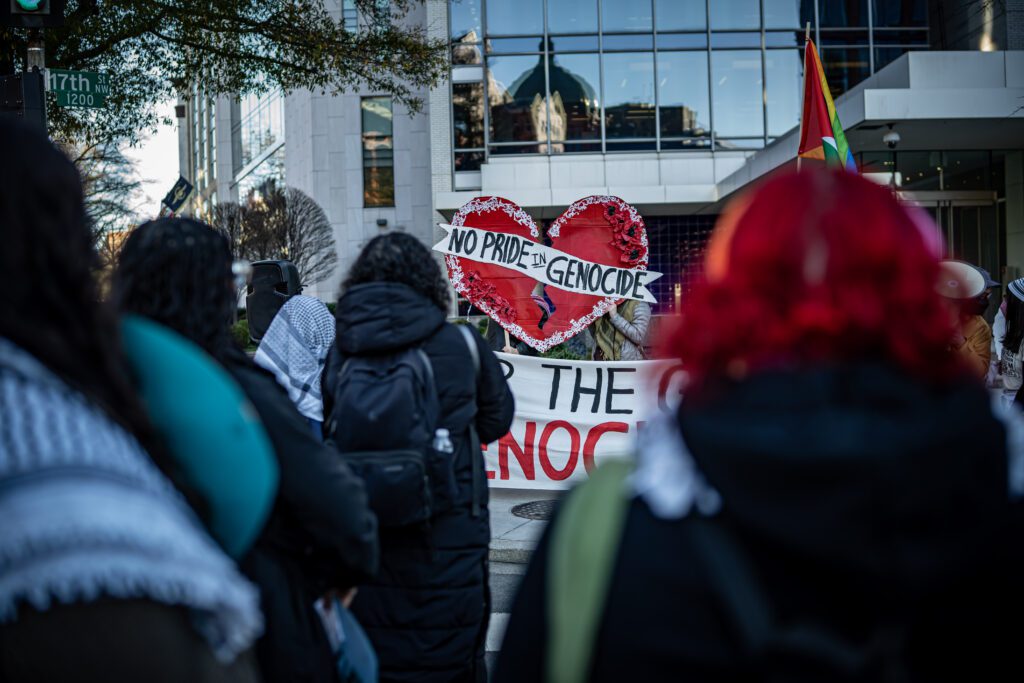
In February 2024, Rand helped organize a protest at HRC’s gala in New York City, alongside the venerable ACT UP and the Palestinian Feminist Collective of New York City. “We were handing out literature,” Rand recalled. “Some folks were reading the literature, and they would come out and say, ‘Wow, we had no idea this was going on. We’re in. We’re going to join your rally.’”
Word spread quickly: The organization known for its support of marriage equality and its iconic equals-sign logo was being funded by a weapons manufacturer. That Valentine’s Day, protesters gathered at HRC’s office in Washington, DC, urging them to “break up” with Northrop Grumman. In March 2024, queer and trans people interrupted then First Lady Jill Biden as she spoke at a Los Angeles HRC gala. Then, in June, activists carrying a Palestinian flag blocked HRC’s New York Pride float outside the Stonewall Inn.
Meanwhile, pressure built inside the organization. Valentine Lynch, who worked in youth programming at the time, started getting questions about the Northrop Grumman sponsorship from the young people they mentored. Some stopped working with HRC altogether. “They were frustrated and disgusted with HRC’s position or lack thereof,” Lynch said.
During all-staff Zoom meetings, participants began to unmute themselves and ask why Northrop Grumman was still a Platinum Sponsor of HRC, according to two former employees who spoke to Inkstick. At least one employee quit in protest of Northrop Grumman’s sponsorship.
“How can you call yourself the Human Rights Campaign and say nothing?”
While at HRC, her job involved making promotional materials for corporate gala sponsors, including Northrop Grumman. But she says that when she asked the nonprofit to put out a statement on Palestine, HRC demurred, saying Palestine was not an LGBTQ+ issue. “There are people that make cupcakes for a living at a local bakery that have, like, a sign that says ‘no to genocide,’” the employee recalled. “How can you call yourself the Human Rights Campaign and say nothing?”
HRC’s responses to the carnage in Gaza remained muted as the death toll climbed throughout late 2023 and early 2024. Instead, the organization focused much of its time (and $15 million) on Joe Biden’s unsuccessful reelection campaign. By July of 2024, Northrop Grumman’s name was absent from HRC’s corporate sponsor list. But it was not until a year later, in 2025, that the organization would confirm publicly that it was no longer taking weapons money.
Queer and trans people across the US have long protested “pinkwashing” by weapons contractors sponsoring Pride events and LGBTQ+ institutions. These protests have only intensified during the genocide in Gaza. “Culturally, in all the queer and trans spaces I go to, all you see is keffiyehs,” Rand, of Adalah Justice Project, said. “All you see is support for Palestine, rejection of Zionism and genocide. We need our organizations to represent that.”
But queer and trans rejection of Zionism may not be the whole story. Far-right activists have also been telling Northrop Grumman to drop HRC since at least 2022 — and, given Secretary of Defense Pete Hegseth’s recent tirades against “woke,” other Department of Defense contractors have distanced themselves from diversity initiatives and pride parades of their own volition. Anti-war organizers believe their pressure was behind the divorce. But the feeling may have been mutual. Defense department contractors, apparently taking cues from the anti-DEI fervor at the White House, ceased sponsoring pride parades in towns across the country this year. They also cut diversity sections from their corporate annual reports to shareholders that detailed their employee demographics such as percentages of employees who were women or people of color.
For former employee Valentine Lynch, who was laid off by HRC in early 2025, it’s a bittersweet victory that should have come far sooner. “If they were doing this because they thought it was the right thing to do, they would have done it when we asked,” Lynch said. “I think that they’re finally facing the repercussions of not being seen as who they want to be seen as.”