




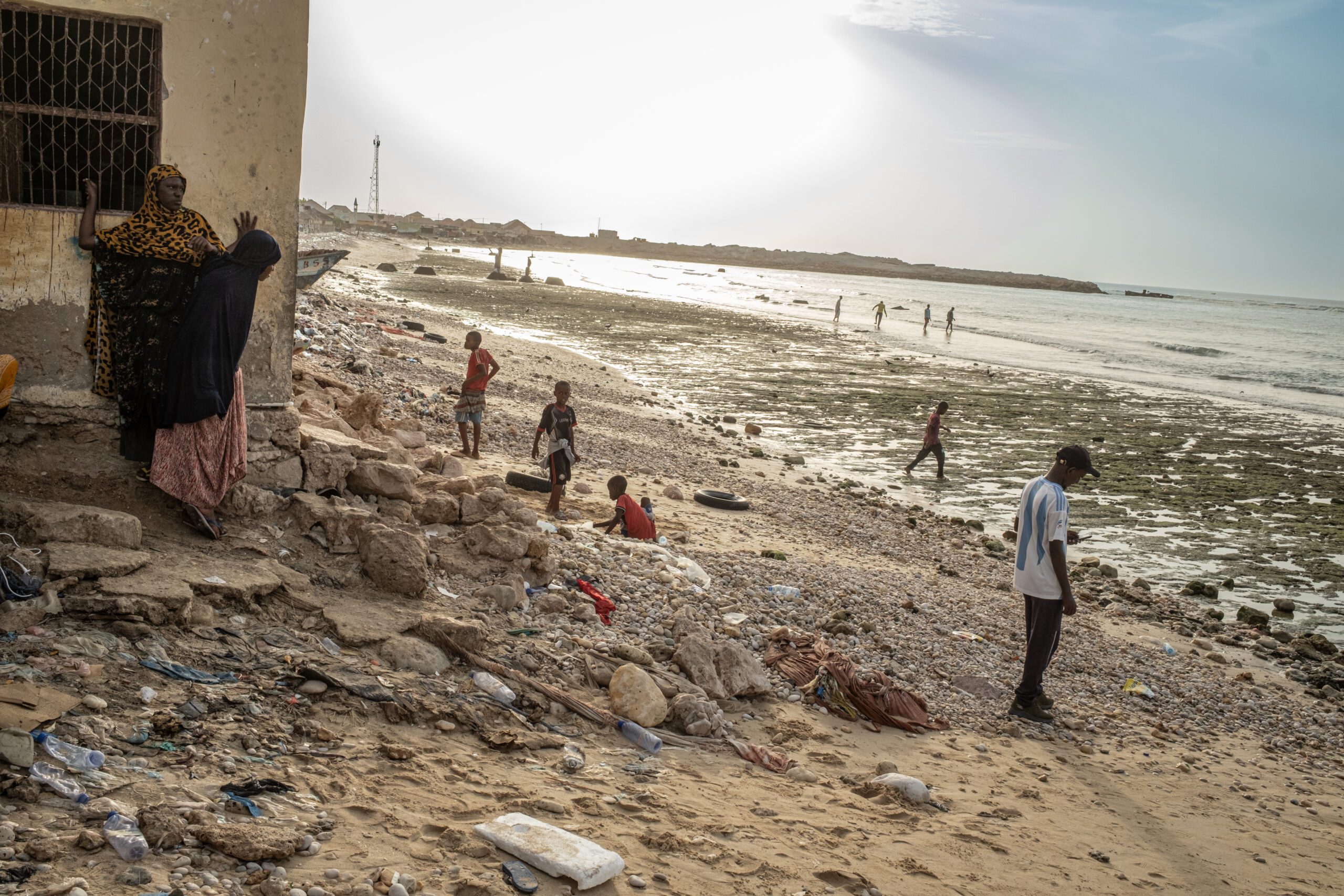
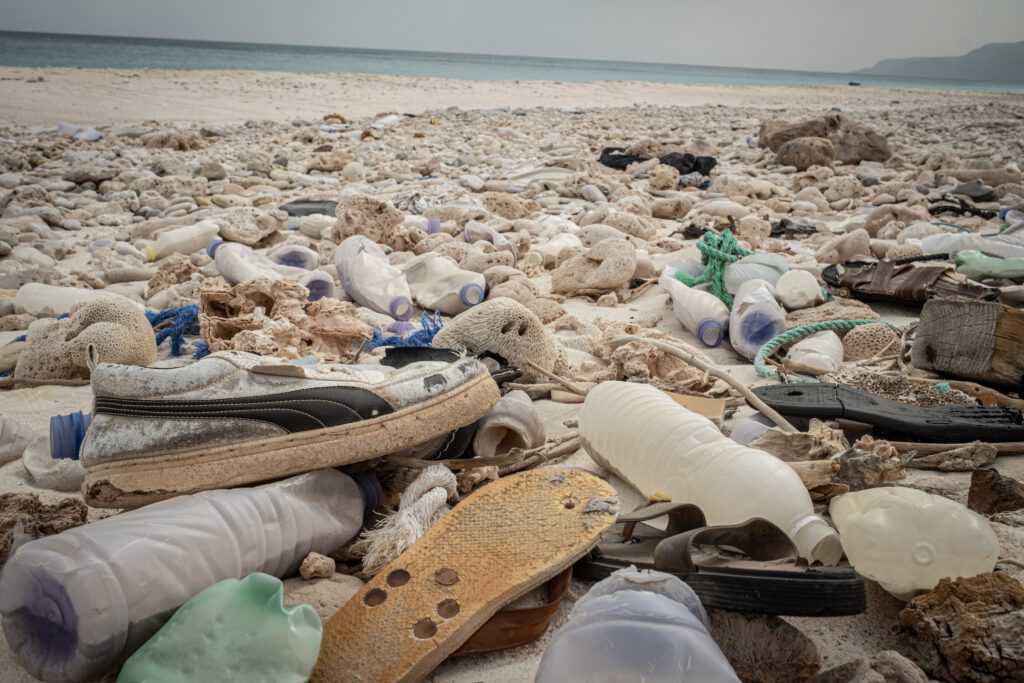
On a long strip of white sand along Mareero’s coast in northern Puntland, Somalia, the beach is littered with debris. A member of the Puntland Maritime Police Force sinks his boot into a heap of bottles and cans, threading between a broken torch, a sun‑bleached hat and shoes faded by salt. It’s almost impossible to walk without stepping on something — objects abandoned by migrants or thrown back by the sea. Seen scattered everywhere, it feels as if the people who left them had simply disappeared, leaving behind only what they were wearing.
Until recently, Mareero’s beach was a main launch site for dalala traffickers sending migrants on small, overloaded boats to Yemen. Puntland security operations shut it down, but departures quickly shifted along the coast. With its hidden coves and mountain trails, Mareero remains a key hub of the Somali branch of the eastern migration route to Saudi Arabia.
On the sand, like a warning, lies the split hull of a fiberglass boat, torn in half by the waves. A police officer inspects a bivouac among the rocks where migrants had probably camped for a few nights. “We don’t know how many boats leave from here or how many make it to Yemen — many never do,” he says.. “Whenever we block one departure site, they find another.”

Captain Ahamed Abdi Muhammed, commander of the Puntland Maritime Police Force, says patrolling the coast is nearly impossible. “We have more than 1,600 kilometers [994 miles] of shoreline, but our unit can only cover an operational radius of about a hundred nautical miles,” he explains, sweeping his hand toward the horizon where sea and sky blur. Their few patrol boats often sit idle for lack of fuel or maintenance, and surveillance is limited to the main ports. “We have no radar and no reliable communications,” he admits. “If a boat leaves at night, no one sees it. And if it sinks, we’ll never know.” On the crossings, he adds: “A small boat that should carry 15 or 20 people usually takes 50. And often, when the fuel runs out, the smugglers abandon the boat with the migrants still on board, adrift at sea.”
The eastern migration route is one of the busiest and deadliest migration corridors in the world. It stretches from Ethiopia across either Djibouti or Somalia and then over the Gulf of Aden to Yemen and, for lucky ones, ends in Saudi Arabia. According to the International Organization for Migration (IOM), Ethiopians account for more than 90% of all people moving along this corridor. They are fleeing poverty, unemployment, and armed conflicts. The overall numbers keep rising: Some 395,000 movements were recorded in 2023, 446,000 in 2024, and already 238,000 in the first half of 2025.
Most migrants choose the shorter and better‑known Djibouti trail. But the most vulnerable — penniless and fleeing conflict or persecution, desperate to disappear without a trace — end up on the longer, more perilous branch through Somaliland and Puntland. The IOM tracked about 58,700 crossings from Somalia to Yemen in 2024, a 23% increase over 2023 and more than double the 2022 total. Only 11 deaths were officially recorded, though even the Puntland police dismiss that number as implausibly low. With almost no nonprofit organizations or oversight, this stretch of the route remains largely untracked. Local officials say many more departures and tragedies go unreported: This Somali branch of the route remains largely invisible to the outside world, despite being among the deadliest migration corridors in the world.

Some 20 kilometres (about 12.4 miles) west of Mareero beach, Bosaso rises from a haze of dust between barren mountains and a strip of turquoise sea. Once the epicenter of Somali piracy, it is now the main hub on the Somali branch of the eastern migration route. As one security official put it, “The old business has simply changed hands.” In other words, the same clandestine networks that once ferried hijacked cargo are now moving contraband and people.
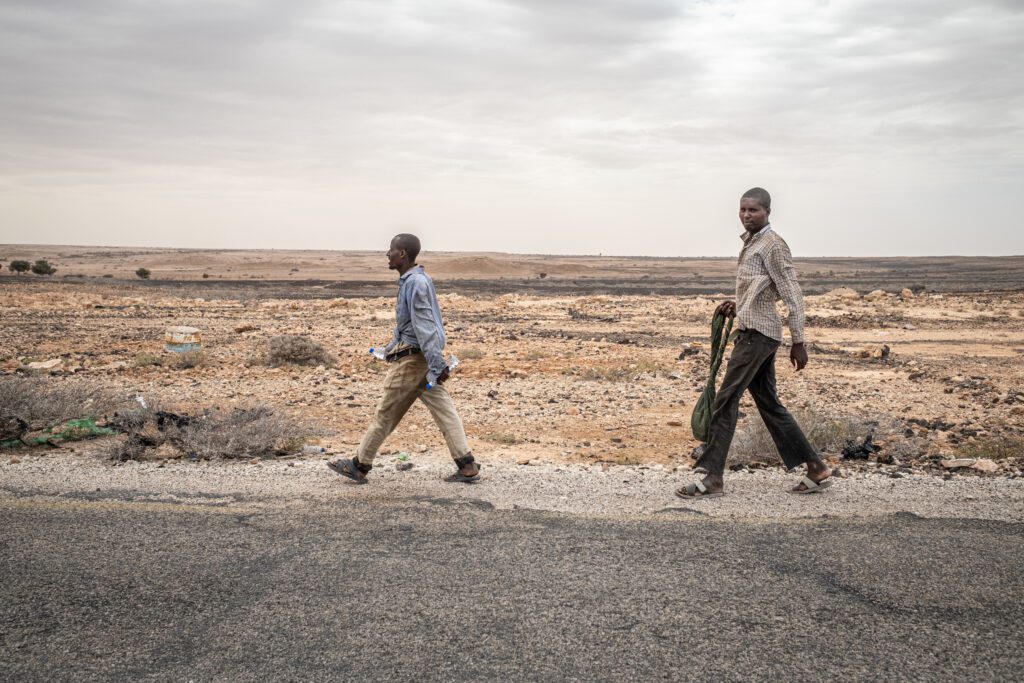
Migrants reach Bosaso in small groups almost daily, gaunt after weeks on foot across Ethiopia and Somaliland or crammed into smuggling trucks that slip over the contested frontier between Somaliland and Puntland. Along the way, they risk being conned or tortured by dalala traffickers extorting money from their families. Four sprawling camps around the city now house thousands of war‑displaced Somalis and stranded Ethiopian migrants; a few decide to stay, but most work long enough to save for the next leg of their journey.
New arrivals often drift to some informal shelters like the Tigray Hotel — an Ethiopian restaurant of tin and dust that serves injera and offers a few beds in back — or the one run by Mama Oromo, a Somali woman raised in Ethiopia who shelters the boys arriving penniless and exhausted. Over the years she has expanded her compound with plastic‑tarp roofs and mats on the floor. “Most of them work in the fields or construction sites for a few months, then they come back here, pay the dalala, and vanish,” she explains. “Some we never see again.”
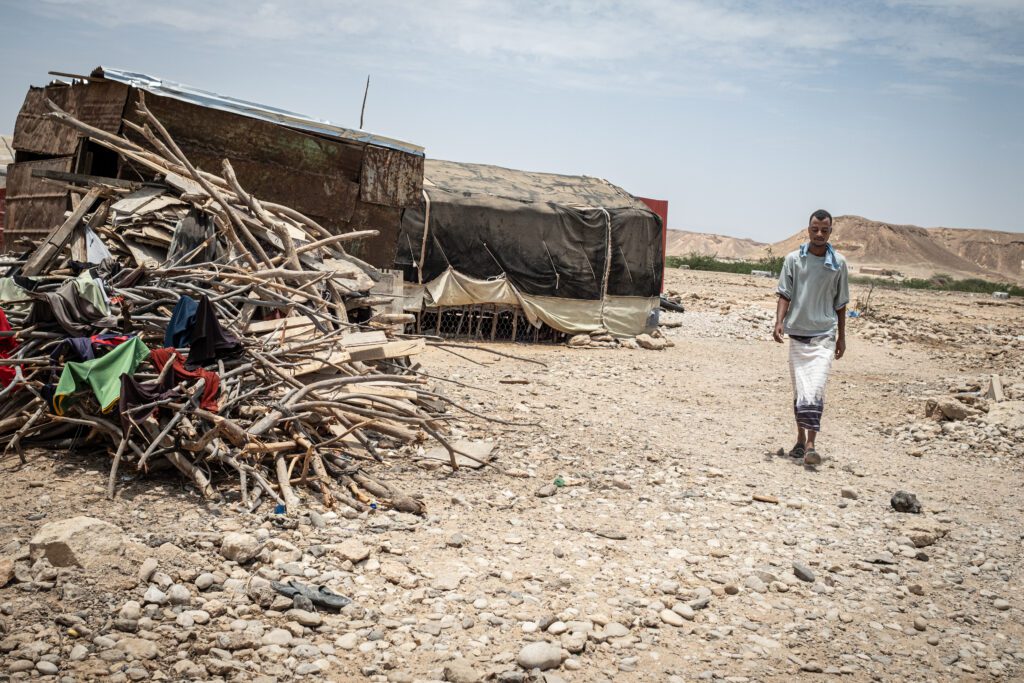
On the outskirts of Bosaso, Rabii Ahmed, a 24-year-old from Dire Dawa in Ethiopia, arrived here four months ago. He lives in a makeshift hut under a dry tree with his brother Mahadi and other migrants. They earn about $80 a month breaking up hard earth to plant tomatoes and onions. “Half goes toward saving for Saudi Arabia,” Rabii says. “There’s nothing for us in Ethiopia; the soldiers recruit by force. I don’t want to end up fighting.” Conscription by federal forces or regional militias has become a new push factor in some Ethiopian regions where internal conflicts are driving boys to leave. Rabii and his group say they feel safe in the Bosaso fields, but “we’ve heard on the radio that Daesh [ISIS] is here, so we’re more cautious now. We just want to get across without trouble.”
Most young Ethiopians who reach Bosaso aren’t aware that another danger lurks just outside the city. In the Cal‑Miskaad mountains nearby, an Islamic State in Somalia (ISS) cell has become a major threat, Puntland authorities say. “Bosaso has become a funnel,” warns Abdirizale Abdulahi, director of the Bosaso Migration Response Center, which operates with IOM support. “People get trapped here. They are vulnerable and exposed to traffickers and armed groups. In this state, it’s easy for them to fall into Daesh’s net.”
“Bosaso has become a funnel. People get trapped there.” – Abdirizale Abdulahi
Newly elected mayor Abdirahman Abdullahi Ali says that Puntland faces the crisis alone. “We have no resources and no international support to handle a crisis that is humanitarian and now also a security threat,” he says. “This mass of vulnerable youth becomes fertile ground for Daesh. We don’t know how to manage the flow anymore; it puts pressure on the local population and creates tensions, even though we have always been welcoming.”
The alarm intensified early this year after joint Somali‑US raids in the Cal Miskaad mountains netted several foreign fighters: Several were Ethiopians.
A local offshoot of the Islamic State in Syria and Iraq, or ISIS, ISS emerged in 2015 when a faction of the al‑Shabaab armed group defected under the leadership of Abdul Qadir Mumin, a former cleric. From its mountain hideouts, the group finances itself through local taxes, extortion, smuggling and hawala transfers, and channels money to other ISIS affiliates in Africa and Yemen. Although Somali and US offensives have killed key commanders, including recruiter Ahmed Maeleninine, ISS still fields about 1,000 fighters, carries out attacks on local forces, and relies on the region’s poverty to recruit and export foreign fighters.
The arrests of Ethiopian foreign fighters have triggered a new wave of raids and ID checks across the area. Inside Bosaso’s sweltering police station, two young Ethiopians sit under guard, awaiting interrogation for illegal entry and suspected links to the Islamic State in Somalia. They are not handcuffed, but two armed officers keep them under close watch. Their eyes show fatigue and worry, and sweat runs down their faces as they sit in silence. They’ve been held for days in the station’s crumbling, overcrowded cells. It’s precisely the migrants’ vulnerability along this route that makes them prime targets for radicalization.


Omar Mahmood, a researcher at the International Crisis Group, notes that “recruitment happens in Bosaso and the surrounding area. Migrants arrive exhausted, hungry, penniless; they become easy prey for ISS promises.” The armed group offers money, food and safety in exchange for small jobs or logistical help. “At first,” Mahmood explains, “many accept simply to survive, without knowing what awaits them. Then, little by little, they’re persuaded to join military training. They don’t do it out of ideology, but out of necessity.”
He believes the group exploits displaced people on the migration trail for coerced labor or as possible new fighters, and “since ISS routinely collects taxes in the region to raise money, it is not excluded that it also indirectly participates in human trafficking along the Gulf of Aden route, profiting from it,” though for now there is no evidence to prove it. The group’s mountain strongholds rise above Mareero’s coast, the origin of most recorded sea departures.
For their part, Puntland authorities believe the threat has grown thanks precisely to the migratory flows. At the Bosaso police station, Colonel Aden Muse, head of the criminal investigation section, explains that among the migrants arriving in the city “not all are looking for a better future.” Some, he says, “are ordinary people looking for work, others are fleeing legal problems, but there is also a third group, much more dangerous: individuals tied to ISIS.” According to Muse, the latter infiltrate the flows “to recruit and radicalize vulnerable young Ethiopians.” “These are not isolated cases,” he says. “It’s a large phenomenon. ISIS attracts them with promises and protection, but then takes them to the mountains to train them or force them to join.” In his view, repression alone is not enough: “Real alternatives for young people are needed, otherwise they will continue to fall into traps.”
Station commander Said Duale also confirms the presence of “some young people who arrive already radicalized from Ethiopia, where cells linked to ISIS have been arrested in the past,” and describes a city awash with illicit trade and crime, where the line between irregular migrants and jihadist infiltrators is increasingly blurred. For this reason he believes there is a pressing need for greater intelligence cooperation with Ethiopia, which he says “remains weak.”

Just last July, a major operation by the Addis Ababa intelligence services dismantled a network linked to ISIS in Ethiopia, arresting 82 suspected members in regions including Oromia, Amhara, Harari, and Somali, who, according to intelligence, “had been trained in Puntland.” The operation revealed for the first time direct links between Somalia’s Islamic State cell and Ethiopian territory, heightening fears that the militant network is extending its influence across borders and using the migration route for expansion.
In recent months, Commander Duale says, Puntland authorities have changed their approach: Now there are more frequent checks and all migrants without documents are rounded up and held, not only those suspected of ties to Daesh. The goal is to reduce the number of people living on the streets, who provide a fertile recruitment pool. “Eight months ago the streets were full of migrants. Today, there are fewer because many have been grouped and deported. But it is not a definitive solution,” he insists, arguing that stopping the flow is impossible. “We expel them and they keep coming back.”
With patrols multiplying and deportations on the rise, the atmosphere in Bosaso is changing; the hospitality that once greeted new arrivals may soon give way to suspicion and fear — a shift already felt by 21-year-old Hamse Abdiraman, who comes from Ethiopia’s Arsi Zone in Oromia. He tries not to draw attention as he walks through one of Bosaso’s informal camps. He arrived about 20 days ago after a two-month trek marked by hunger and fear of arrest. Raised in a poor, fatherless family, he says he was “taken at night to a military camp and forced to train without pay.” After three months, he says, “I stole a rifle and fled. I know they’re looking for me.” When asked about the new threats spreading in Puntland, he shrugs. “It doesn’t change much,” he says quietly. “I’m already afraid of the sea — and of Yemen. But one day, I’ll try anyway. I just want another chance at life.”


