


In a sterile gray cell 12 feet long by seven feet wide in Mendota, California, sits Casey Goonan. An anarchist and abolitionist with a PhD in African American Studies from Northwestern University, Goonan was convicted for actions taken during the recent upsurge of campus protests against the Israeli destruction of the Gaza Strip.
In September, they were sentenced to nearly 20 years in prison after pleading guilty to a federal arson charge in January 2025. As part of the plea deal, Goonan took credit for a series of arsons across UC Berkeley and Oakland, taken in protest of Israel’s war on Gaza and the violent policing of pro-Palestine student protesters in the United States. Although no one was injured and only property damaged, federal prosecutors successfully applied a domestic terrorism enhancement to Goonan’s sentence, drastically increasing the severity.
Goonan’s prosecution and conviction come at a moment of escalating attempts to repress political dissent on far broader terms. The administration is pursuing a number of unpopular actions catalyzing resistance around the country, and the circumstances Goonan now finds themself in demonstrate the ease with which the machinery of counterterrorism is being selectively directed towards those deemed sufficiently threatening.
In the early hours of June 1, 2024, an unoccupied police car on the UC Berkeley campus partially burned after six Molotov cocktails placed beneath it ignited. The fire was extinguished before the vehicle became fully engulfed. An anonymous blog post the following day took credit for the fire, framing it as a response to Israeli attacks on Rafah and in support of student protesters facing police and pro-Israel vigilante violence. The anonymous author wrote that the act “came from a place of love for Palestine, and love for revolution and liberation of all oppressed people.”
The spring of 2024 saw the proliferation of pro-Palestine protest encampments at universities nationwide as the Biden administration continued to provide military and diplomatic assistance to Israel during the deadly war in Gaza. In May, students at the University of California, Los Angeles were violently attacked by a large group of masked Israel supporters during the night. Police were present but allowed the attacks to continue for hours before intervening. No attackers were arrested, but the following night saw hundreds of riot police assault the encampment and arrest 210 protesters, echoing similar instances of police force used against student protesters around the country.
On June 11, Goonan attempted to burn down the Ronald V. Dellums Federal Building and US Courthouse in Oakland. They were disrupted by a security guard while throwing rocks at a window. Goonan fled the scene but lit three Molotov cocktails among a planter of shrubs. The building did not burn, but the window was smashed. Two more arson attempts were attributed to Goonan after another online post stated they were taken in defense of protesters calling for financial divestment from Israeli entities. Goonan was arrested at their parents’ home on June 17, 2024, and an FBI agent assigned to a domestic terrorism squad submitted an affidavit one week later.
Goonan took responsibility for these actions in their plea deal and acknowledged to federal prosecutors that their actions were taken with intent to influence government policy. This allowed the prosecutors to reframe Goonan’s case as no longer one of solely arson but of domestic terrorism.

Section 3A1.4 of the US Sentencing Guidelines allows for domestic terrorism enhancement if the actions in question meet the definition of the federal crime of terrorism, which means an offense that is “calculated to influence or affect the conduct of government by intimidation or coercion, or to retaliate against government conduct,” and is in “violation of one of the statutes enumerated in section 2332b(g)(5)(B).” The statutes cover numerous categories of offenses, including what Goonan ultimately pleaded guilty to, “844(i) relating to arson and bombing of property used in interstate commerce.”
The domestic terrorism enhancement recategorized the severity of Goonan’s actions and ultimately led Senior US District Judge Jeffrey S. White to issue a sentence of 235 months and an additional 15 years of supervised release, surpassing the 188 months federal prosecutors had recommended. Restitution of $94,267.51 was also ordered.
What we’re seeing now is a much broader application of the idea that some people are domestic terrorists, and the import of this is that it carries severe, severe consequences in terms of amount of jail time and placement in certain custodial settings.
Jeff Wozniak
“The application of the domestic terrorism label is not necessarily something new for the feds to apply to a case where they see a political angle,” explained Jeff Wozniak, one Goonan’s defense attorneys, “but I think what was clear here, and what is becoming more clear, is that even though we’ve seen the label apply to animal and environmental rights activists over the decades, what we’re seeing now is a much broader application of the idea that some people are domestic terrorists, and the import of this is that it carries severe, severe consequences in terms of amount of jail time and placement in certain custodial settings.”
Federal prosecutors recommended imprisoning Goonan in a highly restrictive Communications Management Unit (CMU) to monitor and limit their communication with inmates and the outside world. Goonan is currently in a holdover unit at Federal Correctional Institution (FCI) Mendota and it’s unclear if they will be sent to a CMU.
“There’s only one CMU in the US right now,” Wozniak continued, “and to think that Casey, who engaged in direct action that led to property damage — nobody was hurt in any of the incidents Casey was involved in — to put Casey next to a white supremacist who’s, you know, killed multiple people is outrageous.”
The prosecutor’s sentencing memorandum offers some insight into the logic motivating the domestic terrorist characterization. Throughout the document, Goonan is described as taking inspiration from Hamas, whose attacks on civilians are repeatedly referenced. No acknowledgement of Israeli war crimes or widespread charges of genocide are referenced. Goonan’s actions are strictly defined as violence, and compared to the shootings of Charlie Kirk, Melissa Hortman and her husband, as well as the attempt on Trump, and attack on Nancy Pelosi’s husband. The specificities and nuances of each case are flattened in the litany.
Prosecutors alleged Goonan’s actions were “the height of political violence,” “a weeks-long reign of terror,” and a challenge to “rich traditions of peaceful political protest — on college campuses and elsewhere — that undergird our democracy.” That Goonan specifically cited the violent repression of peaceful protests across university campuses is ignored. Prosecutors cite Goonan’s lack of remorse and their alleged desire to inspire others as reason for ensuring their sentence was harsh enough to deter others from engaging in similar acts. An example needed to be made of Goonan.
“This whole notion that if Casey was to be allowed back into civil society and the so-called free world, that they would be unrepentantly continuing their domestic terrorist activities … what does that actually entail? What has Casey actually been doing?” asked Dylan Rodríguez, a friend and former professor of Goonan’s at UC Riverside.
“At this point, almost 20 years of prisoner support, especially political prisoner support — as in collective political organizing and political education by way of study groups and zines, going to public demonstrations to confront anti-trans fascists and people who support police and state terrorism — like that is the nature of what Casey does, in terms of a vast totality, that’s what Casey does and has been doing,” he explained.
“So this story that’s told about Casey, then works to retroactively situate all those activities under the story of the domestic terrorist that culminates in the property destruction of a police car and window, and then that suffices for subjecting someone to punishment of the highest possible order.”
After far-right organizer Charlie Kirk was killed on Sept. 10, 2025, the Trump administration immediately blamed, without evidence, the political left for the violence. Within two weeks, Trump declared “Antifa” a domestic terrorist organization, despite “Antifa” not existing as an organization. The term refers to a politics of anti-fascism that includes a historical tradition of activists directly confronting fascist political organizing.
Later that month, the White House issued National Security Presidential Memorandum/NSPM-7, which directs the National Joint Terrorism Task Force to search for people to prosecute. The memorandum lists “anti-Americanism, anti-capitalism, anti-Christianity; support for the overthrow of the United States Government; extremism on migration, race, and gender; and hostility towards those who hold traditional American views on family, religion, and morality” as views indicating potential “domestic terrorists.”
On Oct. 8, the White House held a “Roundtable on ANTIFA,” which saw the participation of the heads of the Department of Justice, Department of Homeland Security, and FBI vowing to crack down on the alleged threat posed by “Antifa.” A select group of right-wing content creators participated in the event and called for federal action to be taken against their perceived political opponents.
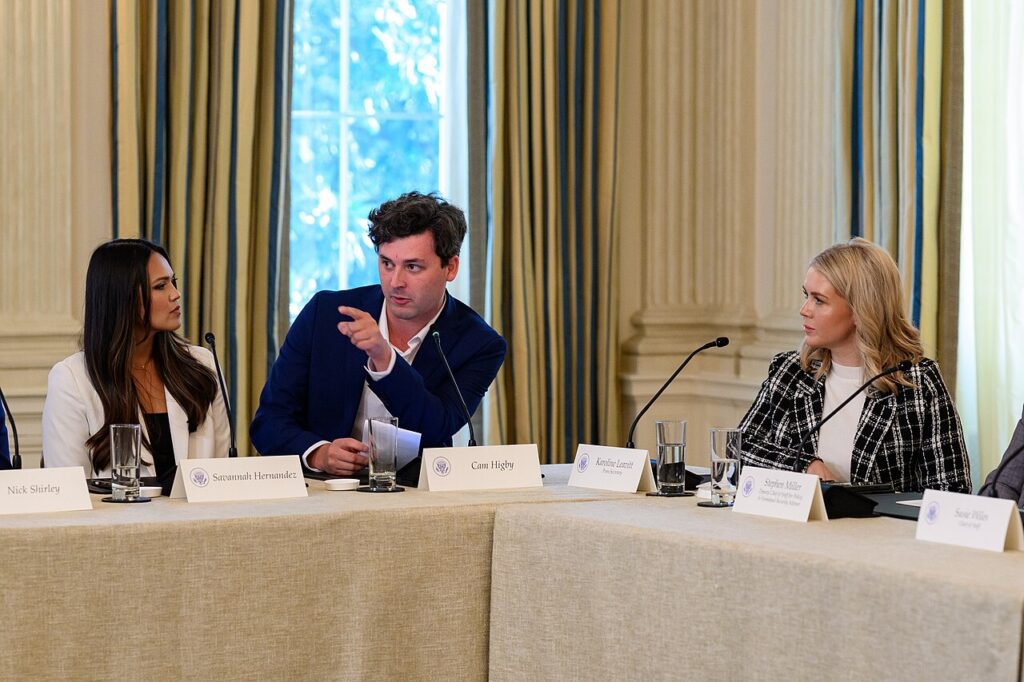
“So my plea to the entire administration, especially to the DOJ, is every single radical left-winger that is in front of the ICE facility in Chicago, in New York, in Portland, please make sure you use the full force of the law to come after each and every single one of them,” begged Savanah Hernandez, an affiliate of Turning Point USA, the conservative advocacy organization founded by the late Kirk. “Because it is us being soft on left-wing violence that has fomented all of the terror we have seen in this country.”
In the immediate aftermath of the killings of Renee Nicole Good and Alex Pretti in Minneapolis by federal immigration officers in January, DHS Secretary Kristi Noem, Vice President JD Vance, and White House Deputy Chief of Staff Stephen Miller all attempted to frame the protesters as domestic terrorists.
While the heightened focus on the amorphous spectacle of Antifa has increased in recent months, hostility to Palestine activism and Palestinian rights has long been a bipartisan feature of US politics. The United States provides billions of dollars worth of military equipment to Israel each year, while historically providing diplomatic cover at the United Nations and other international institutions. When the International Criminal Court issued arrest warrants for Israeli Prime Minister Benjamin Netanyahu and former Israeli Defense Minister Yoav Gallant in November 2024, the Biden White House immediately rejected the move as “outrageous.”
This support has allowed the Israeli state to continue its almost 60-year-long military occupation of Palestinian territories in the West Bank, including East Jerusalem, and prior to its now nearly complete destruction, the blockade on Gaza. The Israeli state, which defines itself in explicitly ethnonationalist terms as “the nation state of the Jewish people,” has engaged in the progressive ethnic cleansing of Palestinian land and usurpation of property, allowing Israeli settlers to colonize occupied territories and inflict violence with relative impunity on local Palestinians. Since Oct. 7, 2023, at least 71,000 have been killed in Gaza and more than 1,000 Palestinians have been killed by Israeli settlers and military in the West Bank. Leaked data from the Israeli military revealed 83% of those killed in Gaza were thought to be civilians. At least 21,000 Gazan children have been killed.
The scale of this violence inspired outrage around the world and led to militant protests in countries supplying Israel with military and financial assistance, raising concerns amongst some supporters of Israel that the very legitimacy of the state is at stake. A recent poll conducted by the Washington Post reported that 61% of Jewish Americans believed Israel had committed war crimes, with 40% saying Israel is committing genocide in Gaza. Other polls have indicated a majority of Americans under 30 sympathize more with Palestinians than Israelis, with support for Israel increasing with respondents’ age.
“I think the level of repression that Casey and student protesters have experienced is a sign that the United States understands that its support of Israel’s genocide, and defense of Israel as a colonial, genocidal state, is nearing its expiration, and in the absence of the ability to manufacture consent, consent is violently enforced with the threat of incarceration and so forth,” explained Shaheen Nassar, a graduate of UC Riverside and head of Alumni for Palestine whose time as a student overlapped with Goonan’s.
“This is a fear tactic, and it’s both a sign that those of us who oppose Israeli genocide, and not just Trump, but this whole American military empire and authoritarian policies domestically, that we’re inching culturally towards a system that is becoming more desperate, but also that we need, as a community, as leftists, as organizers, as activists part of the international solidarity movement, that we need to prepare for the next five, 10 years of activism, and a heavy, heavy response.”
Nassar, whose family is from Gaza and has lost 40 members to Israeli attacks since 2008, knows firsthand what it means to experience negative consequences for activism.
In 2011, Nassar was one of 11 students prosecuted for interrupting Israeli ambassador Michael Oren during a talk at UC Irvine in 2010. Although the students acted independently of any organization, UC Irvine held the Muslim Student Union responsible and attempted to suspend the organization for one year, while the local district attorney at the time, Tony Rackauckas, filed criminal charges. The trial quickly received national attention, and despite critics pointing out the selective nature of the prosecution, 10 of the 11 students were convicted of misdemeanors.
“Back then, I felt like we sort of created this moment in which we drew attention to severe repression of Palestinian voices and dissident voices, specifically on the issue of Palestine and the Muslim community. And I think what we saw in recent years with the genocide that was unfolding, the proliferation, of not just one Irvine 11, but hundreds,” explained Nassar.
“And our movement — our resistance, protest and solidarity movement — was ill-equipped and not prepared to deal with all those repressions.”
By the spring of 2024, more than 3,100 people had been arrested during pro-Palestine protests on university campuses. University chapters of Students for Justice in Palestine faced suspension around the country, with opponents alleging that rampant antisemitism characterized the groups.
Though critiquing the actions of a state and attacking someone for their identity are two very different concepts, governments and institutions around the world, including 36 US states, have adopted or endorsed the International Holocaust Remembrance Alliance (IHRA) working definition of antisemitism. The IHRA lists two examples of antisemitism as “denying the Jewish people their right to self-determination, e.g., by claiming that the existence of a State of Israel is a racist endeavor,” and “applying double standards by requiring of it a behavior not expected or demanded of any other democratic nation.”
The Trump administration frequently uses allegations of antisemitism to police the limits of acceptable speech and behavior. Under Marco Rubio’s leadership, the State Department has revoked hundreds of visas from international students and visitors who have expressed criticism of Israel in some variety. In March 2025, Tufts University doctoral student Rumeysa Ozturk was arrested and detained by masked federal agents who claimed she engaged in unlawful activities after writing an op-ed in the Tufts Daily arguing for divestment from companies with Israeli connections. This followed the highly publicized arrest of Mahmoud Khalil, a Palestinian graduate student and activist at Columbia University, by Immigration and Customs Enforcement (ICE) at home in Manhattan. He was incarcerated for more than three months as the government attempted to deport him, claiming his views threatened US national security.

In August last year, the State Department announced they denied visas to members of the Palestine Liberation Organization (PLO) and the Palestinian Authority (PA) in the run-up to the United Nations General Assembly meeting in New York City. They claimed they would not “reward terrorism,” even though the groups are political rivals of Hamas and were not involved in the Oct. 7 attacks.
For Rodríguez, these attempts to weaponize the rhetoric of antisemitism mirrors the expansive use of the rhetoric of terrorism to manage the boundaries of ideological legitimacy.
“Part of the contemporary moment is this notion that all so-called extremisms fall under the same political category, and it’s not unlike the agenda that the Anti-Defamation League and other Zionist organizations have put up around the lexicon of antisemitism,” he explained.
“That people who are actually fighting for liberation from apartheid and genocidal colonialism are framed as equivalent to neo-Nazis denying the historical event of the Nazi-induced Holocaust of Jews, Romani, Africans and others … that they’re all part of the same category of extremists, works to undermine the credibility and the legitimacy, as well as the actual content, of what different forms of political extremism actually attempt to accomplish and induce.”
“As of today I haven’t been outdoors or breathed fresh air since the morning of Sept. 24,” Goonan wrote by hand in a note photographed and posted to Instagram by supporters on Oct. 21. They describe inconsistent access to necessary insulin, prompting spiking glucose levels. They worry about the negative consequences of “that type of medical neglect.” And they detail other aspects of daily life at FCI Mendota as they await transfer to another prison. “I am foreseeing this being a long next 19 years.”
During the nearly 20 months Goonan has already spent incarcerated, they have continued to draw attention to the plight of imprisoned Palestinians and supporters. In August 2024, they partook in a hunger strike in solidarity with T. Hoxha, an imprisoned activist in the UK who organized with Palestine Action, a group similarly designated a terrorist organization by the UK and banned.
Since Goonan’s imprisonment, UC Berkeley has been widely criticized for sharing the personal data of 160 faculty, staff, and students at the request of the Trump administration as part of an ostensible investigation into antisemitism. Rafah, where American activist Rachel Corrie was killed by an Israeli bulldozer in 2003, has since been almost entirely razed by the Israeli military. Despite a ceasefire being declared in October 2025, civilians continue to die in Israeli attacks across Gaza and the West Bank.
As Trump increasingly uses the term Palestinian as a slur to describe his non-Palestinian political opponents, those concerned with challenging entrenched power clearly have their work cut out for them as anti-Palestinian rhetoric increasingly converges with expanding state articulations of domestic terrorism. Though daunting, this reality only emphasises the need to keep persevering for people like Nassar.
“ I feel that the dehumanization and genocide of Palestinians, it’s not limited to the borders of historic Palestine, and some of that dehumanization transcends borders. That was part of our experience with the Irvine 11 case, and part of that has extended now to our allies like Casey,” he explained.
“But I think there’s an opportunity to basically align the majority of marginalized and oppressed people, working-class people together, and that’s unprecedented. All this evil and repression is making it easy for us to organize and unite, and maybe we can bring about a society that we’ve always craved and wished existed but have never seen realized.”
Correction, Feb. 16, 2026: This article has been updated to correct the spelling of Jeff Wozniak’s name.
.jpg)

