












A Northrop Grumman manager who recently addressed a group of company engineers in Utah told the employees to expect a “culture change” at the arms manufacturer, according to an engineer. The manager explained that the change would include a focus on speed and an expectation to “fail fast, learn faster,” the engineer explained. The manager’s presentation included a remarkable slide, obtained by Inkstick, that describes the company’s main customer — the Pentagon — as prioritizing the speed of weapons production over their cost or even their performance.
The engineer, whose identity Inkstick is withholding, said the mood among coworkers in the meeting was a demoralized one, since many had understood performance of their products in the hands of US service members to be their top priority.
The company sent an email with the subject line, “One Big Thing: Acting with Speed,” to employees after the manager’s address to the engineers. That email expanded on the manager’s directive. “The way our customer is acquiring has changed their top need from low cost to increased speed,” it stated.
The email added that Northrop Grumman is seeing “big changes in our environment that require us to think and operate differently,” citing both the Trump administration’s focus on speed and “increased pressure from non-traditional entrants” to the defense contracting field, an apparent reference to new military contractors that originate from the tech industry. The email went on: “As a result, our focus this year will be on innovation at speed. We need to maintain our focus on Perform, Innovate, and Learn at speed, but will make innovation and Acting with Speed (one of our leadership behaviors) front and center.”

The slide refers to “reducing oversight layers [and] processes,” “speed-based performance scorecards,” and “streamlin[ing] testing and evaluation.” Julia Gledhill, a research analyst at the Washington, DC-based Stimson Center and military contracting expert, said the policies are red flags for Pentagon watchdogs who scrutinize the department, whose budget topped $1 trillion this year.
“The clear winners of a faster, looser acquisition system are military contractors — many of which have publicly advocated for reforms to relax weapons testing and evaluation and other oversight measures designed to reduce costs,” Gledhill told Inkstick by email. “These reforms advance at the expense of taxpayers’ pockets and servicemembers’ safety.”
She added that it has been “quite clear for a while that acquisition reforms designed to speed the process are likely to raise costs,” but that the internal language at Northrop Grumman is revealing. “Northrop Grumman is stating the quiet part out loud.”
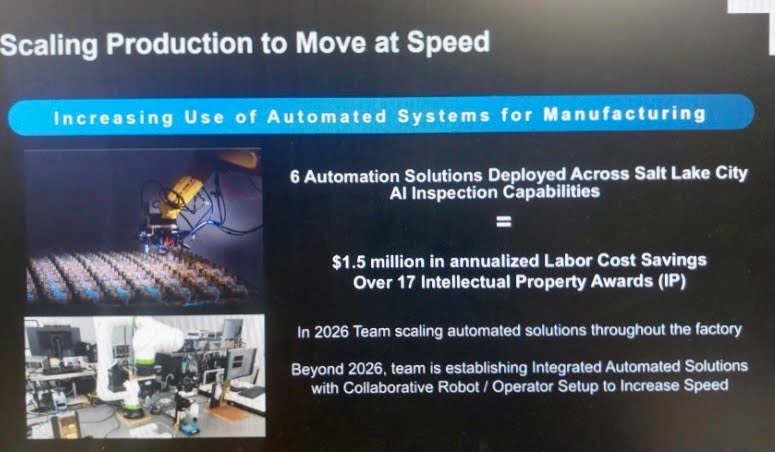
A second slide recently shown to employees at a company meeting describes the company’s plans to achieve its speed goals by using artificial intelligence to automate manufacturing processes, including for “inspection capabilities” across Salt Lake City. The slide claims that AI will reduce the need for human workers and save the company $1.5 million in labor costs annually. It also says the company will begin using a “Collaborative Robot” this year to speed up production. The company is the largest military contractor in Utah, where it receives tens of millions of dollars in state tax rebates to subsidize its missile and rocket plants in exchange for creating jobs.
The policy changes come at a time when the already-record-setting Pentagon budget may take an unprecedented leap forward. The Trump administration formally notified Congress last Friday that it plans to ratchet the Pentagon budget to $1.5 trillion, an increase of $500 billion over last year’s request. Unnamed US officials told the Washington Post in April that the administration is also expected to ask Congress for an additional $80 to $100 billion to fund the US-Israeli war on Iran, which has seen the US military rapidly expend equipment like munitions and missile interceptors. Northrop Grumman, the third largest Pentagon contractor, derives 84% of its revenue from sales to the US government and holds contracts for high-profile weapons projects that the administration is prioritizing. Among these is the Golden Dome missile shield and intercontinental ballistic missiles to launch nuclear warheads, the latter of which are manufactured in Utah.
Northrop Grumman did not respond to Inkstick’s phone calls or emailed requests for comment.
In November, Trump’s Pentagon published a 40-page document outlining how it intends to reform its process for purchasing weapons from private contractors. These policy changes mirror much of what is in the Northrop Grumman slide, though it doesn’t explicitly say that the Pentagon is deprioritizing cost consciousness in favor of speedy production.
Dr. Travis Sharp, a senior fellow and director of the Defense Budget Studies at the Center for Strategic and Budgetary Assessments in Washington, DC, said that the current administration and specialists like himself indeed believe that the US military is often too slow in developing new weapons systems and capabilities. A hallmark case is Lockheed Martin’s F-35, an advanced fighter jet that is the country’s most expensive weapons program ever. The aircraft has been in the works since the mid-1990s and only entered full-rate production in 2024. Throughout that period, China undertook a military buildup that produced jets that “quite frankly, are a really big challenge to the F-35,” Sharp said. That time lag means a program as expensive as the F-35 — the United States expects to spend $2 trillion on the weapons over the program’s lifetime — can become out of date as it enters service.
Alongside those legitimate concerns, Sharp added, a marketing battle is taking place among defense contractors in DC. A new cohort of companies that are backed by venture capitalists and have their origins in Silicon Valley are now attempting to break the five top Pentagon contractors’ near-monopoly on prime weapons contracts. Companies like Anduril and ShieldAI claim they will shake up the defense contracting status quo and produce a new suite of technologies, like autonomous weapons, faster and cheaper than the likes of Lockheed Martin. Anduril founder Palmer Luckey, a billionaire who invented a gaming headset before entering the weapons business, has cultivated close ties between his company and the administration through his fundraising for Trump, campaign contributions to congressional Republicans, and announcing a mega-factory for autonomous weapons in Vice President JD Vance’s home state. A rival defense executive publicly derided Anduril as “the Theranos of defense,” referring to the infamous pharma tech company that promised to revolutionize blood testing.
A key way to predict a system’s cost is by analyzing the cost of its closest predecessor, like the fighter jet that came before it, Sharp said. But the types of products being marketed by the Silicon Valley entrants to the defense contracting market are genuinely new, and, Sharp fears, their true costs are being misrepresented or underestimated by the companies and the Pentagon. “These systems could end up costing a lot more than people expect,” he said. “And the cost estimates that have been publicly produced by the Air Force and by DoD [Department of Defense], I have not found them fully convincing.”
The emphasis on speed and volume of production comes at a time when the Pentagon is barreling past a $1 trillion budget. Sharp warned that the administration is using reconciliation bills in Congress to add funding to the military. Such funding functions as “big pots of money,” offering more flexibility than standard budgets because they are not structured as line items.
Other measures in the Pentagon’s reform plan also point to, as the Northrop Grumman manager’s email noted, a decreased emphasis on “low cost.” One of those is the use of a purchasing mechanism mentioned on Northrop Grumman’s slide called Other Transaction Agreements (OTAs), which Gledhill noted have increased tenfold in the last decade. She said that the use of OTAs opens the door to price gouging because they’re exempt from certain accounting principles and other acquisition regulations that come with typical contracts. As a result, “it’s easier for contractors to charge whatever they want on OTAs without justifying prices,” Gledhill said.
Weapons procurement can be measured along three variables — production speed, cost, and performance — and not all three can be maximized at the same time, Sharp said. Engineers at a place like Northrop Grumman, which has a history of exquisite and advanced weapons systems, are primed to value performance above the other two and indeed are capable of “amazing things,” he said, like producing stealth aircraft that traverse the skies undetected. And their priorities often align with those of the end user, he added. “Engineers are not the only ones who love the performance variable. The other types of people who love the performance variable are service members,” said Sharp, who is also a Navy reserve officer.
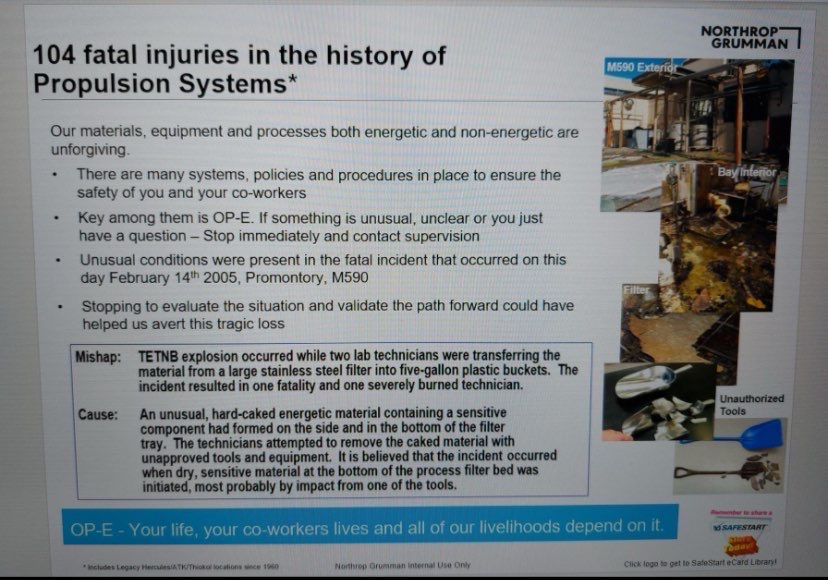
Employees at Northrop Grumman in Utah have particular reasons to be wary of a focus on increased speed. There is a long history of deadly accidents, explosions, and fires at the company’s properties in the state. Just last April, a building on the company’s missile and rocket plant in Utah’s West Desert exploded, causing locals’ homes to shake five miles away. A local police officer who arrived on the scene was alarmed by the company’s workplace safety preparations. “Multi-billion dollar company, and they have the oldest fire equipment I’ve ever seen in my life,” he said in bodycam footage obtained by Inkstick through a public records request. According to a Northrop Grumman internal training slide sent by an employee to Inkstick, some 104 fatal injuries have occurred at the company’s propulsion systems properties since 1960. Just two years before the latest explosion, two workers perished on the job at a sister plant to the West Desert one in the Salt Lake City suburb of Magna when they were asphyxiated by leaking argon gas.
Some of the reforms laid out in the Pentagon’s acquisition document align with fiscal watchdogs’ proposals, such as the US government asserting intellectual property rights on weapons technology. Lockheed Martin’s ownership of the software for the F-35 has led the company to have a de facto monopoly on the plane’s repair.
But Sharp said that there is an obvious “contradiction in the administration’s approach,” since some of their proposed acquisition reforms are positive from a price control perspective but the government is simultaneously seeking to ratchet the Pentagon budget to $1.5 trillion. “That volume of spending makes oversight very difficult,” Sharp said.