








Under the buzz and roar of Israeli drones and warplanes, Joud Sleiman and Ali Jaber jumped on a motorbike and set off through the abandoned streets, swerving past mounds of rubble. It was March 24, and the two medics were heading to pick up food for needy families in Nabatieh, a city in southern Lebanon that has almost been turned into a ghost town. They were dressed in their paramedic uniforms and their motorbike was clearly marked as an ambulance.
“I told them to ride slowly and to go straight [to the families] and come back to the center,” said Mohamed Sleiman, the father of Joud and a veteran paramedic. “Five minutes later, they were killed by an Israeli strike.”
When Israel expanded its war on the Lebanese militant group Hezbollah on March 2, Joud and Ali volunteered with the al-Nabatieh Ambulance Association, a local unit founded in 2002. They were among dozens of young volunteers who stayed behind after Israel issued “evacuation orders,” which forced tens of thousands of inhabitants to flee in terror. Some six weeks later, a few dozen families still remain in Nabatieh — many are too poor or sick to flee, while others refuse to abandon their homes. Ali, 22, and Joud, just 16, died helping them.

They are among 2,055 people — men, women and children — Israel has killed during its latest war on south Lebanon, which ostensibly aims to weaken Hezbollah. Of that number, at least 88 are medics.
A French media network filmed Mohamed when he arrived at the scene of the strike and discovered that it was his son who was killed. He broke down in tears as his colleagues consoled him. Joud and Ali “stayed despite the risks,” he told me in Nabatieh, nearly a week after Joud was killed. “For anybody who chooses this path, all we can do is support and respect their choice.”
Attacks on healthcare is a tale as old as modern warfare, yet Israel has normalized the practice in recent years. In 2023 and 2024, Israel perpetrated the majority of healthcare attacks globally, accounting for 53% on medical facilities and 67% on medics, according to a report by Doctors Without Borders, known by its French acronym, MSF.
Throughout the current war, Lebanon’s Ministry of Health accuses Israel of carrying out at least 114 attacks on emergency medical services. Six hospitals have been shuttered as a result. Meanwhile, the World Health Organisation said that Israeli-US attacks have also damaged more than 20 health facilities in Iran, triggering the evacuation and closure of some hospitals.
Such attacks are prohibited under international humanitarian law, the main framework governing the rules of war. Israel insists that armed groups such as Hamas in Gaza and Hezbollah hide weapons in hospitals and transport fighters and equipment in ambulances. Still, it has never presented conclusive evidence for these claims.
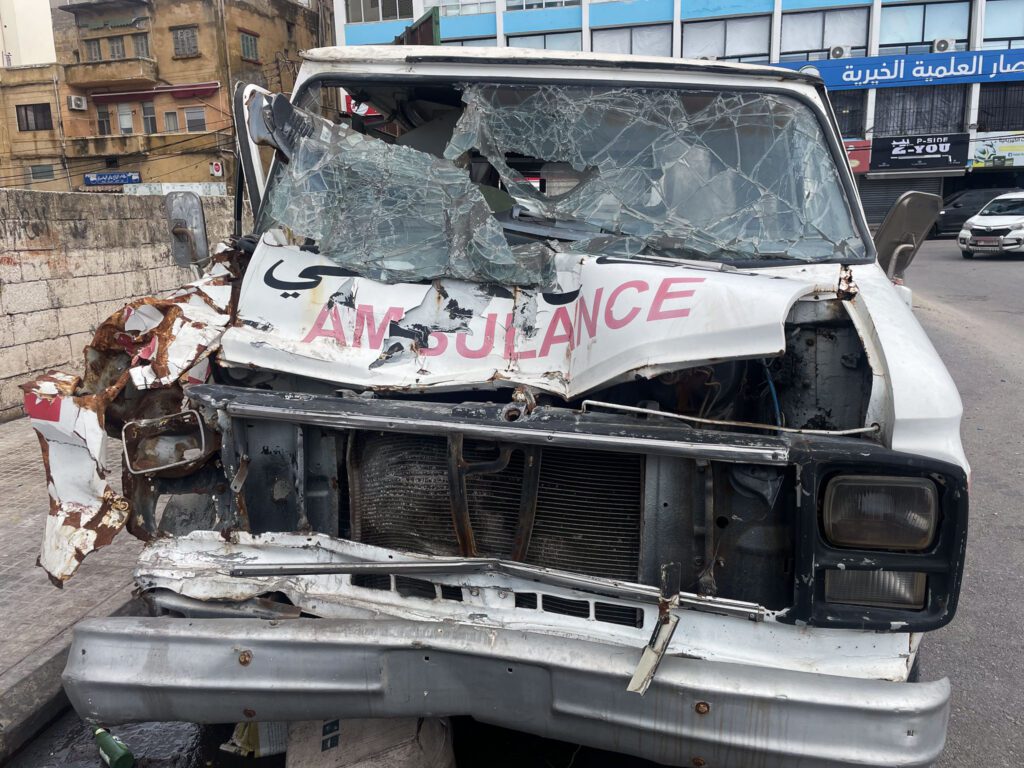
Observers believe that attacks on healthcare are part of a broader strategy to permanently uproot civilians — often referred to as ethnic cleansing — both in the occupied Palestinian territory and southern Lebanon.
“We have seen [similar practices] in the West Bank and Gaza. … It’s no surprise that Israel is now doing this in Lebanon,” said Yara Asi, an assistant professor at the University of Central Florida in the school of global health and informatics. “Israel has said itself it wants to occupy south Lebanon, so they will bomb healthcare services to push people out of there.”
Israel’s practice of targeting healthcare dates back to at least the 1967 Arab-Israeli war, when it captured Gaza, the West Bank, as well as Syrian and Egyptian territory. During the conflict, Israeli tanks and artillery struck Augusta Victoria Hospital on June 6, causing staff and patients to flee.
After the war, Israel began to deliberately deprive hospitals in the occupied Palestinian territories of essential resources. Palestinians were forced to navigate messy bureaucracy to obtain Israeli permits in order to import vital medications and equipment, explained Asi. Over time, Israel set up checkpoints to block paramedics from reaching the wounded and keep patients from reaching hospitals in time. “From looking at the [historical] trends, it’s not a mystery that Israel has been trying to collapse healthcare sectors,” Asi said.
Israel stepped up its assault on healthcare when it invaded Lebanon in 1982 and besieged the western part of Beirut, the capital. At the time, Israel was at war with the various armed factions that comprised the Palestine Liberation Organization (PLO). Yet during the siege, Israeli forces shelled the Gaza Hospital in the Palestinian refugee camp of Sabra and Shatila in Beirut, as well as the Acre Hospital and the Islamic Home for Invalids. Israel even bombed the Sabra Children’s Hospital. Witnesses recall the trauma of seeing small, severed limbs and burned corpses scattered across the ward.
Lebanon’s former health minister, Firas Abiad, whose father was the director of one of two major hospitals in West Beirut during the invasion, said that while Israel may have some plausible deniability for past attacks on healthcare facilities and workers, those arguments no longer stand. Israel’s pattern of “double-tap” strikes that target first responders when they arrive at the scene of the initial attack, suggesting an intention to kill medics.

“The war technology in ‘82 wasn’t guided by the same level of intelligence and precision as it is today,” Abiad told me by phone. “That’s what makes this time different. What’s clear today is that [Israel’s] attacks on healthcare are not the result of rockets going astray. Attacks on medics are being done on purpose in order to deprive everyone still in south [Lebanon] of medical access.”
Back in Nabatieh, 40-year-old Mahdi Sadek, the head of the Ambulance Association, was sitting on the sofa in their center with colleagues huddled around. I asked him if he believed there was a connection between Israel’s attacks on healthcare during the invasion in 1982 and its attacks on medics today.
“Of course,” he told me. “We are living in a world with double standards, where some people and states are above international accountability.”
Mohamed, 42, joined us on the sofa and shared fond memories of his son Joud. Since he was a small boy, he said, Joud wanted to help people. At the age of six or seven, he joined relatives and friends in carrying warm cooked meals to neighbors in the community.
Later that day, Mohamed visited his son in the cemetery. When we arrived, I watched him kneel to kiss Joud’s grave and whisper a message, quiet enough for only the soil to hear.
Despite Mohamed’s grief, he told me he doesn’t have the luxury to mourn his son. He insists that he needs to keep it together for his colleagues, many of whom are just a few years older than Joud. “I have 50 young men under my responsibility,” he said. “I can’t just abandon them to go and grieve.”
At one point, Mohamed told us about several of his colleagues: There was Ghaleb with a two-year-old son, Ali the newlywed, and Hussein who is expecting his second child. None are sure if they’ll survive the war and see their loved ones again. “We are all in the same boat,” Mohamed said. “Nobody is more important than the other and we all know that we could be killed [by an Israeli airstrike] at any time.”
Mahdi, who has a baby boy and five-year old girl, echoed the same sentiment. Since his family fled Nabatieh at the start of the war, his wife has been looking after the children in Beirut, a relatively safer city.
She checks on Mahdi after daily airstrikes on Nabatieh. Often, she begs him to relocate to Beirut to do less dangerous work, like delivering aid to the displaced. “I don’t listen to her,” Mahdi said, acknowledging her concerns. “As paramedics, we have a duty to stay and help the people still here in Nabatieh.”
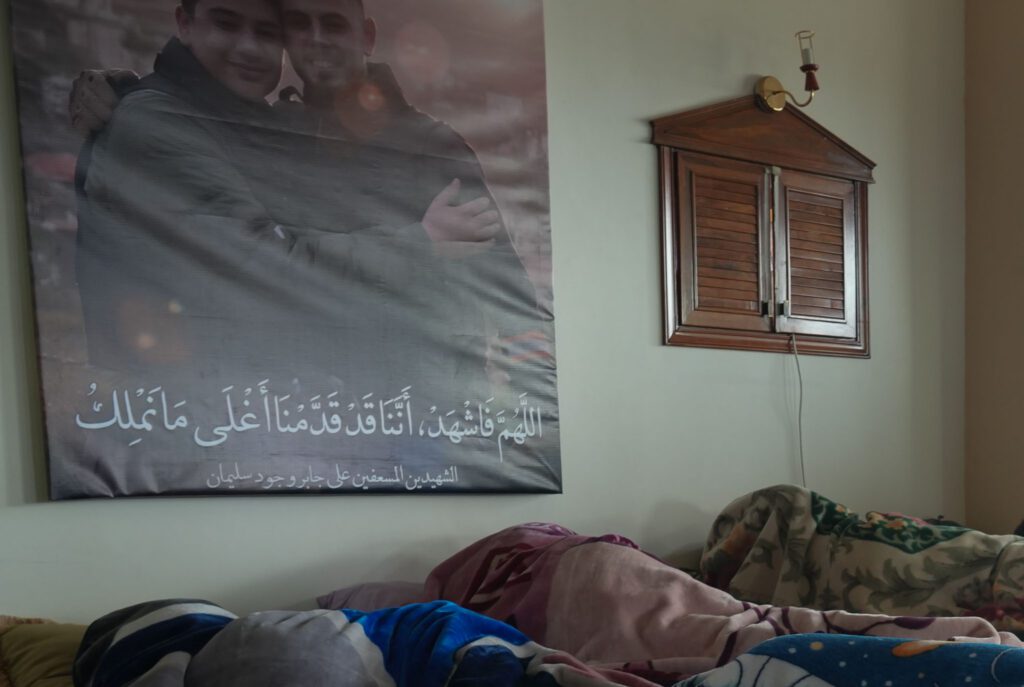
Joud and Ali shared the same conviction. Back at the Ambulance Association, a framed picture of the pair hangs on the wall above the sofa in the common room. They are dressed in their uniforms with their arms draped around each other’s shoulders.
They, too, refused to leave.