









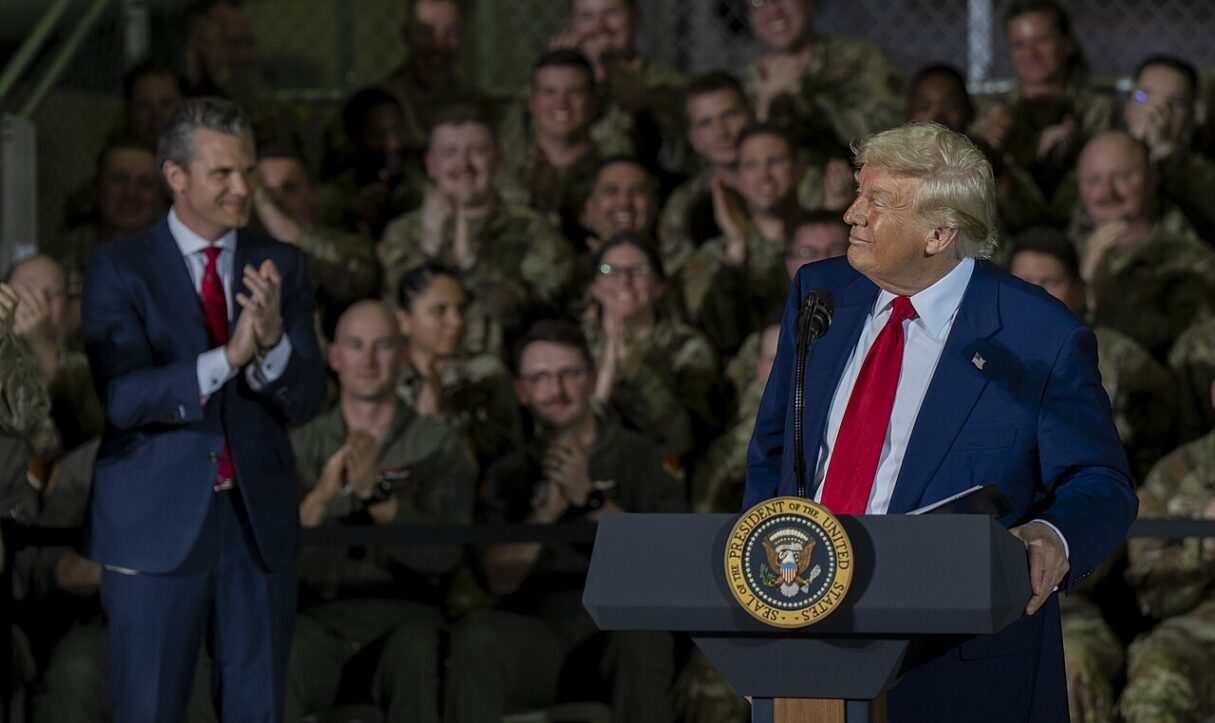
Under President Donald Trump, the United States has attempted to subjugate countries in the Western Hemisphere and beyond. Trump’s foreign policy has regularly violated these countries’ sovereignty, and their peoples’ basic dignity. If the US is going to rejoin the international community after Trump — not remain some rogue aggressor — it needs to re-commit to respect for basic sovereignty. American progressives should be out in front defending this principle of the international legal order.
Of course, Washington’s respect for sovereignty has always been unreliable — since World War II, it has overthrown governments in Iran, Guatemala, Chile, Iraq and Libya, among others. Even in that historical context, though, the Trump administration has been uniquely open in its disregard for other countries’ autonomy and its intent to dominate them. US progressives ought now to repudiate Trump’s vulgar neo-imperialism — but also to challenge traditional foreign policy elites in both major parties by standing for sovereign equality, and for other peoples’ right to be free.
It shouldn’t really be necessary to champion the principle of sovereignty — that is, a country’s right to determine its own domestic and foreign policy. After all, respect for sovereignty is among the founding precepts of the post-World War II international system. It is codified in the United Nations charter, which, as a Senate-ratified treaty, is US law.
Still, the Trump administration has gone back in time to revive an earlier, more predatory mode of international relations. This has been most evident in the so-called “Donroe Doctrine,” in which Trump’s State Department has recalled the country’s early 20th century imperial turn to assert, explicitly, US “dominance” in the Western Hemisphere. US Secretary of State Marco Rubio is now reportedly puppeteering interim Venezuelan President Delcy Rodriguez over WhatsApp, after the US military abducted her predecessor, Nicolás Maduro. The Trump administration apparently aims to impose a similar arrangement on Cuba, if it can identify another compliant local personality.
Elsewhere in the hemisphere, Trump has threatened to annex Canada and attempted to dictate the latter country’s domestic language policy and trade relations. Trump has demanded control over Greenland and threatened to seize the island militarily.
Nor is it only the Western Hemisphere where the Trump administration is enforcing US “dominance.” It has also bullied and coerced countries across the Middle East.
I am writing from Lebanon, where in June the Trump administration brokered a Lebanese-Israeli “framework agreement” that effectively makes Lebanese sovereignty subject to US and Israeli approval. Per this agreement, Lebanese authorities must prove they are capable of real sovereign control by disarming the militant group Hezbollah. Only then will Israel, at some indeterminate future point, “redeploy” its armed forces from occupied Lebanese territory. In the meantime, the United States will supervise a capacity-building program for the Lebanese army and oversee funds for Lebanon’s postwar reconstruction to ensure they do not benefit Hezbollah. According to the agreement, the Lebanese government even committed to halt any complaints against Israel in international political and legal forums.
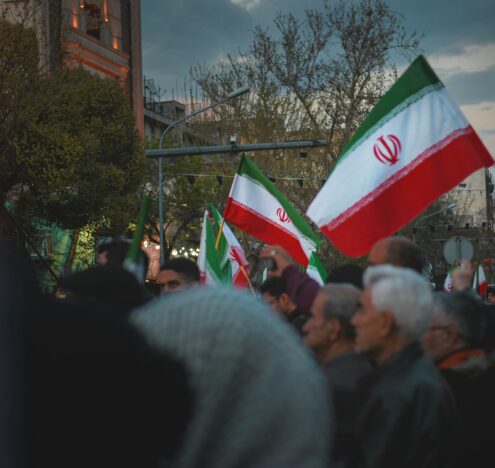
Lebanon is an extreme case, made more complicated by Lebanese leaders’ receptivity to foreign influence and willingness to cede sovereignty to outmaneuver domestic political rivals. Yet the Trump administration has also menaced other Middle Eastern countries. Most obviously, the Trump administration attempted to topple Iran’s government and install Venezuela-like comprador leadership earlier this year. And the administration has also manipulated regional countries through less kinetic means. This April, for example, it refused to send Iraq its own oil revenues — which, per an arrangement dating back to the post-2003 US occupation, are held at the Federal Reserve Bank of New York — unless the Iraqi government cracked down on pro-Iran Iraqi paramilitary groups. The administration has also reportedly conditioned sanctions relief for Syria on the new Syrian government restructuring its diplomatic and economic relations.
The Trump administration’s policy has been consistent, whether in the Western Hemisphere, the Middle East, or beyond — it is trying to subordinate and control these countries, using whatever policy tools are most readily at hand.
Trump, of course, did not invent US hegemony. It is both a historical reality — as acknowledged, notably, by Canadian premier Mark Carney earlier this year — and, in the Washington foreign policy debate, a bipartisan mode of thought.
US foreign policy discourse has long favored intervention and unilateral imposition, as if the United States is the lone protagonist of world politics. US politicians and affiliated think tankers typically imagine solutions to global problems premised on US coercion — including military action and economic sanctions — with minimal consideration for other countries’ sovereign prerogatives.
And among Washington’s traditional foreign policy elites, indifference to other countries’ sovereignty is frequently bipartisan. Returning to just Lebanon: In 2024, the Biden administration attempted to force Lebanon to elect its preferred presidential candidate as the country was being bombed by Israel. And this August, Democratic US Senator Jeanne Shaheen and Republican colleague James Lankford introduced bipartisan legislation on Lebanon that reinforces Trump administration policy — new funds for Lebanon’s security services paired with US oversight of the country’s security sector and postwar reconstruction, as well as sanctions for uncooperative Lebanese.
This elite tendency is presumably a product of the United States’ historical role — America’s overweening power, and its past interventions in other countries’ politics. And the international system surely trends toward some degree of hierarchy, given wide disparities in countries’ capabilities and resources.
But this is why a progressive foreign policy alternative matters — as a conscious rejection of hierarchical control, and a counterpoint to Washington’s bipartisan conventional wisdom.
Progressive members of Congress are already opposing the “Donroe Doctrine” in the Western Hemisphere. Now they ought to stand up for smaller countries’ sovereignty — their right to be independent and free — everywhere, in the Middle East and beyond. Because even though every American should be repelled by Trump’s gangsterism abroad, progressives’ values in particular seem especially consonant with the principle of sovereign equality.
American progressives have been working for years to develop a uniquely progressive vision for US foreign policy. That work continues, including efforts to translate that vision to more specific programmatic applications. In the meantime, though, progressive thinkers have identified some core values that ought to underpin a progressive foreign policy. They include solidarity with other peoples globally, who deserve safety and dignity much as Americans do; and a commitment to a more equitable world order, opposed to powerful states’ attempts to dominate others, or to vain, destructive efforts to maintain US primacy in particular.
These progressive values are not always articulated in terms of “sovereignty.” And defending state sovereignty may feel unnatural for progressives who more often locate their solidarity with other peoples, not governments. Indeed, there can be tension between respect for sovereignty and other progressive priorities, including safeguarding individual human rights. The interests of countries’ governments and peoples are not coterminous, and authoritarian regimes frequently cite national sovereignty to deflect criticism of domestic repression.
Yet national sovereignty matters, much as individual rights do. It represents countries’ collective right to self-determination, and to freedom from foreign control. And it is consistent with progressives’ vision for a fairer world, in which strong countries cannot prey on the weak with impunity.
Great powers’ violations of sovereignty, meanwhile, are generally not progressive. The United States may profess concern for human rights when it pushes around other countries, to be sure. In reality, though, it is typically keeping its unaccountable allies in power, collectively punishing people with sanctions, or securing exploitative commercial arrangements. The big-hearted, liberal case for interventionism is frequently just pretext.
The Trump administration’s abuse of smaller, more vulnerable countries is offensive and wrong. It also seems unwise: It will lead to a more anarchic, law-of-the-jungle international order, and it will likely produce resistance to the United States in countries the Trump administration is currently victimizing. That popular enmity may be long-lasting — it’s worth recalling that Iran is an implacable enemy of the US today partly because Iranians blame America for propping up the country’s former dictator, Shah Mohammad Reza Pahlavi.
American progressives have lately won support by arguing against US backing for unjust wars overseas at the expense of education and health care at home. This seems like a moment in which progressives can lead opposition to Trump’s predation abroad, and champion an international order of sovereign, independent states. Because Trump’s eventual departure may make US foreign policy less nakedly rapacious, but there is a durable constituency in Washington, one that spans both parties, for US primacy and domination. It falls to US progressives to resist this bipartisan pathology, and to insist that other countries also deserve to be free.