



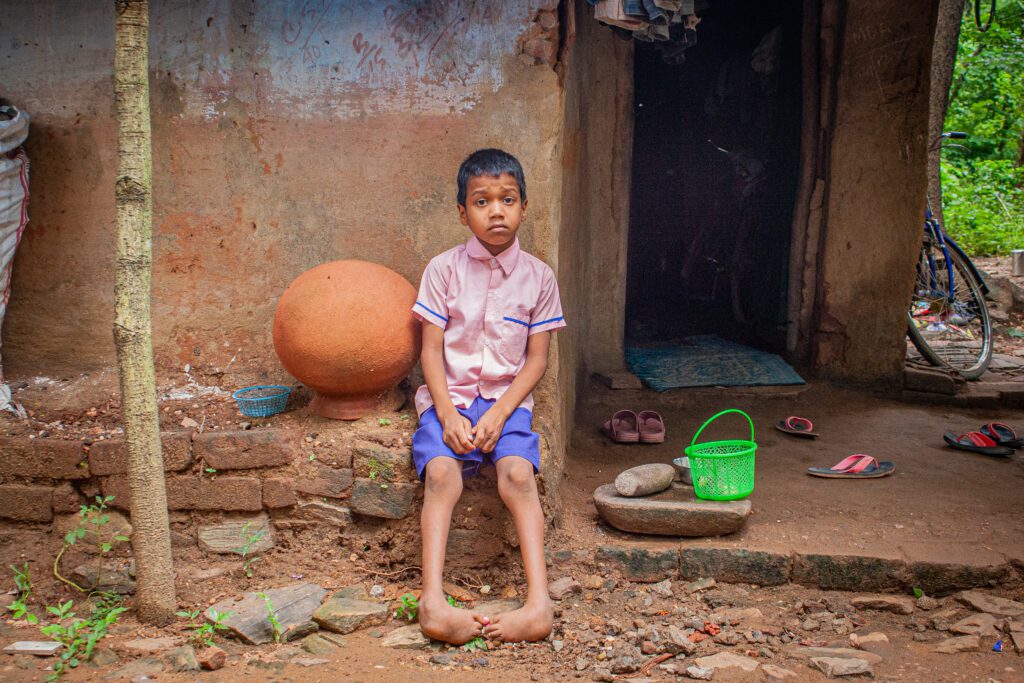
Aakash Sardar, a six-year-old boy from India’s Jadugoda, lives with deformed feet. According to his mother, Sunita Sardar, he has not yet been issued a birth certificate by local authorities. Sunita says that without a birth certificate, Aakash cannot register for an Aadhar Card, an identification document the boy would need for a bank account to be opened in his name or in order to apply for disability compensation. His father, who worked as a mason, passed away from tuberculosis in 2021.
These hardships are common in India’s far-flung eastern state of Jharkhand. India is one of nine nuclear-armed nations in the world, but far from the country’s corridors of power is Jadugoda, a largely forgotten town tucked among the region’s mineral-rich forests. For more than five decades, Jadugoda’s indigenous Adivasi communities have paid the true price of the country’s nuclear arsenal. One in three residences is home to someone with a physical or intellectual disability.
Women in Jadugoda often speak of repeat miscarriages — some losing up to six pregnancies — and children are born with missing eyes, malformed limbs, and disfigurements on their faces. At the same time, cancer, infertility, skin diseases, and early deaths are routine.
In the early morning haze, children in the villages of Dungridih and Bango walk past steaming tailing ponds — the open, rust‑stained sludge from uranium milling pooling dangerously close to homes. Around them, houses cluster within a few hundred yards, and fields irrigated with contaminated water sway in the breeze. Yet even as the machinery hums and miners head underground, a more silent threat lingers above ground: radiation.
Each day, villagers turn to the tributaries of the Subarnarekha River to drink, bathe, and wash — often unaware that the water they depend on carries a hidden danger.
In Jadugoda, the journey of uranium from ore to reactor fuel begins at the processing plants, where raw rock is crushed, ground, and chemically treated in a process known as leaching. This transforms the ore into a concentrated uranium compound called uranium peroxide — commonly known as yellowcake. Once processed, the yellowcake is packed into drums and transported to the Nuclear Fuel Complex (NFC) in Hyderabad for enrichment.
But what’s left behind in this process tells a far more troubling story.
The milling stage produces an enormous volume of radioactive waste in the form of a thick liquid slurry. This toxic waste is flushed out through long pipelines that cut through villages and forests, ultimately emptying into vast tailing ponds. As the liquid settles in these ponds, the heavier radioactive residue — known as tailings — forms a sand-like layer. During storms or strong winds, this contaminated dust often blows into nearby homes, fields, and water bodies.
There are three such tailings ponds in Jadugoda, all constructed and maintained by the Uranium Corporation of India Limited (UCIL), a public-sector company under the Department of Atomic Energy. Each pond is surrounded on three sides by hills carved out from mining, with the fourth side enclosed by an embankment that receives a constant flow of radioactive waste through pipelines.

Villagers say these man-made hills and tailing ponds have turned into slow, silent threats to their lives. What was once forest land now stores toxic remnants of uranium extraction. Local communities have long complained that these ponds are contaminating both groundwater and the nearby Subarnarekha River, posing serious health risks with every passing year.
Jadugoda, where India’s first uranium mining site was built in 1967, provides nearly a quarter of the uranium for the nation’s nuclear power program. Its tailings ponds — unlined, open-air reservoirs holding waste from milling — have spread radioactive dust and leachate in nearby villages for decades. Local residents and independent researchers have repeatedly recorded alarming levels of exposure: Water drawn from shallow groundwater and the Chandnadi stream contains uranium levels hundreds of micrograms per liter — far above the World Health Organization’s limit of 30 ppb and India’s limit of 60 ppb or less. These levels translate to cumulative internal exposure through ingestion, inhalation, and dust, especially dangerous over years of daily contact.

Many women born with conjoined fingers, shared how miscarriages and infertility turned them into social outcasts — labeled baanjh (Hindi for sterile) — dragged from homes and rejected in marriage markets. A 2010 epidemiological survey by Indian Doctors for Peace and Development documented a slate of hardships: alarmingly high rates of infertility, stillbirths, and abortions; a higher prevalence of chronic lung disease and pediatric mortality; and markedly lower life expectancy in the villages that sit within a 2.5-kilometer (1.5-mile) radius of tailing ponds.
These statistics cut deeper when layered atop local stories: of children born with undersized heads, deformed limbs, facial tumors, seizures.
Still, the state-run Uranium Corporation of India Limited (UCIL) insists there is no link between radiation and these ailments, dismissing concerns as “long-standing myths” not rooted in scientific research. A Bhabha Atomic Research Centre‑backed survey claimed anomalies were due to malaria, malnutrition, genetics, and not radiation. UCIL leaders have asserted there were no illnesses related to radiation exposure and downplayed safety concerns despite minimal testing, secret dosimeter readings, and removal of warning signs across villages
While UCIL highlights employment — including some 4,700 tribal workers — and infrastructure development, critics argue those tangibles obscure the costs: health, dignity, futures lost to invisible radiation etching itself into their bodies. As India races toward 63 GW of nuclear capacity by 2032 and strives to ensure that 25% of electricity is supplied by nuclear sources by 2050, Jadugoda remains its beat and its blemish. India aims to produce 40,000 MW of nuclear power by 2030. But at what cost?

Not far away, 20-year-old Anamika Oraon lives in the village of Dungridih, less than a mile from the Narwa Pahar uranium mine. She dropped out of school after the eighth grade and now works a laborer on nearby farms from eight in the morning until four o’clock in the afternoon, earning only ₹200 (about $2.29).