



Before the latest war started, the Gaza Strip would still be wide awake after midnight. The seaside promenade was filled with chairs, families sharing laughter, friends strumming the oud, and vendors selling nuts and tea along the shore. The lights of the cafés shimmered on the water, and there I was, eating ice cream with my siblings at the end of the week.
On holiday nights and New Year’s Eve, the markets never slept either. The honking cars and crowded streets felt as though they were celebrating with us. On ordinary nights, evening meant calm after a long day of achievement: children at school, fathers at work, university lectures. For me, night was a time to unwind: a cup of Nescafé, revising my lectures with my friend Tasneem over WhatsApp. I never realized the value of those moments; they felt so normal, even dull at times. The electricity cutting out would annoy me, as would the sound of the zananah — the buzzing drone — decided to disturb our peace. Still, night for us meant weekends by the sea and quiet on other days.
Then, in October 2023, the war came, turning the night into dark hours we prayed to survive. One night not long ago, around midnight, the darkness was complete, the only light a dim bulb in the corridor. I sat by the window, hoping for some relief from the noise of my thoughts, when gunfire suddenly cut through them. Looking up, I saw a quadcopter drone hovering low above our neighborhood. My heart jolted. It was the first time I had seen it this close.
A small drone flying so low, firing at anything in sight, though no one was outside — only hungry, whimpering dogs. Who was its target? Could it have been someone like me, someone simply fleeing their thoughts for a breath of air at the window? Could I have been next?
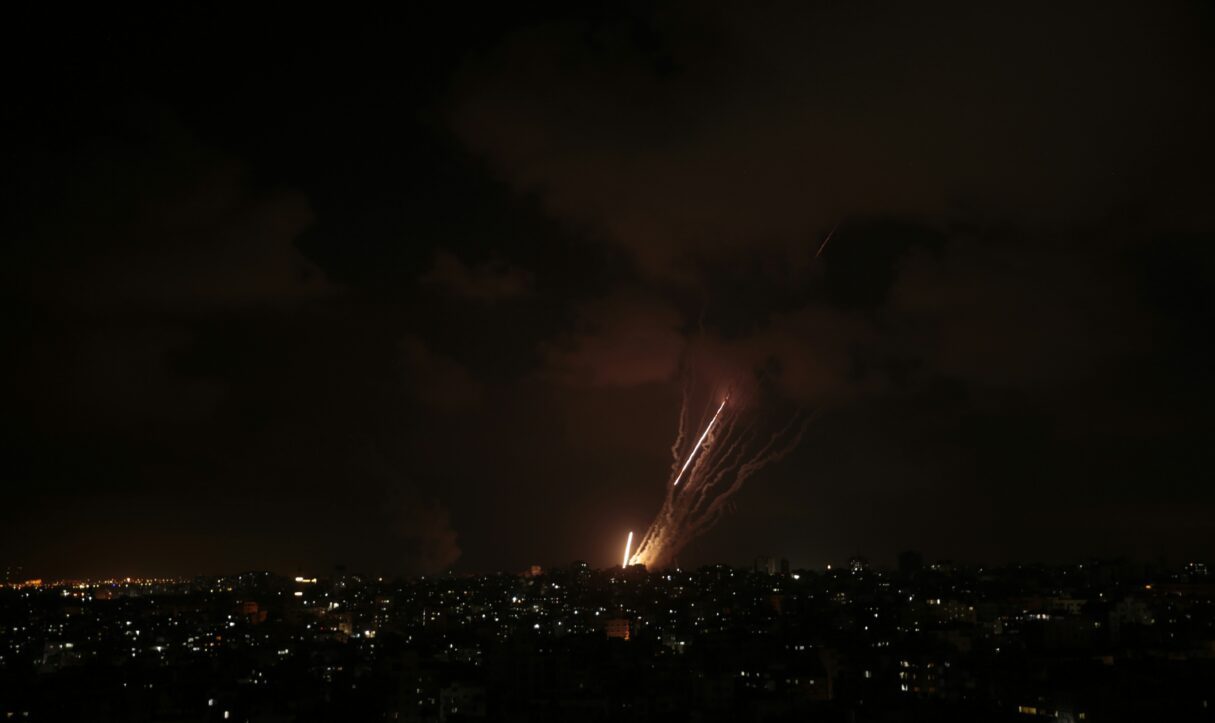
Even Gaza’s air is heavy with the weight of war, just like its sky. Sleep comes only when exhaustion finally overpowers the clamor of fear and thoughts that fill our war-stricken days. Nightfall begins another chapter of war. The neighbors’ radio stays on, broadcasting news as they wait for any glimmer of hope, any scrap of good news to shorten the endless hours. But even at night, there is no escape from death; fear never leaves our hearts. Nightmares, insomnia, shelling from every direction: missiles from the sky, warships from the sea, tank shells from the land. Night here is not like ordinary nights: It is pitch black, without electricity, without streetlights. Drones flash like cameras over the streets, and sometimes explosions illuminate the entire neighborhood. Some nights feel like the Day of Judgment itself, as if the world were truly ending.
And as the war has dragged on with no solution in sight, I’ve lived through all the seasons under it. In summer — like now — after unbearably long days, nights are suffocatingly hot without fans or air conditioners, with hunger gnawing at us and mosquitoes added to our list of enemies alongside the occupation. Winter nights were the worst for me; they became etched in my memory from mid-December 2023, when I felt I was living in a ghost town. By seven p.m., the streets were deserted: no power, no internet, no phone network, not enough food. The only sounds were the quadcopter drone crying like an infant, the ambulance sirens, and a man’s desperate screams.
Death traps are everywhere. Add to that the sound of tanks — I never imagined I would hear one, the grinding of their tracks crushing everything beneath them. The military operation reached the Maghazi refugee camp, where my grandmother and aunts lived, and forced them to flee to us. Their house became a barracks for Israeli soldiers. My grandmother could not sleep; she pretended to rest, but her eyes were wet with tears. How painful it is to hear the sound of missiles destroying your home.
On those winter nights, with internet and phone service cut off for two full months, I had no way to check on my friends. My closest friend, Dalia, was in northern Gaza while I was in the south. The so-called Netzarim checkpoint, which the Israeli army built to divide the Strip, separated us. Her house was only 20 minutes away, but visiting her would have cost me my life. I lost contact with her, and my heart trembled with worry. She was my dearest friend — we used to talk for hours. I also lost touch with my classmate Tasneem, with whom I had stayed in contact since the war began. Her last message before the blackout was: “The bombing sounds are terrifying. Do you know of a safe place we could go?”
When the phone network finally came back in early February, it was devastating. I discovered that many people I knew had been killed. But the harshest blow came when I opened Facebook and found the news of Tasneem’s death. She had been killed in early December, and I had lived two months without knowing. My phone fell from my hands, and my eyes filled with tears. I picked it up again, praying I had misread, but no — the condolences flooded her page. Her profile still showed her graduation photo. She had been counting down the days to finish her final year at university. Her last post was a prayer for success in her studies. She never knew the next posts would be eulogies for her and her dreams.
The second shock was the killing of my professor, Dr. Refaat Alareer, a devastating loss for our English department. I broke down completely. And it wasn’t only Tasneem and Refaat; other classmates too: Doha, Nahla, Mohammad, Saja … each name a burst of life and unfulfilled dreams.
I tried calling Dalia many times, but the network in the north was too poor. Death became an obsession. Each report of shelling in Gaza City, where she lived, made my heart race. I prayed constantly for her safety. Eventually, she called me. I thanked God she was alive. I told her about our friends who had been killed, and we wept together, overwhelmed by the relentless tide of events—far heavier than our young lives could bear. She told me how night had also become terrifying for her, how it was always tied to bad news.
Between the winters and summers of war, we tried to steal moments of joy, clinging to life with sheer stubbornness. On New Year’s Eve, I stayed up with my displaced aunt, and we wished for the war to end, for better, warmer years to come. Yet, once again our wish was shattered, this time by missile. A new year had arrived, and its first hours were already soaked in blood.
Things only grew worse. Night became a space for endless questions. Parents faced their own battles with their children: How do you comfort a child crying from hunger, too weak to sleep? How do you convince him to go to bed early? How do you answer his innocent question: “Daddy, if I’m asleep when they bomb our house, will I not feel the pain?” And how does a mother soothe her baby when her body has stopped producing milk? How do parents protect their little ones from the fear of darkness when they themselves are afraid of it? Conventional medical wisdom holds that good sleep is the foundation of health. Here in Gaza, it has become a distant dream.
I am still awake, the buzzing of the drone ringing in my ears. My questions only multiply: Will the darkness ever lift? Will the night ever return as a time for rest and dreams, as I once knew it before the war, as so much of the rest of the world knows it now?