










A new study concludes that the United States and China, despite pursuing radically different visions for how artificial intelligence should be developed and governed, have become leaders in the global AI race through one shared formula: heavy government spending and deep military integration.
The paper, entitled “Pathways to Technological Hegemony: A Comparative Study of the US and China in the AI Age,” was published in the Brazilian journal Revista de Estudos Internacionais. Amâncio Jorge de Oliveira, Janina Onuki, and Rodrigo Pedrosa Lyra, researchers from the University of São Paulo and the Federal University of Pernambuco, authored the paper.
They used a method called Qualitative Comparative Analysis to systematically compare the two countries across five factors thought to drive AI dominance: regulatory policy, government investment, private sector dynamism, military integration, and semiconductor dependency. The researchers assigned each country a binary score on each condition and ran tests to determine which factors were truly necessary or sufficient for reaching what they call the “technological frontier.”
The answer is unambiguous: “Our findings demonstrate that Government Investment (GI) and Military Integration (MI) are the most decisive factors for achieving leadership in the AI race,” the report said. Every other factor — including whether a country has a thriving private tech sector or depends on foreign chips — turned out to be neither essential nor independently decisive.
That conclusion cuts against a narrative popular in Washington, where policymakers and industry figures have pointed to Silicon Valley’s freewheeling innovation culture as the core engine of American AI leadership.
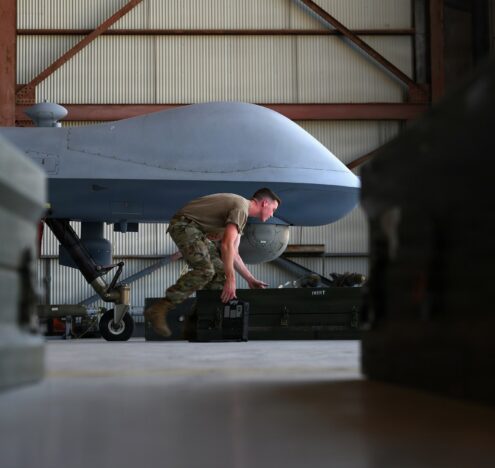
According to the study, companies like Google, Microsoft, and OpenAI matter, but their impact is limited without the backing of state resources and defense-oriented applications. The Pentagon’s investments in autonomous weapons systems, battlefield AI, and programs like Project Maven, the researchers argue, are not peripheral to American dominance; they are structurally central to it.
The finding lands differently for China, where state control of the technology sector is a given rather than a debate. Beijing’s “New Generation AI Development Plan,” its Military-Civil Fusion strategy, and its direct funding of firms like Baidu, Alibaba, and Tencent have drawn frequent criticism from Western observers as evidence of authoritarian overreach. The study frames those same features as the mechanism through which China has closed the gap with the United States faster than most analysts expected.
The researchers point to performance data from the LMSYS Chatbot Arena — a widely used benchmark for large language models — to illustrate just how quickly that gap has narrowed.
In early 2024, top American models outperformed their Chinese counterparts by roughly 9%. By early 2025, the margin had fallen to under 2%. The authors attribute that acceleration, in part, to China’s ability to use state coordination to work around US semiconductor export controls, which are designed to slow Chinese AI development by cutting off access to advanced chips.
On semiconductors, the study reaches a finding that complicates the current bipartisan consensus in Washington around the CHIPS Act and export restrictions. The United States, heavily reliant on Taiwan’s TSMC and South Korea’s Samsung for advanced chip manufacturing, scores as semiconductor-dependent. China, which has invested massively in domestic producers like SMIC and Yangtze Memory and is actively pursuing self-sufficiency, scores as less dependent. Yet both countries are leading the AI race. Semiconductor access, the researchers conclude, is a vulnerability and a constraint but not the determining factor that American policy has often treated it as.
The paper carries obvious limitations. With only two cases, the analysis cannot claim broad generalizability, and the binary coding required by the methodology inevitably flattens complex realities. The authors acknowledge that future research should expand to other emerging AI powers, including the European Union, Japan, and India, and should examine AI leadership in commercial and scientific domains, not just military ones.
Still, the core argument has implications that reach well beyond academia. For countries watching the US-China competition and trying to chart their own AI strategies, the study suggests that betting on private sector momentum alone is not enough. Governments that want a seat at the frontier, the data implies, will need to spend heavily and integrate AI into their defense establishments regardless of their regulatory posture.
The authors frame the broader rivalry in historical terms, comparing it to the Space Race of the 20th century while noting a crucial difference: Unlike the original Cold War, the United States and China are deeply economically entangled even as they compete for technological supremacy. That interdependence, they argue, makes strategic decoupling a policy choice rather than an inevitability — and one whose consequences for global AI governance remain far from settled.