



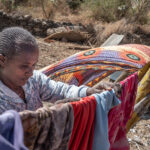








The past few months in Kandahar have been ruthless, Gul Mohammad Aryan tells me over a spotty internet connection. As director of the Sustainable Goals Organization for Afghanistan, he has been trying to support Afghan refugees who are now coming back from other countries in the region. More than 2.86 million people returned last year, the vast majority from Pakistan and Iran. “They have left everything in Pakistan, they have left everything in Iran,” Aryan says. “They just came with their clothes. They don’t have enough.”
The country they return to has been hit with repeated and compounding crises. Two earthquakes have struck since the summer. Border skirmishes with Pakistan flared. Nearly 23 million people need humanitarian relief. Food aid is reaching less than 10% of food-insecure Afghans, according to the United Nations’ World Food Programme. Child malnutrition is at historic highs. Meanwhile, the country is running out of water. The Mercy Corps aid organization reports that Kabul is on the brink of “becoming the first modern capital in the world to fully deplete its water reserves.”
Behind the humanitarian crises, Afghanistan’s economy has been in tatters since the Taliban came to power in 2021. International debates continue around the right economic strategy to engage with this actor that is deemed a Specially Designated Global Terrorist by the United States, and that continues to commit systematic human rights abuses.
One of the ongoing economic debates centers on the use of targeted sanctions and international restrictions on Afghan assets. The US, the European Union, the United Kingdom, and the UN all impose targeted sanctions on Taliban leaders, many dating to 1999, with additional sanctions introduced by Australia in December. In 2021, when the Taliban retook power, then US President Joe Biden’s administration froze $7 billion of the Afghan Central Bank (DAB)’s assets held in the US. The money was later transferred to a newly established Geneva-based charity with a board made up of American, Swiss, and Afghan trustees. The fund has not yet made any disbursements. Meanwhile, the appointment of senior Taliban military official Noor Ahmad Agha, who is under US sanctions, as DAB governor maintains the international standstill.
Foreign investors face a perfect storm of government opacity, decades of endemic corruption, and the political risk of dealing with sanctioned government officials. The Taliban government’s Deputy Prime Minister for Economic Affairs insists that financial restrictions are not in the interest of Afghanistan, the region, or the world.
These global economic decisions are felt most sharply at the human scale. Aryan recalled waiting in line to take out the limited cash withdrawals permitted each week. “The trust the bank had previously — people have lost that trust,” he says.
Some projects have ground to a halt since the Taliban takeover and restrictions continue to affect ordinary businesses. Construction companies working on government contracts couldn’t withdraw money, Aryan explains. Work was done, but workers were left unpaid. “Four years have gone by, but still the projects have not started again,” Aryan says.
“The markets have had food. The problem is, do families have enough money to be able to buy it?” says Dayne Curry, program director at the Agency Coordinating Body for Afghan Relief and Development (ACBAR). “The economy is never going to recover in a meaningful way unless Afghanistan can fully participate in a global economy.”
International aid has fluctuated. Initial cuts after the Taliban takeover were followed by a massive influx of cash. Donors sent $10.72 billion between 2021 and 2025. Despite attempts to provide relief while circumventing the government, there has been controversy around how much aid the Taliban was able to divert and appropriate.
Then, current US President Donald Trump’s administration slashed $1.03 billion worth of programs in the dismantling of USAID. This cut agricultural and rural development, food security, health programs, and support for women. In response, UN Emergency Relief Coordinator Tom Fletcher didn’t mince words: “People will die as a result of these cuts.”
Now, Afghanistan has headed into 2026 needing $1.7 billion for humanitarian assistance.
“We have seen the international community invest in Afghanistan for 20 years. Then they left everything. They forgot the people of Afghanistan.”
Gul Mohammad Aryan
Private philanthropists have provided some backing for development. Last year, Dubai-based Afghan billionaire and real estate tycoon Mirwais Azizi committed $10 billion to reconstruction, including a solar power plant and a medical complex in Kabul. But this philanthropic generosity reveals a growing wealth gap. “The poorest of the poor, the most vulnerable, are not seeing whatever wealth has accumulated over the past 20 years return to them in a meaningful way,” Curry says.
The Taliban’s economic policy focuses on building political legitimacy and regional partnerships. Over four years, the cash-strapped Taliban implemented major public sector layoffs and cut pensions until this summer, leaving Afghans struggling to make ends meet.
In August, the government introduced a five-year development strategy focusing on international relations, security, aligning the government with a long-term vision, and increasing “international confidence.” This agenda is “commendable,” says Ibraheem Bahiss, a Kabul-based analyst with the International Crisis Group. Still, he adds, “We’re not really seeing what you’d generally expect when a government’s talking about good governance,” such as citizen-focused reforms like digitization and improving accountability of public services. “What we were hearing was more about Islamic law and Islamic justice,” Bahiss said.
Alienated by unreliable Western governments, the Taliban government has focused international cooperation in other directions. The Turkmenistan–Afghanistan–Pakistan–India (TAPI) Gas Pipeline, which has been underway since the mid-1990s, is continuing apace with the Turkmenistan section completed last year, and groundwork advancing on Afghan soil. The Trans-Afghan railway and new oil and construction deals with the Russian republic of Tatarstan set the stage for deepening Central Asian integration. Old revenue streams have also been replaced: Opium was outlawed and there have been crackdowns on illicit mining. The government has overseen billions in mining deals with China, Qatar, Turkey, Iran, and the UK.
The controversial Qosh Tepa Canal is one of the Taliban’s major infrastructure projects. The planned 285-kilometer (177-mile) canal, launched in 2021 soon after the Taliban took power, aims to address the country’s water scarcity. But it risks exacerbating regional water insecurity by diverting water from the Amu Darya River that nourishes Tajikistan, Uzbekistan, and Turkmenistan.
To circumvent sanctions from the West, Russia, and Iran linked their banking systems last year. Afghanistan now looks to join Russia’s MIR system, a Visa and Mastercard alternative. Domestically, the Taliban has focused on expanding Islamic banking.
In winter’s frigid nights, people are still suffering. Human rights groups have implored neighboring countries to stop the deportation of Afghans that “ignores why they fled in the first place and the serious dangers they face,” according to Amnesty International. The global rights watchdog cites a “clear disregard” for human rights obligations and violation of the binding principle of non-refoulement, which limits the forcible return of people to places where they face grave danger.
This fragility has only deepened amid tensions with Pakistan. Spin Boldak, a town roughly 100 kilometers (62 miles) from Kandahar on the Pakistan border, has for generations been a heartland of trade. Now, it is a gateway for mass deportations, with nearby refugee villages and markets emptying out. The town has also been in the crossfire between Pakistani and Taliban-allied fighters. Border closure has devastated trade, and a Taliban ban halted medicines and surgical goods coming from Pakistan.
After an earthquake ravaged Kunar and killed thousands last August, many survivors were left homeless, sleeping out in the open in Dewagal Valley or in makeshift shelters. “Their homes were not properly made. They were living in poor conditions,” Aryan says.
As the problems pile atop one another, people across the country have had to repeatedly pick up the shards of their lives and rebuild. “We have seen the international community invest in Afghanistan for 20 years. Then, they left everything,” Aryan explains. “They forgot the people of Afghanistan.”