
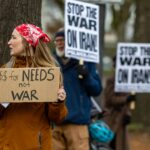




After a summer of protests and pushback against Immigration and Customs Enforcement, the Justice Department wants to quash dissent in Los Angeles. There’s open collaboration between the FBI, Department of Homeland Security, and local police under a restated mandate for disciplining the political left.
Around the country, similarly large protests against ICE raids have taken place in Chicago and Minneapolis, the latter of which saw immigration authorities shoot and kill two people this January. Last year, the FBI was ordered to redirect a quarter of its working hours to immigration operations. Urban divisions were seeing 50% of their efforts aiding DHS. In Los Angeles, FBI swat teams joined raids in Chinatown and the Fashion District.
Soon after the protests began last June, FBI agents started showing up at activists’ homes, warrantless but looking to talk to people about their political organizing or presence at a protest. The National Lawyers Guild (NLG) warned about a wave of door-knocks, grand jury subpoenas, and surveillance aimed at activists.
“The first and most important goal of a door-knock is intimidation,” said Kylah Clay, an attorney with NLG. The second aim is to get a target to self-incriminate, which is why Clay says no one should speak to agents without a lawyer. “You’re more likely to talk yourself into a conviction than anything else.”
Federal authorities are also using criminal charges to pressure defendants into taking plea deals, Clay said, citing a recent case in Boston where demonstrators were charged with the “promotion of anarchy,” or inciting a riot, a felony that dates back to the first Red Scare. Severe, complex, and arcane charges burden the defense and test the nerve of people sympathetic to the cause.
“It’s less about winning convictions and more about suppressing protests,” said Mike German, a former FBI agent and Brennan Center Fellow.
A person fighting multiple felonies in federal court bears high financial and social burdens. They’re often denied bail and are forced to spend many months inside pre-trial jails. In dismissed cases, First Assistant District Attorney Bill Essayli has insinuated his office plans to keep community defense groups under investigation indefinitely.
The FBI’s Los Angeles division, working hand in glove with federal prosecutors, has been busy building cases against community response networks and cobbling together felony charges for people showing up to ICE protests. More than 100 cases have been filed, but federal prosecutors have been trounced by public defenders in the courtroom, earning a losing streak unheard of for federal court, where less than 1% of defendants in criminal cases were acquitted in 2024.
In September, President Trump labeled Antifa — shorthand for the anti-fascist movement — a domestic terrorist organization and issued National Security Presidential Memorandum 7 directing the Justice Department to investigate leftist organizations and activists.
NSPM-7 names “anti-Americanism, anti-capitalism, and anti-Christianity,” as well as “extremism on migration, race, and gender,” as beliefs held by “domestic terrorism organizations.” The memorandum calls for a “new law enforcement strategy that investigates all participants in these criminal and terroristic conspiracies — including the organized structures, networks, entities, organizations, funding sources, and predicate actions behind them.”
It’s not a new strategy for the Justice Department or the FBI, German says. One only has to look anywhere in the FBI’s history to find evidence of the agency going after trade unionists, environmentalists, civil rights activists, and on and on. NSPM-7 is both marketing and a true escalation, German explains, the verbalization of a policy that has given the agency enormous authority to surveil and infiltrate groups without evidentiary predicates.
Between 1956 and 1971, the FBI’s Counter Intelligence Program (COINTELPRO) included illegal and covert actions, such as infiltrating political groups, surveillance, and harassment. COINTELPRO ended in name after it was publicly exposed, but the work of sabotaging and defanging political movements intensified. After the attacks on Sept. 11, 2001, the FBI remade itself under the banner of counterterrorism. Whatever guardrails existed were excised.
German saw the Bureau “target groups because of their ideas rather than any type of threat that they pose,” using a discredited theory that justified the perpetual surveillance and suppression of groups the FBI deemed political adversaries. The radicalization theory holds that to address political violence, you have to go left of boom — take aim at everyone professing certain ideologies and you’ll capture the few people who will eventually commit violence.
“It’s less about winning convictions and more about suppressing protests.” – Mike German
The theory, German points out, is bunk. But it’s useful because it allows the government to “label their political opposition as dangerous terrorists and discredit any ideas that challenge the government policies that they are instituting.” German says the FBI does not collect data on domestic terrorist violence because it would reveal how malformed its approach is.
It’s how you catch a felony charge for bringing face shields to a protest where police are shooting protesters in the head with kinetic impact projectiles, or “less lethals.” It’s how throwing a rock makes you a part of a conspiracy.
“The tools you would use to conduct an investigation into a bombing are very different than the tools you would need to evaluate people’s political opinions and associations,” German says. And the difference in the number of people investigated in either instance is giant. “It justifies a mass surveillance approach to suppress political advocacy and association.”
And, according to critics and experts, it distorts the reality of what the FBI calls domestic terrorism.
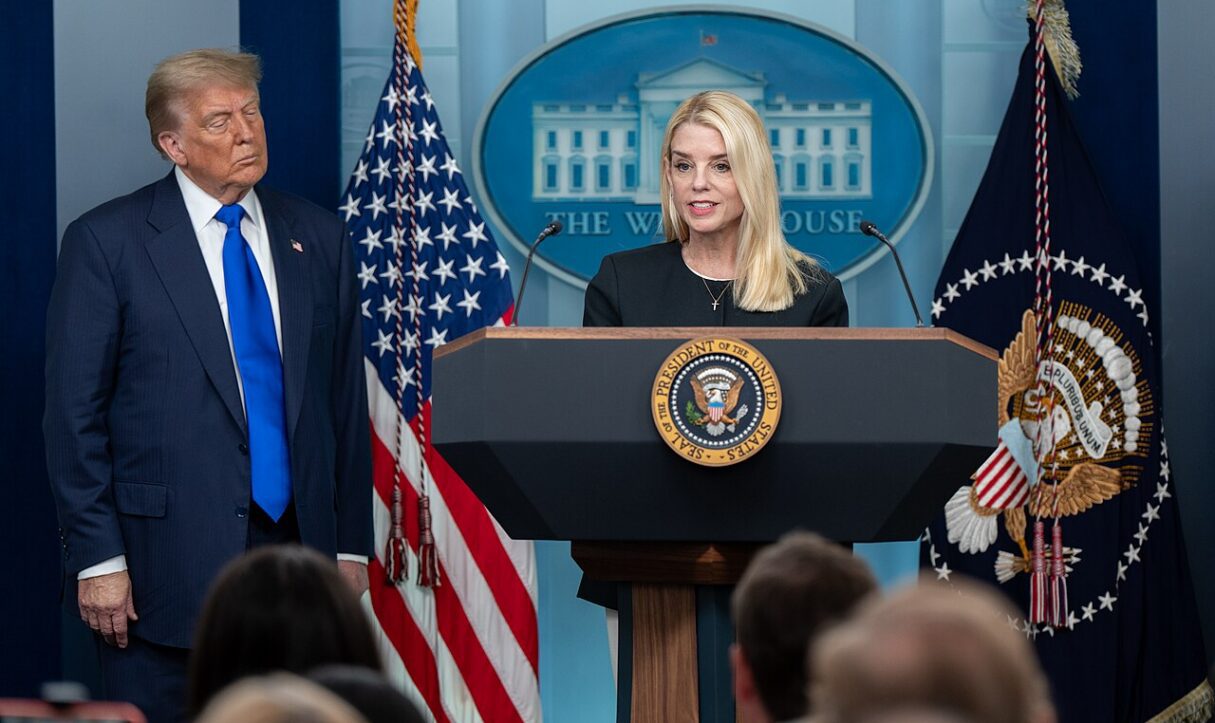
Following NSPM-7, Attorney General Pam Bondi directed Justice Department agencies to compile a database of organizations under investigation for “domestic terror.” There are at least 27 open NSPM-7 investigations at FBI divisions across the country, according to an October memorandum obtained by Party of the People.
The first NSPM-7 case to be litigated ended last week in victory for the Justice Department — eight people who protested the Prairieland Detention Center in Texas last July were convicted of providing material support for terrorists. In all, 18 people have been charged in connection to the non-fatal shooting of a police officer during the demonstration. Only one of the defendants was named as a shooter, but federal prosecutors crafted an ambush conspiracy, drawing together a loosely connected group by criminalizing what is otherwise completely legal behavior. It’s a guilt by association case leaning on the government’s claim that Antifa, a broad political category, is in fact an organized terrorist cell.
“This is a successful attack against anyone who dares to protest injustice in the U.S., especially the ongoing violence being committed by DHS and ICE,” the NLG wrote after the verdict.
In Los Angeles, NSPM-7 guided the investigation that led to the arrest of four people on terror charges. A paid FBI informant and undercover agent infiltrated a Signal chat where the Justice Department alleges an “anti-capitalist and anti-government” group called Turtle Island Liberation Front was plotting to set off pipe-bombs at “Amazon-type logistic centers” on New Years Eve, and ICE agents at some future date.
Publicly available information on the case is limited, particularly on the FBI’s involvement, details that could help identify a genuine plot from an FBI-manufactured one. There are reasons to squint at the Justice Department’s account of things, according to attorneys.
“The government portrays a conspiracy of indiscriminate violence. The evidence depicts a planned property crime with explicit precautions to avoid harm,” one defense attorney argued, a fact corroborated in an FBI agent’s criminal complaint. The complaint itself casts doubt on the likelihood of the plot ever happening. In the government’s telling, the defendants didn’t have the right materials or the experience and they expressed doubt about how little time they had to prepare.
More broadly, there’s ample examples of FBI agents orchestrating the crimes they in turn investigate.
To implement NSPM-7, Bondi instructed agencies to offer greater cash rewards for tipline callers, “establish cooperators” within these groups under investigation to gather information and testify against them, and incentivize state and local police to implement NSPM-7 through grants.
The relationship between federal authorities and local police has been forged over the past 40 years, according to German. It benefits local police to link arms with federal agencies. Post-9/11, the FBI expanded its authority and access through partnerships with local and state police via Joint Terrorism Task Forces and fusion centers.
They may bicker, but local police still consider federal agents their brothers and sisters. The Los Angeles Police, the Los Angeles County Sheriff’s Department, and the California Highway patrol fired 10,000 less lethal munitions at demonstrators last June, effectively doing the grunt work of ICE and CBP — brutalizing protesters and forming skirmish lines around detention centers — while also sharing intelligence and investigative resources.
LAPD Chief Jim McDonnell has complained about not receiving forewarning about ICE raids due to the risk of accidental “blue on blue” fire. As LA County Sheriff, he delivered people to ICE directly and argued against a state sanctuary law. He says local police won’t enforce a new California law requiring DHS agents to lose their masks. “The reality of one armed agency approaching another armed agency to create conflict over something that would be a misdemeanor at best or an infraction, it doesn’t make any sense,” he said.
Demonstrators wearing face masks are the “people doing the violence,” McDonnell claimed. They “do this all the time, they go out there from one civil unrest to another… and they are connected. Some would call them anarchists.”
Such contradictions might be increasingly common, but they reveal the anxiety animating the Department of Justice and its partner agencies, how they lost control and the lengths they will go to to reclaim it, how Essayli, for instance, can claim that anti-ICE protests were unsuccessful and insist “our agents were overwhelmed … our buildings at night were viciously attacked. They were almost able to breach the building and get inside.”