









On a dreary Wednesday last June, at least a dozen immigrants living in Chicago were summoned via text message to what they thought was a run-of-the-mill check-in. When they arrived at the Immigration and Customs Enforcement (ICE) facility in the city’s South Loop area, they were promptly detained.
According to Fred Tsao, policy director at the Illinois Coalition for Immigrant and Refugee Rights, ICE had “decided to get really cute” and effectively summon people for arrest. News spread, and soon some of the detainees’ family members were protesting outside the facility alongside supporters and local lawmakers. That’s when the police showed up.
As later revealed by the South Side Weekly, Chicago PD was called by an ICE contractor and a Homeland Security officer who said they needed help with crowd control. Illinois’s Trust Act, made possible by years of advocacy from people like Tsao, prohibits police from assisting with federal immigration enforcement. Actions like setting up a perimeter are prohibited.
Yet over a dozen CPD units came to the facility and did exactly that. Shortly afterward, the protestors watched from beyond the perimeter as ICE vans carried the detainees to other facilities (with one person ending up at a facility in Kentucky).
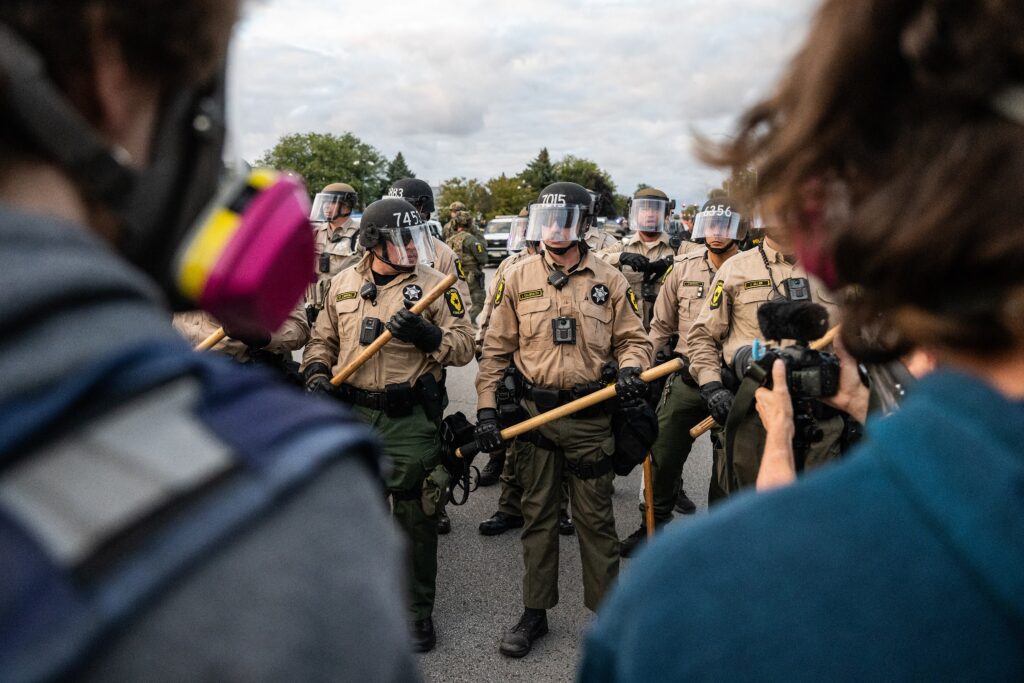
CPD claims they didn’t violate the Trust Act, but It wouldn’t be the first time that local collaboration was called into question amid the federal insurgency the Trump administration dubbed “Operation Midway Blitz.” In October, when Marimar Martínez was shot five times by Customs and Border Protection (CBP) agents, local police officers were on the scene. They used pepper balls and tear gas on protestors who, like Martínez, were there to document the immigration actions that had engulfed the city.
Nine months after the June incident, Chicagoans are still calling on local agencies to investigate the potential Trust Act violation. (“We have no comment on this,” the Chicago Office of Inspector General said.)
Illinois Attorney General Kwame Raoul told Inkstick that his office “takes any allegations of TRUST Act violations seriously,” but did not say whether an investigation was taking place. “My office is and continues to be in constant communication with the Chicago Police Department about this and other public safety issues as part of our ongoing collaboration to implement the consent decree.”
In the Martinez incident, scrutiny from the mayor and governor has largely focused on the federal officers. Meanwhile, collaboration between local law enforcement and the Department of Homeland Security (DHS) is increasingly common thanks to rich incentives from the federal government.
Because of the expanding influence of DHS agencies like ICE and Border Patrol, advocates, attorneys, and immigration experts interviewed for this story say the reforms being debated in Congress won’t make much of a difference, if any, in communities throughout the US. Rather, immigrant safety depends in large part on the work of local activists and mutual aid networks.
“I always regard it as somewhat of a misnomer when people refer to Chicago as a sanctuary city or Illinois a sanctuary state, because ICE is still operating here,” Tsao says. “It’s just that you’ll not see Chicago police or county sheriffs or Illinois State Police or really any other police departments cooperating with ICE. Or at least they’re not supposed to.”
After Renee Good and Alex Pretti were shot and killed in Minneapolis, the Trump administration criticized local law enforcement for what they called a lack of cooperation. Working together, Vice President JD Vance argued, would “lower the temperature” and prevent further chaos.
But for years, researchers and journalists diligently tracking DHS have pointed out that local and federal collaboration is often the source of chaos.
Reece Jones, an author and political geographer, wrote a book about the massive expansion of the Border Patrol and how its operations have spread into communities far beyond what one might traditionally consider a “border.”
“I would argue that what we’re seeing today is just a continuation of what the Border Patrol has been doing since its beginning,” Jones says. “All that’s happened is the Trump administration has brought what was before in the shadows of the border into the glaring light of a major American city. [Border Patrol] can stop and interrogate pedestrians and vehicles at a lower standard than all other police, and that’s what we’re seeing happening on the streets.”
Todd Miller, an Arizona-based journalist who has covered immigration for decades, agrees that violence previously confined to the borderland is now stretching throughout the US. The culture of Border Patrol, Miller says, is rooted in dehumanization and violence, making its violent tactics a direct result of its history and training.
He’s particularly incensed by the findings of organizations like No More Deaths, who, in one report, showed that Border Patrol routinely failed to take action in life-or-death situations. In another report, they showed how agents slashed water jugs left out for immigrants traveling the desert.
“When I read these reports, I think, ‘Well, if this is out in front of the greater public, if everyone in this country knew about what these reports are saying, this Border Patrol thing would not be thrown in a silo off to the corner,’” Miller says. “‘People would realize that this is a much bigger thing, that this is a well-financed, super-abusive agency.’”
While the ever-expanding budget afforded to DHS has helped ICE and Border Patrol become behemoths, 287(g) agreements have also been critical to the agency’s influence at the local level.
These agreements effectively deputize local police departments and sheriff’s offices, allowing them to work hand-in-glove with ICE for the arrest and detention of immigrants. Under recent initiatives, agencies that join the program can have the full salaries and benefits of officers reimbursed by ICE, including up to 25 % of overtime pay. Agencies also qualify for quarterly performance bonuses of $500 to $1,000 per officer based on assistance in locating people living in the US without legal documentation.
“I think it’s really important to know that the vast majority of deportations are through local law enforcement, because we have local law enforcement everywhere, all over the country,” says Lena Graber, an attorney at the Immigrant Legal Resource Center. “DHS has built its entire enforcement machine around exploiting and co-opting that physical numerical and geographical spread and making it the gateway to deportation.”
This is why advocates are pushing states and municipalities to limit the extent to which local law enforcement can work with federal agencies. Roughly a month after the city of Camden, Delaware, announced then backtracked on a 287(g) agreement, the state passed a law banning those partnerships. Maryland did the same, as did New Mexico. The latter state also banned counties from operating detention centers alongside ICE, which will prompt the closure of existing facilities in three counties.
Organizations like the immigrant-led Somos Un Pueblo Unido worked for a decade to make that New Mexico law a reality. Arturo Ramon, the organization’s spokesman, points out that immigrants are crucial to the fabric of New Mexico’s communities and economy; immigrants contribute approximately $1.4 billion in annual taxes to the state. What’s more, ending 287(g) agreements was a moral imperative given the history of putrid conditions and due process violations in the state’s immigration detention facilities. Since 2018, at least 15 people have died at one of the facilities that now must close because of the new law.
“What the agreements basically do is they make communities less safe,” Ramon says, “because they increase the fear and instability by pulling local law enforcement into federal immigration enforcement, which breaks trust and breaks the bonds of community that we rely on.”
Elsewhere along the US-Mexico border, local politicians are pushing for similar laws. In Tempe, Arizona, city council candidate Bobby Nichols has far-reaching plans for how to limit the reach of what he calls “the deportation machine.” He wants to bar ICE from staging raids on city-owned property and cancel the city’s contract with Flock Safety, a company that manufactures license plate readers.
“What the agreements basically do is they make communities less safe.” – Arturo Ramon
Nichols also wants to create “ICE-free zones,” integrate mutual aid groups into city infrastructure to support immigrant families, and potentially use public alert systems to notify residents of ICE activity. Together, he argues these steps would protect residents’ privacy and reduce federal immigration enforcement’s footprint in the community.
“I think it’s important for us to respond to these difficult times to the best of our ability, by creating public programs that protect working people,” he says. “And I think that’s possible. It just requires us to have a good understanding of the law and act boldly in the face of dangerous authoritarianism.”
Nichols is, by his own description, “sort of a larger white man” with a beard. In a city rife with trepidation over immigration enforcement, his appearance has made for some interesting interactions while he’s canvassed for votes. “I walk up to the doors by myself a lot of the time, and there are people who won’t open the door to me just because they don’t know whether I’m with an agency,” he says.
But he’s quick to share who he is and what he wants to do. “I want to make Tempe more affordable. I want to protect our safety and our privacy. I want to make sure that the city is accessible for everyone, and I want young families to be able to build lives here and raise children here,” he adds. “I talk pretty quick, so sometimes I get to both of these topics before they get a chance to say anything.”
The people interviewed for this story emphasize that stopping collaboration between ICE and local law enforcement is just one way to protect immigrants. Even if they’re successful, they know so much work remains to curb the administration’s harms.
A few weeks before Christmas, Jesus Acosta Gutierrez, a Venezuelan man living with Temporary Protected Status about 45 minutes west of Chicago in Elgin, Illinois, was arrested by ICE after a traffic stop. Federal authorities claim Gutierrez rammed an ICE vehicle; Gutierrez and his attorney vehemently deny this, saying he was the one who was rammed.
After the crash, Gutierrez fled on foot and barricaded himself on the balcony of a nearby apartment building for several hours, drawing a crowd of about 200 onlookers. ICE deployed tear gas, pepper spray and flash-bang grenades before taking Gutierrez into custody. Elgin police responded to the scene, but in a statement after the arrest, they emphasized that they were there to treat citizens harmed by ICE’s chemical irritants.
When they respond to future calls, the police noted they will “determine the appropriate action within the parameters of the Illinois Trust Act.”
ICE, for their part, accused local police of failing to protect their agents. They also accused Gutierrez of being a member of the gang Tren de Aragua — another charge he and his attorney deny.
“They damaged my integrity,” Gutierrez told Inkstick, via a translator. “They made up lies.” (Prior to his arrest, they say, Gutierrez’s only run-in with the law was a petty traffic citation.)
He spent roughly two months in a detention facility in Indiana, where he says he was afraid of some of both his fellow detainees and the guards, who would withhold shower and medical care as forms of punishment. He lost 25 pounds and suffered from a horrible gallbladder pain because of a preexisting health condition.

All the while, the government continued to claim he was part of a violent gang, even though his attorney says they’ve never presented evidence to back that up. In response to Inkstick’s questions about what evidence links Gutierrez to Tren de Aragua, outgoing DHS spokesman Tricia McLaughlin said, “DHS intelligence assessments go well beyond just gang affiliate tattoos and social media,” though no tattoos or social media were mentioned in the original question.
“Tren De Aragua is one of the most violent and ruthless terrorist gangs on planet earth,” McLaughlin continued. “They rape, maim, and murder for sport. President Trump and Secretary Noem will not allow criminal gangs to terrorize American citizens. We are confident in our law enforcement’s intelligence, and we aren’t going to share intelligence reports and undermine national security every time a gang member denies he is one. That would be insane.”
Gutierrez’s Temporary Protected Status was revoked, so Gutierrez, facing deportation, decided to move back to Venezuela. In early February, he arrived in the country he’d left nearly three years earlier, when he embarked for the US and settled in Elgin to work as a painter and Uber driver.
He loves Elgin, he says, and will miss the community he found there. But right now, he’s largely focused on recovering from the trauma of his arrest and detention. “Unfortunately the psychological effects I’m still struggling with, and I think they’re going to be here for some time,” he says.
He can’t shake the feeling that his entire ordeal — being hunted down over a year after a traffic offense, suffering horrific treatment in detention — was all by design. “It was forced,” he says. “They wanted us out. … There is no humanity. There are no human rights in this country. There is no freedom in that country there. That’s not a free country.”
Top photo: Law enforcement stand outside an immigrant detention facility in Chicago during an anti-ICE rally in September 2025 (Paul Goyette/Wikimedia Commons)



.jpg)