








Skip to content
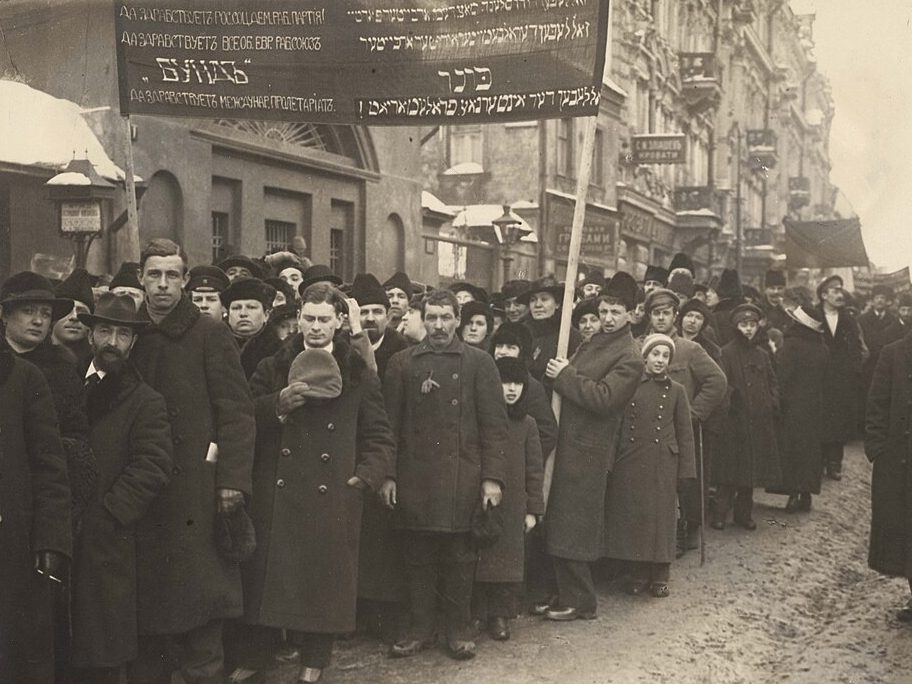
A photo shows the socialist Jewish Labor Bund during a rally in 1917 (Public domain/Wikimedia Commons)

‘For Your Freedom and Ours’: The Lessons of the Jewish Bund

In a new book, author Molly Crabapple examines the story of the revolutionary Jewish Bund — and the lessons for resistance today.

Words: Moira Lavelle
Pictures: Public domain
Date:

The story goes that Henryk Erlich — the revolutionary, writer, orator, and Bundist — penned his last words in 1942: “I die knowing that I was right.” Bold, but there is an argument to be made. More than eight decades after the Lviv pogroms, the Warsaw Ghetto Uprising, and Erlich’s death, many of the positions and prognostications of the left-wing Jewish Labor Bund now seem prescient.

Writings about the suddenness of autocracy and the need for immediate response, paeans to minority cultural institutions, polemics against the danger of antisemitism, and critiques of Zionism all read as astute analyses primed for the current cultural moment. But these ideas were first printed in tenacious underground newspapers and pamphlets smuggled in false-bottom suitcases more than a century ago. Molly Crabapple’s latest book, Here Where We Live Is Our Country: The Story of the Jewish Bund, lovingly details the formation and promulgation of the ideas of the Jewish Bund, reanimating its revolutionaries and organizers amid a context she paints as fearsomely similar to the now.

The Bund, a revolutionary socialist Jewish organization formed in Tsarist Russia, was forged through exile, the Russian Revolution, the First World War, and the horrors of the Holocaust. The workers’ group turned political party was secular but firmly Jewish, strictly socialist, and awesomely stubborn. The Bund was illegal under the Tsar, briefly tolerated by the Bolsheviks, forced to Poland, barely permitted by the Second Polish Republic, and later crushed into Nazi-ordered ghettos. Still, they refused to disband or dissolve. They resisted the logic and violence of the virulent antisemitism encircling them at every turn.

Crabapple focuses on the lives of the fierce labor organizers, fighters, and theorists of the Bund. Inspired by her great-grandfather Samuel Rothbort, an artist and Bundist who fled to New York, she jumps from his paintings, to memoirs of revolutionaries, to speeches of the party’s central committee, to the many, many party communiqués. Crabapple writes to make you fall in love with the Bundists — with their charm, their surety, their steadfastness, their loquaciousness — but more so to make you fall in love with their ideas.

The Bund was formed with what we would today call intersectionality (a term coined by Kimberlé Crenshaw in 1989) as its basis. The group understood that the oppression they faced as Jews and as workers overlapped and had to be combated as such. The Bund offered Yiddish language classes, unionized Jewish laborers, prolifically churned out political analyses, ran mutual aid across borders, and formed patrol groups that fought back with brass knuckles and iron rods. They urged a class-based solidarity without sacrificing the specificity of culture.


Molly Crabapple's 'Here Where We Live Is Our Country' explores the history of the Jewish Labor Bund

Crabapple’s driving motif is one of the Bund’s central tenets — the concept of “hereness,” or Do’ikayt in Yiddish, a steadfast insistence that it was their right to remain and to fight right where they were. “We are not strangers here and not guests, even though the Russian government considers us as such,” wrote a local Bund committee in 1903, later continuing: “We demand and fight for that which belongs to us, for human, civil, and political rights.” They argued the same later in Poland and Germany. The Bund avowed that where they lived, where they struggled, was their country. In much the same way, South Africa’s 1955 Freedom Charter would declare that “South Africa belongs to all who live in it,” a phrasing New York’s new mayor, Zohran Mamdani, name-checked in his inauguration speech in January, arguing that the city belongs to all of its residents.

The Bund’s focus on hereness led them to reject the concurrently created Zionism from the jump. While Ze’ev Jabotinsky and his Revisionist Zionist movement worked with far-right and ultra-nationalist elements to advocate for Jewish emigration from Russia, Ukraine, and Poland, for instance, the Bundists argued that leaving Eastern Europe was precisely what their antisemitic neighbors and governments wanted. They also decried the oppression and subjugation of a people they identified with. A statement in the 1947 Bund Bulletin reads as a clarion call: “The future of the Jewish community in Palestine […] cannot be built upon latent or open war against the Arab majority of the country as well as against the Arab countries surrounding Palestine. […] However, such a state of affairs would be the inevitable result of the creation of a Jewish State.”

Bund newspapers and speechgivers wrote about their support for the Palestinians in much the same way they wrote about the socialists in China, or sent money to socialist organizers in New York. They called for an international socialism with a broad-tent approach that they argued was the only way to freedom. They opposed, as one Bundist wrote in 1929, “any nationalism, any chauvinism, be it Arab or Jewish.”

The Bund built itself brick by brick against an unending war on their politics, their culture, their individual and collective existence. They were not afraid of war, but they fought to end it — as guerilla warriors, or ghetto resistance fighters too often ignored by those they believed were comrades. In a heartbreaking letter to the non-Jewish population of Warsaw, sent as Nazis lay waste to the ghetto in 1943, a Bundist writer sent “fraternal greetings,” concluding: “Know that every threshold of the ghetto has been and continues to be a fortress, that we may perish in the struggle but never surrender. […] The battle is being waged for your freedom and ours!” 

What Crabapple does intentionally — and very well — is draw parallels between the reality of the Bund and the history of now. She compares unending Bund conferences with dragging Democratic Socialists of America meetings she has attended. She imagines the streets of Vilna during the 1905 revolution were similar to the Occupy Wall Street encampments. She recognizes that Bundists giving tea to refugees forced from Nazi Germany had similar instincts to today’s punks handing out blankets to refugees arriving on Europe’s shores. She notes similarities in the mass lynching of African Americans and pogroms of Jews, and explicitly compares the obliteration of the Warsaw Ghetto to Israel’s pummeling of the besieged Gaza Strip.

The catalog of constant and bloody pogroms is dizzying. Reading about massacre after massacre leaves the reader with a nausea akin to scrolling through the carousel of horrors (the news) on the phone. But this is what Crabapple is driving at. She details this violence to explain what can come out of it — how it informed debates between Zionists and Bundists, describing the myriad forms of resistance the Bund developed over decades, and showing the moments of failure and success of an organization that refused to compromise, at times for good and for ill.

Here Where We Live Is Our Country is easily riveting, lovingly sourced, and urgent. It is not a lecture on what we can learn from the victors of history, but rather a reminder that the violences have not stopped.This book it is a valuable ticket to ride along with people who were confident that, impending defeat or not, resistance was nonnegotiable, and they would fight knowing they were right.

Molly Crabapple’s Here Where We Live Is Our Country: The Story of the Jewish Bund will be released by One World on April 7, 2026, and is now available for preorder.

The top photo shows the socialist Jewish Labor Bund during a rally in 1917 (Unknown author/public domain/Wikimedia Commons)

Moira Lavelle

Moira Lavelle is an independent journalist based in Athens, Greece. She has reported on politics, migration, borders, and gender for outlets such as The Sunday Times, NPR, The Independent, Al Jazeera, AFP, BBC, and Rest of World.

Hey there!

You made it to the bottom of the page! That means you must like what we do. In that case, can we ask for your help? Inkstick is changing the face of foreign policy, but we can’t do it without you. If our content is something that you’ve come to rely on, please make a tax-deductible donation today. Even $5 or $10 a month makes a huge difference. Together, we can tell the stories that need to be told.

SIGN UP FOR OUR NEWSLETTERS