












Two years ago, I was seated at a dinner table in a friend’s home, meeting her family and their friends for the first time. Just before the evening began, she leaned in and said, almost casually, “I should warn you, some of them might say something inappropriate.” She said it like a disclaimer. I nodded and smiled, already familiar with the kind of “something” she meant. Later, two of those family friends arrived. I introduced myself, warm and polite. A little while later, I found myself alone at the table with them, making small talk. One of them paused, looked at me curiously, and said: “Wow! Have you always gone to school in Uganda? Your English is so good.”
The remark didn’t shock me. It rarely ever does. What surprised me, if anything, was that it didn’t come sooner. I had seen it on their faces as soon as I said hello and introduced myself when they walked in. The pause, the calculation, the gaze that didn’t seem to follow what I was saying but how I was saying it. The sheer surprise that I, their family friend’s guest from Africa, could speak like this. Clear. Articulate. Comfortable.
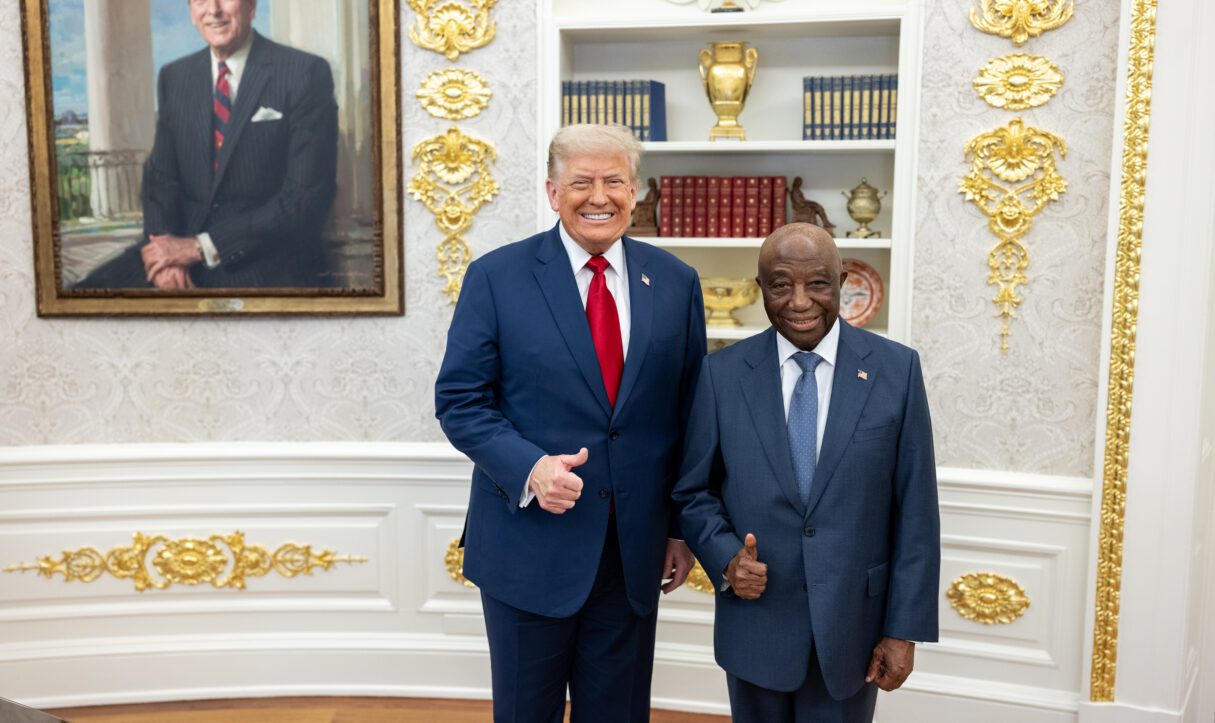
So when President Donald Trump praised Liberian President Joseph Boakai for his “beautiful” English, I didn’t flinch watching the viral clip. I chuckled. Not because it was funny, but because it was all too familiar. The moment has since made headlines, media responses fixated on the absurdity of Trump’s comment, while others zeroed in on President Joseph Boakai’s reaction: a composed, almost whispered, “Yes, yes.” His calmness was not just diplomatic restraint; it was symbolic. It was the kind of quiet you learn to carry when you’re used to being underestimated, when your presence is treated as an exception, and when dignity requires you to weigh every possible reaction against the cost of being misunderstood.
The comment to Boakai landed not as flattery but as confirmation that in global diplomacy, Black credibility is still measured not by how one speaks the English language but by how one sounds. For Africans, the ability to speak English is not enough. One must speak it “well,” which often means sounding less African. It is why, even as African nations assert themselves geopolitically, they are still subject to this subtle but persistent gatekeeping.
Global security and soft power depend as much on perception as they do on policy. Who is considered trustworthy? Who is seen as intelligent? Often, the answer lies not in what is said, but how it is said. Accent, tone, rhythm; these become the benchmarks to assess authority and credibility. And when African leaders are praised for sounding eloquent, it is because the baseline expectation remains so low. Their voice is heard only after it has been filtered through the lens of Western acceptability. This dynamic is not just demeaning. It is dangerous. It implies that legitimacy is something to be earned through mimicry, rather than through sovereignty or substance. It erases the colonial foundations that installed English as the default language of governance, education, commerce, and diplomacy in Africa.
In diplomacy and international policy spaces, the ability to speak “beautiful” English shapes perceptions of intelligence and leadership. It determines whose voice is considered legitimate in security dialogues and global partnerships.
Frantz Fanon, writing in Black Skin, White Masks, argued that mastering the colonizer’s language was a way for the Black subject to be seen as human and civilized. In English-speaking Africa, we didn’t need to migrate to assimilate; we were born into systems that prioritized English over our mother tongues. Language wasn’t just a tool for learning, it became a tool for survival. Fluency opened doors, while “accented,” or better yet, “local” English invited ridicule or exclusion. This dynamic is magnified on the global stage. In diplomacy and international policy spaces, the ability to speak “beautiful” English shapes perceptions of intelligence and leadership. It determines whose voice is considered legitimate in security dialogues and global partnerships.
When Boakai is asked, “Where did you learn to speak so beautifully?” the question is more than insulting. It exposes the racialized astonishment that someone like him could sound composed, fluent, or persuasive. It negates the history of Liberia, where English is the official language and the population includes descendants of Black African Americans resettled through the US-led colonization movement in the 19th century. It signals a quiet disbelief that a Black African leader could participate in global diplomacy without translation.
That disbelief, cloaked in admiration, becomes a mechanism of gatekeeping. A way of reinforcing who is worthy of being heard, and who is merely present. Language, in this context, becomes a form of soft power. But it is soft power only when spoken in the “right” accent, with the “right” cadence. African accents are too often treated as a joke or as incompetence, unless they are softened, trained, or sound western-educated. This performance of fluency, when accepted, becomes a signal to the West that a leader is rational, modern, and “safe.”
So when someone asks, “Where were you educated?” or says, “You speak such good English,” I hear more than a compliment. I hear a colonial echo. I hear the cost of fluency. How many years were spent adjusting, exaggerating, performing not for understanding, but for acceptance? “Where were you educated?” is rarely just a question. It carries with it the quiet suspicion that a leader like Boakai must have learned English elsewhere, somewhere Western, somewhere legitimate. It reduces us to spectacles: the “good” African, the “exceptional” immigrant, the one who defies expectations. It’s racism dressed as wonder.
Fanon reminds us that colonialism isn’t just physical domination; it is psychological compression. It narrows the space in which Black people can exist freely, speak without translation, or be heard without disbelief. In this light, Boakai’s calm “Yes, yes” becomes more than diplomacy; it reflects the impossibility of responding truthfully when even your fluency is treated as an anomaly.
Perhaps the real resistance lies not in how we respond but in refusing the question altogether.