













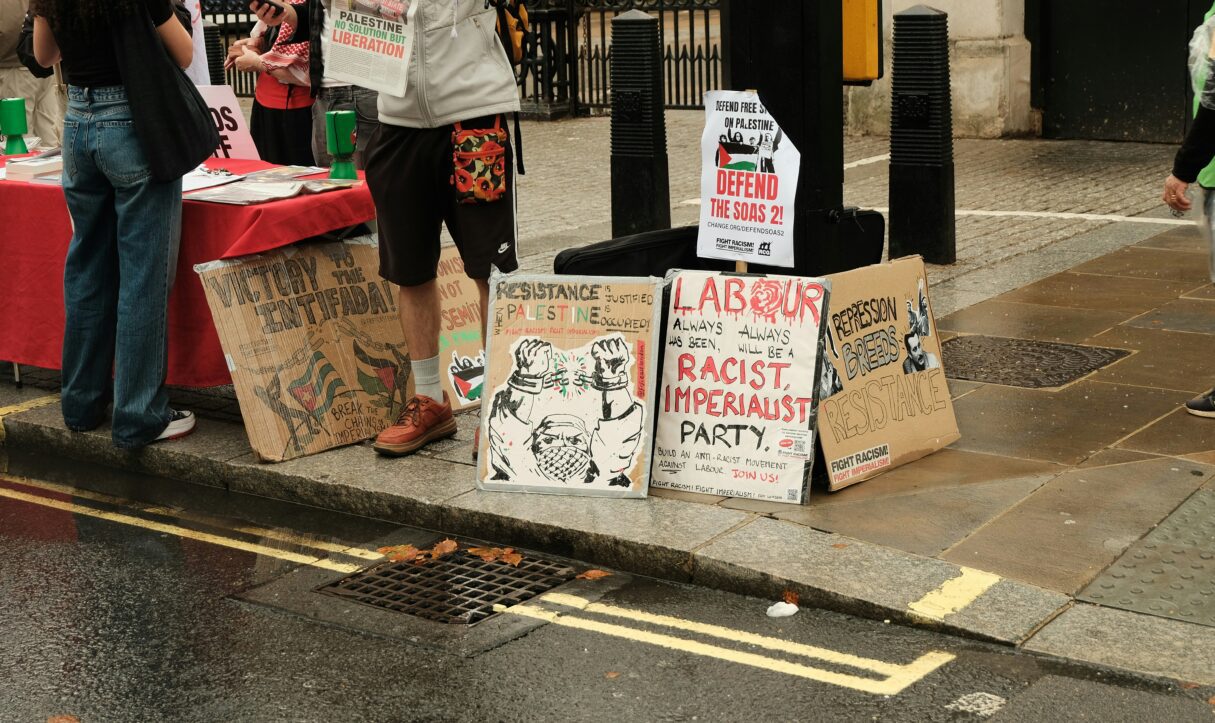
Just a year after the British Labour Party’s landslide election victory in July 2024, the center-left party is facing a sharp decline in its polling numbers: the far-right Reform UK sits nine points ahead in recent polls, claiming 34% to Labour’s 25%. Critics have accused the UK Prime Minister and Labour leader, Keir Starmer, of pandering to far-right rhetoric in an attempt to claw back some of the support from Reform. Worse yet for Labour, it now faces another threat from former parliamentarian Zarah Sultana, who left the party earlier in July and plans to set up a new left-wing opposition.
The picture marks a stark contrast to last summer, when the party came to power, winning 411 seats out of an available 650 in the House of Commons, ending 14 years of Conservative rule and delivering one of the worst defeats for the Conservatives in its history.
A year on, tensions within Labour are now brewing as critics accuse the party of a sharp drift rightward in both policy and tone. Last month, the party suspended four of its members of parliament for voting against the government, which has chosen to continue a Conservative-era cap on welfare benefits for families with more than two children.
Mounting criticism also recently forced Starmer to walk back comments he made in a speech in May 2025, when he warned that a lack of strong migration controls put the UK at risk of becoming an “island of strangers.” Starmer later expressed “regret” over his choice of words, but Sultana, who had faced suspension for opposing welfare caps, condemned Starmer for, in her words, echoing the 1960s far-right politician Enoch Powell. “It adds to anti-migrant rhetoric that puts lives at risk,” she said in a post on X at the time.
Sultana has continually expressed dissatisfaction with Labour’s political trajectory throughout the last year, but she is far from the only left-wing critic. In July, she announced that she would team up with former Labour leader Jeremy Corbyn to form a new political party.
In a joint statement, they cited Labour’s support for welfare cuts, military spending, and “complicity in crimes against humanity.” Calling for a “free and independent Palestine,” the statement added: “It’s time for a new kind of political party, one rooted in our communities, trade unions, and social movements.”
Even as Labour continues to splinter, though, the party has pushed forward with policies that clash with its leftist constituents. After members of Palestine Action broke into a military base and spray-painted graffiti on an air force jet to protest what it called British complicity in Israel’s war on the Gaza Strip, the government designated the activist group a terrorist organization in early July. Nine Labour MPs voted against the measure, while United Nations experts condemned it as a likely misuse of terrorism laws.
According to Dr. Georgios Samaras, an assistant professor in public policy at King’s College London, Labour now resembles a “hybrid mainstream party” plaguing itself with “ambiguous media messaging, dubious communications tactics, repeated U-turns, and outright ideological flip-flopping.” Under the leadership of Tony Blair in the 1990s and early 2000s, Labour embraced fiscally conservative policies. Now, the way Samaras sees it, the party has adopted “far-right positions on migration, gender rights, and free speech.”
As Reform UK gains ground in polls, Samaras explained, Starmer’s attempts to capture right-wing voters are falling flat. “Reform supporters, some of whom endorsed last year’s far-right riots, will not trust Starmer to pursue a far-right agenda,” he said, arguing that the prime minister is risking “a spectacular death of his own party.” Samaras cited a July 9-10 Find Out Now poll, which put Labour’s support at 21% and Reform UK at 34%. That survey also found that the combined support of Labour and the Conservative Party sat at 37%, just a few percentage points above Reform UK.
Meanwhile, migration remains an enduring and contentious issue among British voters. The previous, Conservative-led government raised the mantra “stop the boats,” a reference to the migration route across the English Channel, a top priority, even proposing to send rejected asylum seekers to countries like Rwanda. Labour scrapped these plans when it took office, and Starmer said at the time that the policy had “never been a deterrent.”
Now, advocacy groups and watchdogs say the Labour government’s anti-migrant rhetoric echoes the most divisive language its right-wing predecessor used. In fact, the Labour government has gone as far as to rank reducing the arrivals of asylum seekers on small boats from France at the top of its agenda.
“Labour has overpromised and underdelivered.”
Griff Ferris, Advocacy and Communications Director at the Joint Council for the Welfare of Immigrants, warned that Labour is fueling the same “racist rhetoric” that contributed to last summer’s riots, which came in the wake of widespread misinformation falsely claiming that an asylum seeker was behind a deadly attack. “The Labour government continues to parrot dangerous and racist far-right narratives,” Ferris said. “It presides over record-breaking deportations and indefinite immigration detention, while failing to address the real issues facing the country.”
For his part, Samaras pointed to Labour’s approach to inequality and public spending, arguing that both have preserved threads of the Conservative party’s ideology. “There is a clear overlap between Starmer’s Labour and Rishi Sunak’s Conservatism,” he said, referring to the former British prime minister. “Labour has overpromised and underdelivered. The proposed wealth tax, for example, has failed to materialize, and the party continues to side with the affluent rather than lifting millions out of poverty.”
Similar discontent has also rippled throughout the education sector, a fact that the Labour government’s anti-immigration policies have only made starker. As Labour presses forward with the Conservatives’ “hostile environment” approach to migration, said Dr. Jordan Osserman, it has almost entirely restricted international students’ ability to bring their dependents to the UK. Osserman, who is Co-President of the University and College Union branch at the University of Essex, argued that these policies effectively mean “that international students view the UK as a less appealing place to study.”
International students, he explained, pay exponentially higher fees to study in the UK. “From a Union perspective, the really radical thing a left-wing government should do is end tuition fees entirely and return to a central funding model where universities are funded by grants,” Osserman said. “There are gradations of that that the Labour government could do — but at the moment they are doing nothing.”
In the face of swelling criticism and ever-worsening polls, the Labour government has defended its record. Rachel Reeves, the head of the Treasury and Chancellor of the Exchequer, has insisted that the Labour government has had to make hard decisions in a tough economy. For his part, Starmer has claimed his party’s migration policy aims to create a “controlled, selective, and fair” system.
Labour has yet to openly respond to the news of Sultana and Corbyn’s breakaway left-wing party, but party insiders who spoke to British media have dismissed the undertaking’s significance and pointed to Corbyn’s failed bids to become prime minister in the 2017 and 2019 elections.
Under British political rules, Labour still has three to four years left before it would have to call for a general election. Still, political threats from both the hard right and the left are growing, and polls have continually painted a grim picture for a Labour government that is still early in its premiership.
In early July, Gideon Skinner, senior director of UK politics at the Ipsos polling and public opinion organization, noted that “disappointment with Labour is clear, even among those who voted for the party in 2024.”
“We know from Ipsos research how difficult it has been to shift entrenched public pessimism over the cost of living, immigration, and the state of public services, and so far, Britons do not think Labour is delivering the tangible change they were hoping for in 2024,” he added.
“This is reflected in satisfaction ratings for the government and prime minister that — while not quite the worst Ipsos has ever seen — are well below the average we usually see coming up to a one-year anniversary.”