

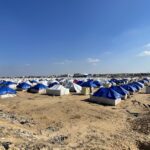



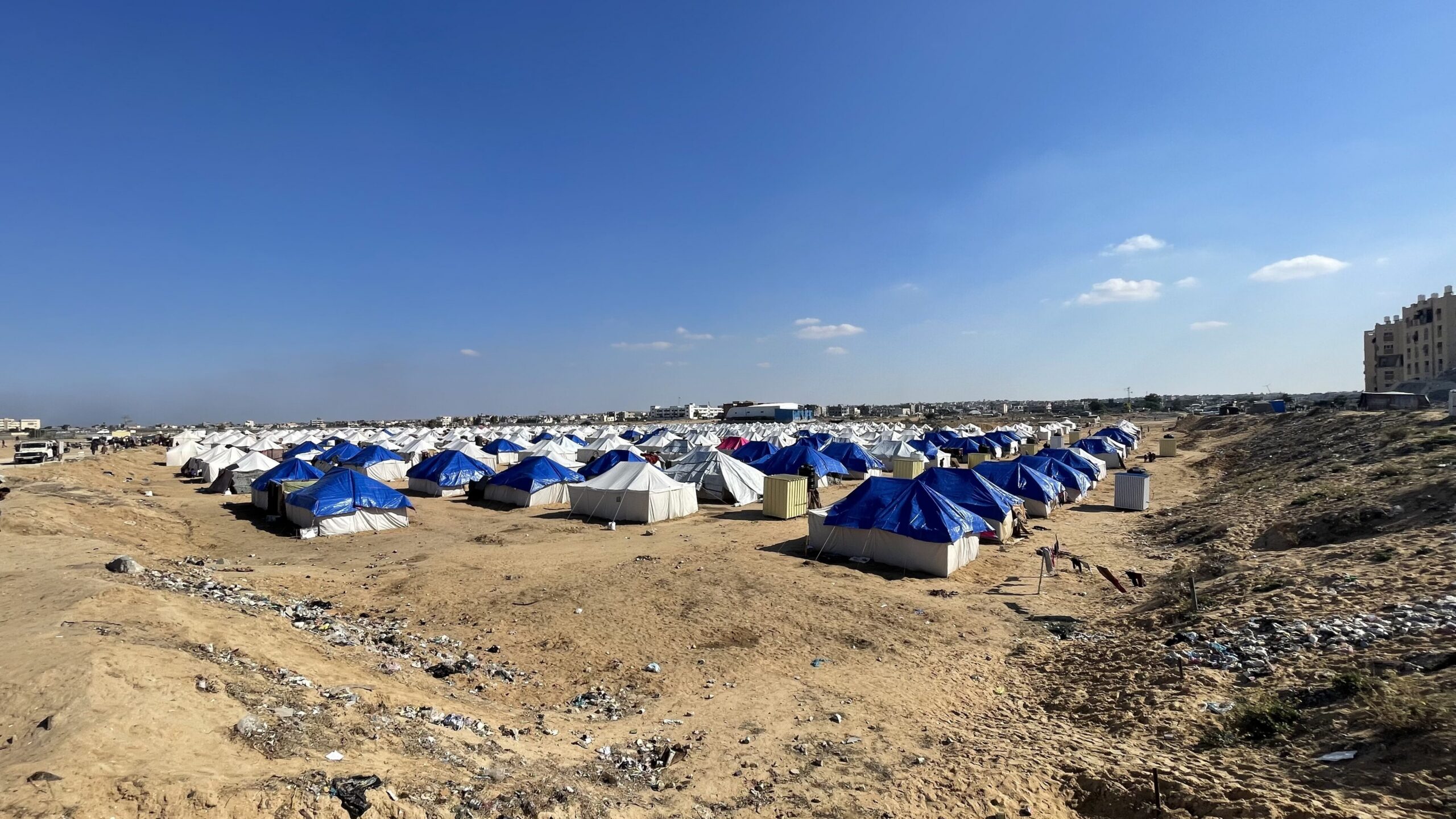
Since the start of 2026, heavy rainfall, harsh winter weather, and a series of intense, low-pressure storm systems have battered the Gaza Strip. Winds reaching up to 130 kilometers per hour (80 miles per hour) have knifed across the coastal enclave, where Israel’s latest war had already displaced around 90% of the population. The gusts have blown away thousands of tents. Meanwhile, homes that Israeli bombardment weakened have now collapsed down on the heads of the families inside.
In northern Gaza, a partially destroyed apartment building stands with an entire wall missing, around it a gray horizon of bombed towers and scattered rubble. As the storm approached this building, a father put up plastic sheets to cover the space where the wall once was. He hoped to salvage whatever he could — but it was to no avail. The mother of the family wept. She was afraid to sleep at night, she explained, because the storm violently shook the building. Her voice was heavy with despair. “I feel like I will die if this storm continues,” she said.
In central Gaza, our situation was no safer. In the neighborhood where I live, we woke on a recent morning to tragedy: a five-story residential building, home to the Shanna family, had collapsed. The building had survived Israeli shelling, but the fierce winds proved too much. It fell down on a father and his children. Local residents of the neighborhood organized protests and vigils on the rubble. All they were asking for was that heavy machinery be allowed to enter Gaza; how else would they remove debris, rescue people trapped beneath the wreckage, and do repairs to keep yet more homes from collapsing?
For Palestinians in Gaza, the ongoing shortage of resources means more and more victims. We hold the authorities responsible — they should provide the support we need. The ceasefire in October 2025 may have ended in the war in news broadcasts, but it continues in Gaza. Israeli forces still randomly open fire on civilians. We were promised equipment and prefabricated caravans — the war destroyed more than 90% of the homes — that have not arrived. Even the winter is a weapon aimed at us, the rain and winds as harsh as the war itself.
There used to be warmth even in winter. We were overjoyed by rain, excited when the Palestine Meteorological Department announced an incoming storm. We would drink sahlab, a warm, creamy winter drink, and eat roasted sweet potatoes. We would embrace the smell of cake and cinnamon rolls baking in our ovens. We would go out with friends for a drive around town, sip hot chocolate while the rain tapped on the car windows. Children wore thick, wool scarves and socks with funny patterns.
Winter has been stripped of its joy, though, and I no longer see any of that. Now I see children dressed in too few layers, walking barefoot in the mud. I see damaged sewage covers exposing waste to the world above ground. Children wake up shivering in the middle of the night, soaked in the rainwater that floods their tents. There is no point in going back to sleep — the storm lasts all night, and it will just wake them again. Appeals fill my social media timelines, while municipalities across Gaza struggle to do the bare minimum. I recently saw a post by a girl whose tent had been overcome with rain: “A tent facing a storm — who exactly is supposed to withstand it?”
I no longer love winter. As with so many things I once loved, the war has given me a phobia of the season. For two years, I have not so much as turned on a heater. What would be the point? There is neither gas nor electricity. The only source of warmth are wood fires, and they are suffocating. We eat lentil soup — the only meal that has warmed my stomach since the war started — nearly every day. I’m sick of it, but what else can we do to fight back the hunger? More than four months after the supposed ceasefire, the war is still disfiguring the most beautiful parts of our lives, just as it has disfigured my city. Once a season of warmth, holidays, and comfort food, winter is now a gray, silent killer.
Since Jan. 14, the storms have killed dozens of people in Gaza, according to the Ministry of Health. Of that number, seven were children who froze to death. Most of the others were killed when war-damaged buildings collapsed on them. At the same time, Israeli attacks continue to take lives: more than 600 since the ceasefire.
My father, whom everyone knows as Dr. Eyad, is a pediatrician at Al-Aqsa Martyrs Hospital. I asked him what the winter looked like from his vantage point. He told me of children suffering from hypothermia, many of them just infants. Their bodies lack the “subcutaneous fat,” he explained, “to protect them from the cold, so their temperature drops rapidly and suddenly.”
What are the signs of hypothermia? He said the children arrive with coldness soaking through their extremities, low blood pressure, low oxygen saturation, and slow heartbeats. In some cases, he went on, it resembles a bacterial infection. “If parents delay bringing the child and there is no rapid medical intervention, the case can deteriorate beyond recovery and lead to death.”
“Once a season of warmth, holidays, and comfort food, winter is now a gray, silent killer.”
In the most recent case, he said, a six-day-old infant named Mohammed showed up at the hospital. Because the boy’s father couldn’t find an ambulance or a ride to the hospital — the fuel crisis has turned transportation into another form of torture — he had carried the child from their makeshift tent on the beach to the hospital.
“We placed Mohammed under warming for about three hours and administered fluids to raise his body temperature,” my father explained. “After three hours, his temperature began to rise gradually, though not to normal levels. Soon after, his condition worsened. We immediately placed him on a ventilator. But tragically, a few hours later, Mohammed died.”
In the eyes of my father and his medical team, the child’s death was “deeply painful.” They had done everything they could to save Mohammed, but it was beyond their control. Worse still was breaking the news to the child’s parents. “Death was not something they expected,” my father went on. “They believed their child was experiencing a normal cold.”
That kind of heartache has become part and parcel of daily life here. Hospitals have seen a surge in unusually alarming pediatric cases linked to the extreme cold and inhumane living conditions — how can you mind your health, after all, when you live in fragile nylon tents on a beach in the dead of winter? Children turn up at the hospitals with limbs blue and resembling gangrene. Some have even lost fingers.
But medical treatment alone cannot stop this, at least not according to my father. Part of his prescription is to not remain silent as the cold washes us away, to demand a life that doesn’t include living in tents that protect from neither the winter cold nor the summer heat, having our health stolen, and being robbed of our livelihoods. Without the prefabricated shelters that are supposed to enter the Strip, without fuel and blankets and winter clothing, and without a serious program to rebuild Gaza, we will remain vulnerable to the cruel whims of the weather.
This isn’t only his message, though. This is my message. It is the message of some two million Palestinians in Gaza who were promised a ceasefire but never got it. People deprived of their very right to live. People stripped of warmth and safety. People whose dignity has been systematically decimated. People who, in their own homeland, have been exiled to makeshift shelters on the shore, left to cook little more than lentils with little more than battered, old pots.
In the absence of justice, we remain suspended, stuck here to live only half a life.