








More than two decades after the invasion of Iraq, former British Prime Minister Tony Blair, the man who wed the United Kingdom to George W. Bush’s campaign to oust Saddam Hussein, has reemerged not as a penitent observer but rather as a proposed architect of peace in the Middle East. In late September, Blair’s name began to crop up in headlines as an option for chair of US President Donald Trump’s so-called Board of Peace in the Gaza Strip.
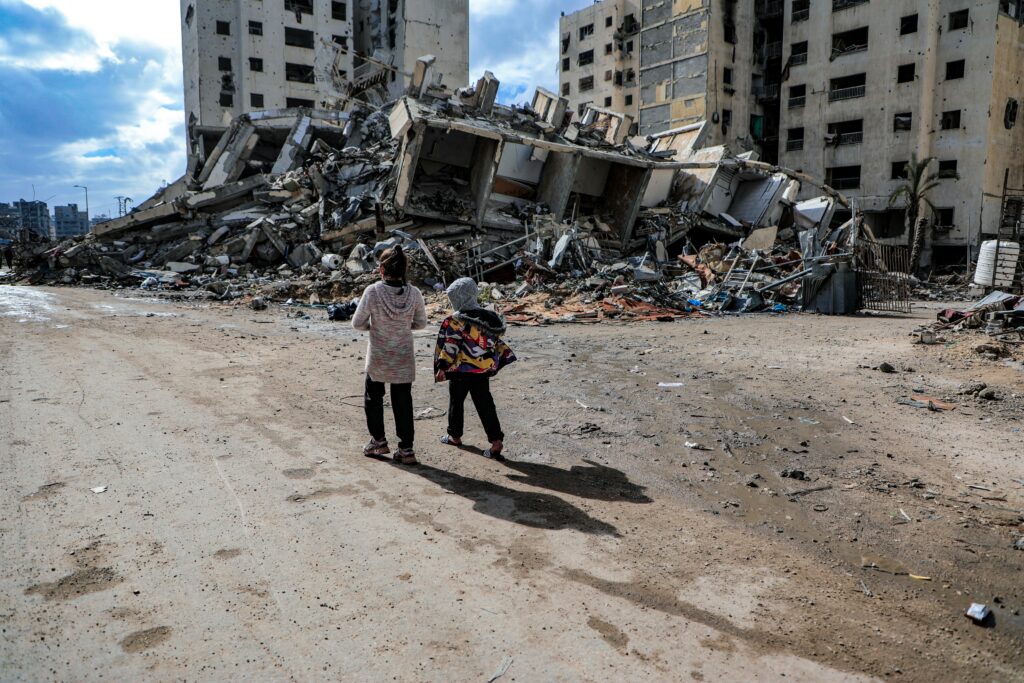
The Trump-led Board of Peace is part of a 20-point peace plan the US has laid out for the current ceasefire between Israel and Palestinian armed group Hamas in the war-ravaged Strip. According to recent reports, the board is a proposed multinational body that would govern Gaza and oversee reconstruction after two years of Israeli bombardment that killed tens of thousands of Palestinians. Hamas and other Palestinians have responded harshly to the suggestion that Blair would be involved, while Trump himself recently admitted he was unsure whether the former British prime minister would be accepted onto the board. Still, Blair’s name was put forward, signaling the strange political revival of one of the UK’s most polarizing leaders in recent history.
For those who worked at the highest levels in Blair’s government, his sudden return to diplomacy in Gaza has evoked a deep sense of dismay. Writer and consultant Carne Ross served as head of Middle East issues at the UK Mission to the United Nations, working extensively on Iraq and matters related to weapons of mass destruction before the war began in 2003. “These days, nothing should surprise one, but I was pretty appalled to see him mentioned in this context, given his history in the Middle East, but also particularly given his history on Israel-Palestine, where I have particular experience,” Ross said.
In October, Blair joined Trump and other world leaders in Sharm el-Sheikh, Egypt, for a summit aimed at solidifying the ceasefire. Blair’s presence prompted controversy when Egyptian President Abdel-Fattah el-Sisi, who came to power by coup, reportedly greeted him warmly. Blair and his Tony Blair Institute for Global Change have been accused of advising the former Egyptian general during the bloody overthrow of the country’s first democratically elected leader, Mohamed Morsi, in 2014. For their part, Blair and the Institute have denied those allegations.
Meanwhile, news of Blair’s potential involvement in post-war Gaza has also raised eyebrows in Westminster. In fact, the news sharpened divisions within the Labour Party Blair once led, with critics objecting to Blair’s potential inclusion. Labour has spent years trying to escape the shadow of the Iraq war, which for many has defined the party for a generation.
Blair himself has expressed regret over deaths in Iraq but has remained firm that it was the right decision to topple Hussein. He has maintained a near-constant presence in the Middle East since his tenureship. On his last day as prime minister, in June 2007, he accepted a role as Quartet envoy in the Israeli-Palestinian peace process, a position he held until 2015 despite a steady stream of accusations of pro-Israel bias.


In 2016, Blair founded the Tony Blair Institute for Global Change and positioned himself as a consultant-entrepreneur mingling easily with heads of state and big business. The Institute bills itself as a think tank and consultancy and says its vision is “open, inclusive, and prosperous countries for all.”
In 2023, it emerged that the Institute continued to advise the Saudi Arabian government despite the assassination of journalist Jamal Khashoggi in Istanbul in 2018 by agents at the behest of Crown Prince Mohammed bin Salaman. “The renewed engagement of the US and Western nations with Saudi Arabia and Crown Prince Mohammed bin Salman illustrates why this decision was correct,” the Institute said in a statement at the time. Still, it continues to weather accusations that have ranged from advising authoritarian governments to being swayed by large donations from tech billionaires.
Ross, the former diplomat, held numerous senior positions in the Civil Service, including serving as a speechwriter for Blair’s Foreign Secretary, Robin Cook. Ross recounted an incident when the foreign secretary was planning his first visit to Israel and the Palestinian territories, which would have included a stop at the Orient House in occupied East Jerusalem. Once the headquarters of the Palestine Liberation Organization (PLO), the Orient House is a historic 19th-century villa that has become a symbol of hope for an independent Palestinian state with its capital in East Jerusalem. According to Ross, the foreign secretary’s plans to visit the Orient House followed suit with other EU officials at the time.
That was, Ross explained, “until he got a phone call from Number 10, i.e., Tony Blair, saying he was not to visit the Orient House.” The call was the outcome of Israeli pressure “not to visit the Orient House because they want to claim that Jerusalem is all theirs,” Ross added. “Blair immediately succumbed to that Israeli pressure.”
The way Ross sees it, that incident set the tone for Blair’s entire approach to the Israeli-Palestinian issue, arguing that Blair helped solidify an international tendency that routinely “downplays Israeli aggression and colonial occupation in Palestine by framing it as a ‘dispute’ between two equal parties who have to be brought to some point of convergence … by well-meaning international efforts.”


To Ross, witnessing the ongoing rehabilitation of Blair and others like him — such as senior officials who presented misleading or dishonest intelligence in the lead-up to the invasion — has been a difficult pill to swallow. “I think they should be shamed and repudiated at the very minimum,” he said. “I actually think they should go to jail. I think they should be prosecuted in The Hague. But instead, we see them pop up in mainstream news as legitimate figures, and I am very shocked by that.”
Ross said he is “one of the few people who knows exactly what they did and how they did,” explaining that he knew well “the numbers of modified Scud missiles,” “the intelligence on chemical weapons,” and “the dots and commas of the Security Council resolutions on Iraq.” He added, “I named the weapons inspection body, UNMOVIC.” That meant, he explained, that he knew the reality better than Sir John Chilcot, who oversaw the 2009-2016 British investigation into the country’s involvement in the Iraq war, and better than both Blair and his spokesperson Alastair Campbell. “And I know that they lied.”
Decades later, Ross sees parallels between the mindsets behind the Iraq invasion and the genocide in Gaza. “What they did in Iraq was very much about ‘might is right,’” he added. “It was an illegal invasion, according to international law, and a great many people died … and [the war in] Gaza has been conducted in complete defiance of international law. War crimes have been committed without any accountability or consequence, and many people have died.”
Dr. Gloria Novovic, a lecturer in public policy at the International School for Government at King’s College, similarly connects the dots between Iraq and Gaza, highlighting a darker pattern that has routinely shaped Western foreign policy. “How does his legacy in Iraq connect to what he’s now doing in Gaza? It seems like a replication of liberal interventionism,” she said.
Novovic argued that if the purpose is to replicate “an imperialist agenda” in Gaza, including prolonging “jurisdictional oversight over supposedly independent countries,” she said, “then Tony Blair is really your guy. It’s very hard to find a better person for that job, and his track record, in that very depressing and devastating way, speaks for itself.”
In Novovic’s view, Blair helped instill the “rules for liberal interventionism – and then broke those same rules.” She added, “With the invasion of Iraq, for instance, they couldn’t even adhere to the very conditions they themselves had established. In that sense, it’s quite similar to what we’re seeing in Palestine: The boundaries keep being pushed, and every action is immediately legitimized through the self-proclaimed superiority of Western solutions.”
“With the invasion of Iraq, for instance, they couldn’t even adhere to the very conditions they themselves had established.” – Gloria Novovic
In the Middle East, Blair’s record similarly continues to inspire deep mistrust, according to Diana Buttu, a former PLO legal advisor and practitioner-in-residence at Georgetown University in Qatar. “He’s among the last people who should be having any role, or any say in anything to do with the Middle East,” she said. “I’m still struggling, as somebody who’s lived here and who’s been involved all of these years, to find what his grand achievements were.”
In Buttu’s telling, Blair failed to deter Israel’s harsh treatment of Palestinians well before the recent war on Gaza. “What makes me think he’s going to be able to push the Israelis to do anything to rebuild Gaza and to allow food in?” she asked. “Israel bombed 98% of the farmland in Gaza, which means that the population now is entirely food dependent on the entry of supplies from Rafah. And if Israel chokes Rafah, that means we’re back to famine again.”
On top of the unlikely scenario of Blair pressuring Israel, Buttu continued, Palestinians view the former British prime minister’s record on Iraq as inseparable from their own fight for freedom. “Palestinians don’t separate countries,” she said. “We don’t see one country as distinct from another; we look at things regionally, at how leaders have dealt with the Arab world as a whole. I’m being very polite here — this is someone who not only facilitated but actively joined in the decimation of Iraq and the killing of over a million Iraqis. When you look at what happened to Iraq, at the false pretenses used to invade and decimate that country — and that Tony Blair was part and parcel of this — it’s not easy for Palestinians to simply separate that away and say, ‘Oh, well, that was a totally different country.”
Despite his name being put forward, few voices have come out in support of Blair’s potential inclusion in post-war Gaza. In one exception, an opinion piece in the right-wing Washington Examiner extols Blair’s supposed virtues by going so far as to claim that “if Gaza could become the new Iraq under Blair’s guidance, the Palestinians would be very lucky indeed.”
The Palestinian Authority, the West Bank-based government that has been accused of aiding Israel’s crackdowns on armed groups in Jenin and elsewhere, offered a lukewarm acknowledgment by signaling its “readiness” to work with Blair after meeting him in Jordan.
Tahani Mustafa, a visiting fellow at the European Council on Foreign Relations’ Middle East and North Africa program, said that no one was “under any illusion” that Blair’s involvement would benefit Palestinians. “I think many are thinking of it less in terms of whether it can lead to statehood but more in terms of whatever stops the bloodshed.”

During his participation in the Quartet, Mustafa explained, Blair helped perpetuate the strategy of isolating Hamas after its political wing won internationally observed elections in 2006. Critics say that choice entrenched a Palestinian national divide and stalled diplomacy. “As head of the Quartet, he oversaw one of the worst strategies the international community pursued at the time, which was to isolate a democratically elected government,” Mustafa added. “It was the first time in the region’s history where we saw an opposition party become democratically elected and a government transition. And he was heading one of one of the most critical intergovernmental bodies in that context that chose isolation over engagement.”
Blair’s long legacy speaks to the way he has viewed Palestinians, apparently prioritizing Israel’s security over their sovereignty, she said. When asked for her opinion on his role as part of this new board: “I think we’ve just hit a point beyond satire.”
Meanwhile, former members of Blair’s government also insist it is impossible to appraise his viability in post-war Gaza without taking a hard look at his leading role in the Iraq war. Chris Mullin, who served as a member of parliament for Labour between 1987 and 2010 and a minister in Blair’s first government, was one of the earliest and most outspoken critics of the invasion of Iraq. Mullin voted against the invasion and later recorded his experience of the rise and fall of New Labour in four volumes of published diaries. “I didn’t anticipate that it would prove as disastrous as it did,” he said of the decision to invade Iraq. “I thought the regime would fall very quickly, and that turned out to be the case, but I never anticipated how badly it would go wrong.”
When it came to Israel-Palestine, Mullin also believes Blair “took the Israeli line pretty well all the way through,” expressing angst, he said, over excesses but never true dissent. “I think, largely because he wanted to remain relevant after he stopped being prime minister,” he said of Blair and the Quartet role.
Mullin noted that Blair’s legacy is mixed. “There were successes in Sierra Leone for example and the big one is Ireland,” he said, noting that the 1998 Good Friday Agreement under Blair’s watch ended most of the violence of the Northern Ireland conflict. “But prime ministers only get remembered for one or two things after the years have passed and sadly, Iraq is likely to be number one.”
Mullin added, “I always say that he was the outstanding Labour leader of my lifetime, but I have one major disagreement with him in that he allied us umbilically to someone who I used to say was the worst American president in my lifetime, but I think we’ve moved on a bit since then.”
Yet, two decades on from Iraq, Blair’s name once again hovers over promised and elusive peace, and alongside another American president. Whether Blair will ever chair Trump’s Board of Peace remains uncertain, but the Tony Blair Institute’s statement, published on behalf of their founder, called the plan “bold and intelligent,” suggesting that, for Blair at least, the conviction that he has a role to play in the Middle East’s future remains undimmed.
For those who lived through the consequences of Blair’s policy, however, assigning him the role of peacebroker appears to undermine the fundamental principle of self-determination. “Legally, he has no mandate at all,” said Diana Buttu. “It’s called the right of self-determination, the right to be free – meaning it’s not for him to decide or to do it on our behalf.”