











When Joshua Arnold started working at Boeing a decade ago, he was 32 years old. A college graduate and a veteran, he was offered a starting rate of $13 an hour. Boeing is one of America’s most profitable defense conglomerates. But as a union machinist, it would take him years to make enough money to start a family.
So Arnold worked other jobs: while full-time at Boeing, he was an army reservist, a security guard, and a Lyft driver.
Now, eleven years into his Boeing job, he’s climbed up the pay scale — he doesn’t have to work weekends anymore. At 39, he started a family, and now, at 41, he has two young children he hopes to put through college on his Boeing money.
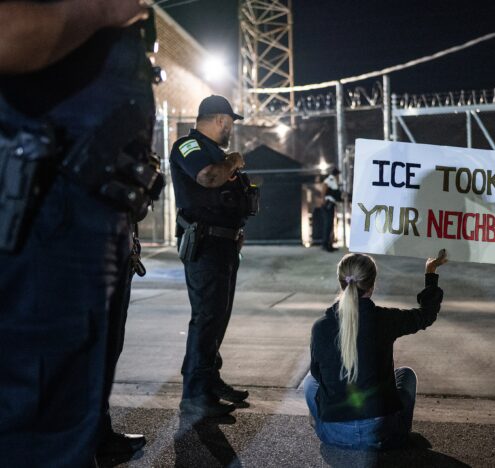
For the past 39 days, Arnold has been on strike alongside about 3,200 of his coworkers — in part, he says, because there are still Boeing employees who are forced to take on second jobs while building warplanes that can cost upwards of $100 million each. On Wednesday afternoon, the union announced they’d reached a tentative agreement with Boeing, one that would increase the average wages of a Boeing defense machinist by 45%. On Friday morning, unionists will vote on that offer, but even then, the fight may not be over.
Boeing is the nation’s fourth-largest defense contractor. Currently, the average salary of a Boeing machinist is around $75,000. Boeing’s former CEO, David Calhoun, made some $33 million in 2023. (That’s nearly $16,000 per hour.)
Boeing’s new CEO, Kelly Ortberg, made his feelings about the strike clear on a late July earnings call with investors. “I wouldn’t worry too much about the implications of the strike. We’ll manage our way through that,” Ortberg said. “The order of magnitude of this is much, much less than what we saw last fall.”
He was referencing last year, when about 30,000 workers in Boeing’s commercial division in Seattle went on strike, costing the company over $5 billion. The current strike, of 3,200 workers, is smaller — but workers told Inkstick that the amount of profit riding on each defense machinist is much greater.
Currently, the average salary of a Boeing machinist is around $75,000. Boeing’s former CEO, David Calhoun, made about $33 million in 2023.
Boeing’s Defense, Space & Security division is responsible for around a third of the company’s total revenue, though it only employs about a tenth of Boeing’s global workforce. As Miriam Pemberton of the Institute for Policy Studies puts it, military-contract manufacturing is more “materials-intensive” than “labor-intensive.” But that means that a strike of relatively few, specialized workers could have outsized power — and that when the 3,200 Boeing Machinists go on strike, politicians pay attention.
The strikers’ demands are relatively standard: faster wage progression, pay raises, and improved retirement benefits. In many ways, Arnold explained, what Boeing defense workers want is to get the same treatment Boeing transportation workers in Seattle get.
“We do the same type of stuff Seattle does,” Arnold said. “And we get worse everything.”
The last time the machinists of District 837 went on strike was three decades ago. Then-employees of McDonnell-Douglas — the defense giant that would, one year later, merge with Boeing — held the picket line for 99 days. During those three months, a F/A 18-C Hornet airplane, one of McDonnell-Douglas’ flagship products, crashed outside St. Louis. Union spokespeople blamed the crash on shoddy repairs to the aircraft by non-union laborers. McDonnell-Douglas denied any connection between the strike and the crash, and an NTSB report on the incident attributed it to pilot error. But it also noted that extensive maintenance was done on the aircraft “by non-union personnel” prior to the accident, that the ejector seat did not fully deploy, and that the plane’s onboard accident recording system suffered extensive damage.
“You can’t expect a foot doctor to do brain surgery,” a union spokesperson said at the time, calling McDonnell-Douglas’ decision to continue production during the strike “insane and reckless.”
“There is no way McDonnell Douglas can produce these aircraft with unskilled workers, be they strike breakers from out-of-state or engineers and other salaried employees.”
Boeing is using a similar tactic this time. On Sept. 4, a company spokesperson announced that the defense giant would go on a hiring spree, recruiting new workers to replace the unionized machinists.
Last year, when Boeing’s Seattle-based commercial wing went on strike for 53 days, it won a 38% wage increase and a ratification bonus. In the weapons-manufacturing business, though, union density has decreased precipitously after two decades of union-busting. The version of District 837 that went on strike in 1996 was more than twice the size of the group going on strike in St. Louis now.
One Boeing machinist I spoke with has seen that decline in unionism through his own family history. His father and grandfather both worked as unionized commercial airplane mechanics with TWA, until that company went under. Back then, he said, “They used to pretty much take care of your health care. You know, they take care of your education. They took care of your retirement.”
Jeff Schuhrke, a historian of labor and American empire, says union size isn’t everything. “It’s not necessarily always about higher union density,” Schuhrke said. “It’s also just about the militancy and how organized and how willing to take action unions are, and in this case, the fact that they’re not just accepting the contract that was offered to them, but they’re rejecting it and demanding better.”
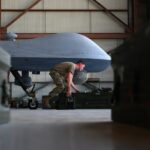
Boeing’s Vice President of Air Dominance, Dan Gillian, has stated that the strike slowed down production of its landmark F-15 and its MQ-25 military drone but noted the Joint Direct Attack Munitions are not affected.
One plane of particular concern is the F-47, the next-generation warplane that US President Donald Trump hopes will secure his military legacy. That contract was awarded to Boeing this past spring, and they’ll soon have to start delivering.
The F-47 is expected to cost up to $300 million per aircraft. Meanwhile, some of the workers manufacturing those planes are still forced to take on second jobs on the side. One coworker of Arnold’s works catering on the weekends.
“I think it is a big deal that Trump just gave Boeing this contract for the F-47, and now these workers who are going to be making that plane are on strike,” Schuhrke said. “That has a lot of political significance. It sends a message to the Boeing management and to the media and the Trump administration. If you want us to make these things, you’ve got to pay us, you’ve got to treat us with respect.”
If the contract is ratified, striking workers will be required to return to work Monday.