








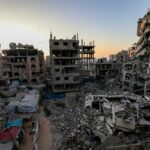


Following a siege that lasted about 18 months, the paramilitary Rapid Support Forces (RSF) overran a Sudanese Armed Forces’ (SAF) base on Sunday, Oct. 26, to gain control over el-Fasher, the capital of Sudan’s North Darfur province. Before this, el-Fasher had been the final city in Sudan’s large, western Darfur region still under the control of the Sudanese government and its military, the SAF.
This is the latest dramatic event in an intense civil war between the rival groups that began in April 2023 as a power struggle between two former allies, General Abdel Fattah al-Burhan and Mohamed Hamdan Dagalo, known as Hemedti. Al-Burhan’s SAF is the Sudanese government’s official armed force, and has claimed control over the country since a coup in 2021 ousted the transitional government put into place after the 2019 overthrow of the decades-long ruler Omar al-Bashir. Al-Bashir was ousted from power following widespread, largely women-led grassroots protests advocating for democracy and human rights.
The development reinforces the increasing geographic splitting of Sudan. The west and southwest portions are mostly under the control of the RSF, whereas the SAF controls much of the country’s center, north, east, and southeast. Importantly, the SAF maintains control over the country’s 530-mile Red Sea coastline and has moved its headquarters to Port Sudan, located on the Red Sea coast.
The fissuring of the country echoes other conflicts, such as in Libya. There, rebellion and armed aggression formed a geographic rupture, with separate entities having de facto control over large swaths of the country’s territory and of its inhabitants, with no progress made for years towards peace or the formation of a unified government. The fall of El-Fasher and the loss of the country’s southwest to the SAF could bode ill for Sudan.
Human rights campaigners who have documented severe human rights abuses committed by RSF fighters on civilians over the course of the war, including in and around el-Fasher during the months-long siege, are raising alarm bells. The RSF has conducted summary executions, threatened men to forcibly enlist into the RSF or else be killed, raped women, and burned down homes, according to observers.
Over the course of the 18-month siege, the RSF built 35 miles of barriers around the city to prevent food and medical aid from entering, and siphoned off potential escape routes for the city’s 1.2 million residents. Many were forced to survive on animal feed.
The RSF has been particularly violent against the Masalit minority in Darfur — the same group that suffered from human rights abuses at the hands of the Janjaweed militia (which is the direct predecessor to the RSF) during the Darfur genocide of the early 2000s.
Of particular concern in the case of el-Fasher is the fact that the RSF has shown intense aggression against residents of cities immediately following their capture. After conquering el-Geneina, the capital city of West Darfur province in 2023, for example, the RSF undertook a widespread assault on the city’s residents, killing between 10,000 and 15,000 civilians, many of whom were part of the Masalit minority. Many Sudan watchers fear that a similar fate is befalling the residents of el-Fasher now that they, too, have fallen under RSF control.
The conflict seems like it’s far from the finish line, and a lasting split along geographic lines appears increasingly likely.
Already, videos are circulating online of the RSF torturing and executing people in el-Fasher. Yale’s Humanitarian Research Lab has used satellite imagery to confirm reports that the RSF has murdered people in the city since capturing it. The Sudan Doctors Network has said that the RSF has killed at least 1,500 people in el-Fasher in the three days immediately following its capture.
Although the RSF’s widely documented human rights abuses have gained most of the international attention and denunciation by world leaders and human rights activists, the RSF is not alone in committing atrocities — the SAF has also been responsible for severely violating human rights.
Over the course of the war, the SAF has indiscriminately shelled residential neighborhoods under RSF control, killing civilians in the process. Along with the RSF, the SAF has also attacked medical facilities and destroyed civilian infrastructure, according to human rights monitors. This has seriously worsened the toll on civilians across the country and makes any potential recovery from the war’s hardships increasingly difficult and expensive.
The fall of el-Fasher demonstrates the RSF’s strength, fueled in part by the support of the United Arab Emirates (UAE). Looking to expand its reach across a region with outsized geopolitical significance, the UAE is the most involved of a number of international actors in the Sudanese civil war. Egypt, Turkey, Iran, Russia, and Saudi Arabia are also in the mix.
Located in the Horn of Africa, Sudan is at the confluence of several localized conflicts — such as in Ethiopia and Somalia — that risk spilling past national borders and mixing with nearby wars to create a complex regional affair. Having leverage over Sudan would help the UAE maintain influence in the area if such a regional conflict took place.
The UAE is also benefiting in a more direct, financial way from its support for the RSF. The majority of the county’s gold is passing through the UAE.
Sudan’s topographical condition is also of interest to the Emiratis. The Red Sea is among the world’s most heavily trafficked sea routes — 12% of global trade passes through the sea. Although the SAF currently controls the coastline, the UAE’s investment in the RSF could help the paramilitary group eventually expand the territory it controls and gain access to ports along the sea. But even if the RSF is unable to conquer territory immediately along the sea, its UAE-supported military capabilities allow it to launch attacks that can reach targets on the coast. The most visible example of this occurred in early May of this year, when the RSF used drones to heavily bombard fuel depots near the airport in Port Sudan, the location of the SAF’s current headquarters.
Ultimately, the conflict seems like it’s far from the finish line, and a lasting split along geographic lines appears increasingly likely. If the war is to end soon, external actors — including the United States — would need to heavily pressure the UAE and other foreign actors to stop fueling the war by transporting equipment to the warring sides.


