




From Israel’s war on Gaza to the Trump administration’s deadly strikes on boats in the Caribbean, from violent unrest in post-Assad Syria to the deployment of military in cities across the United States, 2025 has been a brutal year. At Inkstick, we have tried to take a different tack, approaching these stories — and others — with a tunnel-vision focus on the humans at the center of them.
That is the same spirit that guides so many of the books our team has read, reviewed, and excerpted this year. We’ve published reviews, excerpts, and author interviews of new books that align with our own editorial mandate. As the New Year approaches, we wanted to revisit a few of our favorites.
Excerpts
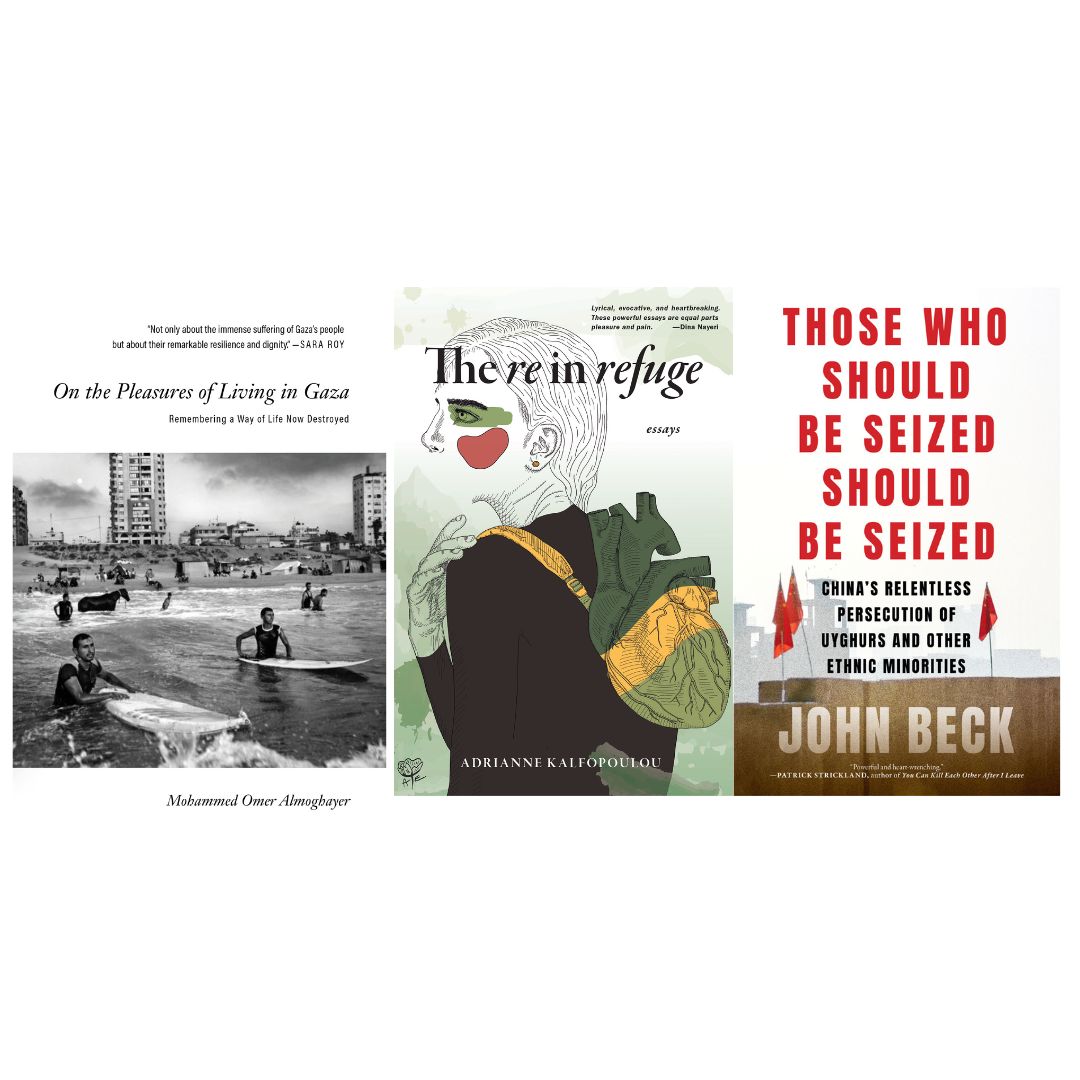
Mohammed Omer Almoghayer’s On the Pleasures of Living in Gaza
In April, we published an excerpt of Mohammed Omer Almoghayer’s powerful and gutting new book, On the Pleasures of Living in Gaza. Released by OR Books, Almoghayer’s On the Pleasures takes readers to places they have likely not encountered while reading about war-stricken Gaza: the moments of joy, friendship, and resilience that rarely emerge in news coverage dominated by death, destruction, and tragedy. A veteran reporter, Almoghayer stands out as one of the most vital voices writing on Palestine and the Palestinians. Read the excerpt here.
John Beck’s Those Who Should Be Seized Should Be Seized
In June, we ran an excerpt from accomplished reporter John Beck’s debut nonfiction book, Those Who Should Be Seized Should Be Seized. Published by Melville House in May, the book offers a deep dive on the long arm of Chinese repression, the injustices imposed on the Uyghur community, and their steadfastness in the face of it all. Read the excerpt here.
Adrianne Kalfopoulou’s The Re in Refuge
In June, we published an excerpt from longtime poet, memoirist, and author Adrianne Kalfopoulou’s The Re in Refuge. Released by Red Hen Press in May, the book is a collection of loosely linked essays that reflect on exile, displacement, and the language barriers that divide us. In elegant and often striking prose, Kalfopoulou pushes readers to reflect on the true meaning of borders — and to ask ourselves what we really know about these manmade lines that impact the lives of so many people around the world. Read the excerpt here.
Reviews
The Kashmiri Stories That Refuse to Die
In July, contributor Muhammad Nadeem reviewed Indian journalist and author Ipsita Chakravarty’s Dapaan: Tales from Kashmir’s Conflict. Released in March by Hurst Publishers, Dapaan draws on oral history, folklore, and on-the-ground reportage paints a moving picture of, in Nadeem’s words, “a Kashmir that resists state-imposed narratives and asserts the power of everyday storytelling as a means of political survival.”
In Iraqi Kurdistan, a ‘Republic of Dreams’
In April, Inkstick regular Winthrop Rodgers reviewed Nicole F. Watts’s Republic of Dreams: Ordinary People, Extraordinary Struggles, and the Future of Iraqi Kurdistan. NYU Press published Republic of Dreams in January, and Watts’s decade of research fuels this impactful work of narrative nonfiction. As Rodgers put it in his review, Watts urges readers “to better understand the people who live in the places that are the objects of geopolitical churn.”
The Neverending War on Terror
In January, Gabriel Colburn reviewed journalist Richard Beck’s Homeland: The War on Terror in American Life. Released by Crown in September 2024, Homeland is a nearly 600-page account of explores the myriad ways that the war on terror changed life in the United States across two decades. As Colburn noted in this review, Beck’s “gripping” narrative “unravels the twisted knots of innocence, trauma, shame, and aggression that have tied the United States to forever wars abroad and ever-deepening crises at home.”
Conversations with Authors
Nuclear Scenario
In June, Inkstick regular contributor Jon Letman sat down with Annie Jacobsen about her unsettling account of the ever-looming doomsday scenario that nuclear weapons threaten to trigger so long as they continue to exist. After its release in 2024, Jacobsen’s Nuclear War: A Scenario quickly became a New York Times bestseller. “I wanted to show in appalling detail just how horrific nuclear war would be,” Jacobsen said. “I learned in reporting the book that the component of time is endemic in the horror that things happen so fast. None of us will have any idea what is happening until the bright lights start.”
Land Controls All
Back in February, Letman also spoke with academic and author Michael Albertus about his deep investigation into the ways land determines one’s wealth, power, and identity. Basic Books released Land Power: Who Has It, Who Doesn’t, and How That Determines the Fate of Societies in January. The book draws on Albertus’s 15 years of researching the central role of land in more than a dozen countries. Asked about the land-intensive needs of AI in an increasingly inequitable world, Albertus said: “The inequalities here are gross inequalities. They’re very extreme. We see that in the relationship of humans to the land in many different ways around the world. Everything from this attempt by Trump to acquire and dominate Gaza to the creation of AI centers and the very unequal access to resources, whether it be water or oil.”


