






The Rodriguez family peers into the lens under the harsh lighting of Havana International Airport. Stretching out his arm, Josue, dressed in a sharp light grey jacket and white shirt, takes a selfie with his wife, Adriana, and their two toddlers to document their final hours in Cuba. Though their faces are partially obscured by masks — as per the COVID-19 travel rules in May 2022 — all four appear to be smiling. Half a year later, thousands of miles away, they would be running panicked through dense Balkan forests, praying that the ground would not explode underneath their feet.



In 2021, the world was still emerging from post-pandemic lockdowns and international travel remained limited, but in Cuba an exodus was beginning. Amid nationwide protests prompted by electricity blackouts and shortages of food and medicine, with anger compounded by decades of political repression, people were forsaking the country. Official statistics estimate that more than one million Cubans left during the 2021-2023 period, but some analysts put the figure even higher. Adriana had studied communications at university but abandoned dreams of being a journalist, unable to bear the prospect of producing propaganda for the government. “Cuba is a prison,” she says by video call from Spain. “I didn’t study for five years to tell lies.”
Unlike most asylum seekers who usually enter Europe from the Mediterranean, the Rodriguezes were able to skip a few steps. Using a Schengen area transit visa, the family flew via Zurich into Serbian capital Belgrade, assisted by a now-defunct visa-free regime that allowed Cubans to stay in the country for up to 90 days. In 2023, Cuban nationals lodged more than 4,500 asylum applications in the European Union. Upon landing, the family requested asylum and were transferred to a nearby refugee camp. They waited several months for an interview, and their daughter started to learn some Serbian words. “We were ready to stay,” Josue said, “but one day, people in the camp told us that we had 15 days to leave the country.”
Believing Serbia’s favorable policy toward Cubans was ending, the Rodriguez family joined a group of their compatriots and headed for the border, where they paid a local fisherman to carry them across the Drina River in a wooden boat and into Bosnia. They headed up to the northwestern frontier town of Bihać with a new destination — Spain. This would necessitate a series of attempts to clandestinely cross the 570-mile Croatian border, a practice now universally referred to by migrants as “the game.” But in the early stages of the game, they had not yet been told about the minefields littering their path.
Aladin Bajraktarević from the Bosnia and Herzegovina Mine Action Center (BHMAC) strides into the hotel breakfast room in Bihać and starts laying out A4 printouts of maps, announcing: “You are six kilometers [3.7 miles] from the nearest mine!”
It’s April 2025, and Bajraktarević points to aerial shots of villages ringed by red blotches signifying minefields. His next photo features a prominent red blotch — blood seeping out from a flock of sheep that had wandered over a mine. “When I show the maps during presentations on landmine awareness, sometimes people don’t listen.” The next photo he places on the table shows a mangled human corpse. “When I show them these, they pay attention. I tell them, ‘Your kids can end up like this.’”
According to BHMAC, the last recorded landmine-related fatality in the Una Sana canton was in 2009, and the victim was a deminer. Since the end of the war in 1995, at least 615 people have been killed by landmines. BHMAC suspects there are at least 20,000 mines in Una Sana, a region stretching across the northwestern frontier with Croatia. Bakrajtarević has a team of 20 deminers, but recruiting new members is a struggle. The low monthly salary of around 700 euros ($790) for a scout, Bajraktarević says, is less than the waitresses serving breakfast earn.

In the 1990s, this region was the scene of fierce battles between multiple armies, and years of shifting frontlines have bequeathed the landscape with a deadly legacy: the country’s highest concentration of landmines near residential areas. But it is in the deep forests and high mountain passes spanning the Bosnian-Croatian border that conceal many more. After the war, this landscape was an underutilized migration route, but in 2016, EU leaders sought to prevent hundreds of thousands of people from crossing from Greece to Western and Northern Europe. Militarized borders and violent pushbacks along the EU border slowly shifted the migration flow westward, and irregular arrivals into Bosnia jumped from around 755 in 2017 to more than 24,000 in 2018.
Towns around Bosnia’s northern border with Croatia became epicenters for migrants, media, and humanitarian organizations. Maps were distributed, warning those crossing the border about the risk of landmines. In the spring of 2021, a Pakistani man was killed and several members of his group injured after walking into a minefield in Saborsko, a small town in Croatia several miles from the Bosnian border. No migrants have been reported killed by landmines in Bosnia, but Bajraktarević and his team regularly find scattered clothes and other detritus strewn around the minefields. Anecdotally, hunters tell him they see migrants entering forests, followed by sounds of muffled explosions. “Dead or Missing in the Balkans,” a Facebook group run by locals and volunteers, contains countless pleas from people whose loved ones were last seen leaving Bosnia, “going for a game.”
The Rodriguezes were advised to follow a route into Croatia that ended near a church, some ruined buildings, and a bus stop. The progress was relatively easy until the first landmine sign plunged the group into dread. Still, they pressed on, walking all night until finally crossing the border where they were promptly captured by Croatian police. “They arrested us and made us sit in a completely sealed van for hours in the sun. They wouldn’t let us feed the children or let them go to the bathroom,” Adriana recalls.
She also explains that the Croatian police searched their belongings and confiscated their telephones. “I confronted them and asked for it back, I was crying because we were going to get lost. Then a female officer put her face right next to mine and told me to leave or she’d hit me. I was holding my one-year-old baby in my arms.”
Without any means of navigation, the Cubans were left stranded on the mountainside. “They just stood there yelling at us: ‘Go to Bosnia, go to Bosnia.’ I was afraid we would never find our way back.”
Again, they walked through the woods under the signs warning of mines. “We saw many blankets, towels, empty water bottles, and clothes,” Adriana remembers. “I can’t say exactly where the minefield began or ended because we only saw signs on the trees, and they didn’t indicate the limits, like ‘it starts here’ or ‘it ends here.’ I’ve never felt so scared.”
Fortunately, they encountered Nedžad, a local businessman, who was hunting in the forest. “They were exhausted, lost, with small kids in their arms,” he told us when we met up on the hilltops outside Bihać. Nedžad, who preferred not to give his surname, hosted the family for a few days while they regained their strength. A former soldier who spent the war fighting on various frontlines in the immediate area, he thought the family was lucky. “They had walked straight through the minefield.”

A Moroccan asylum seeker now living in Italy sends us a video of his passage out of Bosnia a few years prior. Sunlight filters through the trees on which hang bright red signs with skulls and crossbones. Between heavy breathing, the man narrates in the Darija dialect of Arabic: “We arrived in Croatia, walking through paths of death,” he says. “May God protect and make it easy for each person walking these paths. I do not know if the Croats will take this video away or it will remain. Please God make it easy on us, please we are in the middle of the Croatian forest. We are in the middle of mines. Please God make it easy on us.”
At a Bihać restaurant adorned with hunting paraphernalia, Ermin Lipović scrolls through photos of the bruised and battered migrants who emerge from confrontations with the Croatian border guards. Some cradle broken arms in slings, others lie motionless on stretchers with head stabilizers. Often, migrants pushed back from Croatia become stranded in the mine-riddled forests and may alert the police, who in turn will call Lipović to guide them to safety. In his fifties, wiry and alert, Lipović leads the local branch of the Mountain Rescue Service and braves harsh terrain and extreme weather to attend to lost hikers, farmers trapped under tractors and paragliders caught in tree branches. Since 2018, migrants are increasingly among the lost.
“Sometimes you see mothers and fathers with little children,” Lipović shakes his head. “They have milk in their backpack and it’s frozen solid. No thermal clothing, nothing. Every time you go up the mountain, you don’t know who you will meet. I go quietly. Sometimes the smuggler says, ‘Don’t come here.’ I say, ‘OK, you’re going to Croatia, but please go that way instead!’
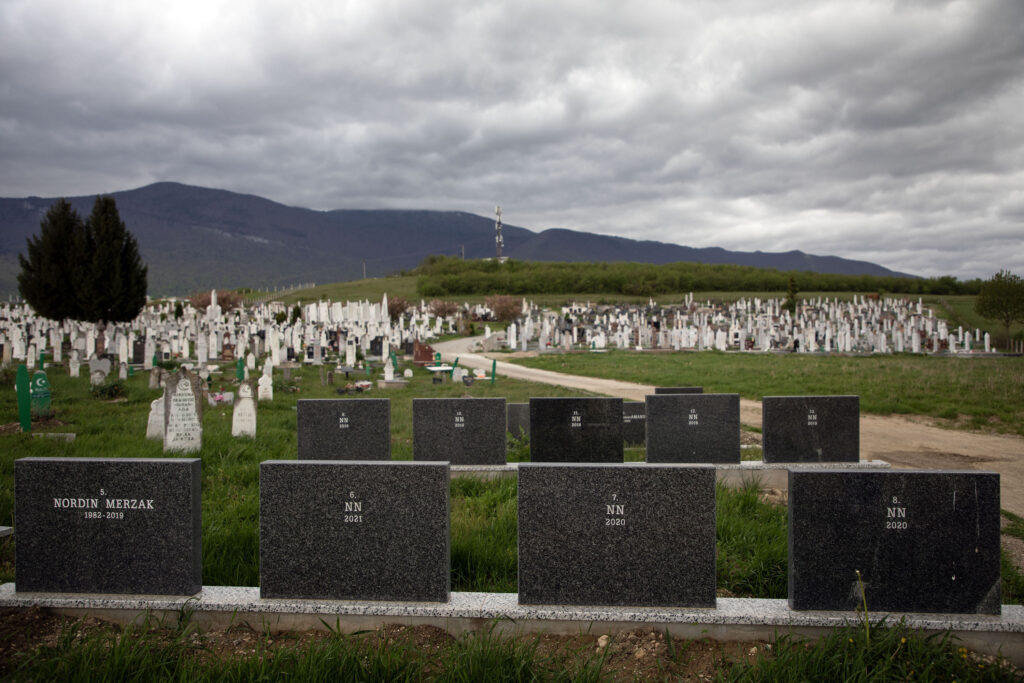
Lipović thinks it probable that some have died from triggering landmines deep in the forest. “You have people here buried without a name,” he says, gesturing to the other side of Bihać. There the town’s main cemetery features a section for migrants with a dozen simple gravestones inscribed with the letters NN (from the Latin nomen nescio, or “I do not know the name”).
We drive southeast out of Bihać toward the largely uninhabited hamlet of Lipa. It was here in December 2020 that people were seen running from clouds of black smoke after the tented settlement hastily established to house migrants was incinerated in an unexplained fire. Months before, Europe’s biggest refugee camp on the Greek island of Lesbos had also gone up in flames. Its replacement — an isolated, heavily surveilled Closed Controlled Access Centre — would herald the EU’s new model of quasi-detention facilities for asylum seekers. In November 2021, local and EU officials opened Lipa amid great fanfare, with the regional head of the International Organization for Migration (IOM), Laura Lungarotti, announcing: “Today we are turning a tragedy into an opportunity.”
Lipa lies at the end of a two-mile-long dirt track, with rows of metal warehouses and shipping containers dotted along a windswept hilltop surrounded by barbed wire fencing. The European Commission financed the construction of the camp with an initial €1.7 million ($1.9 million) with member states also contributing an additional €500,000 ($570,000) for a small detention facility inside. Sixteen miles away from the nearest town, Lipa is in the middle of nowhere or, to use a Bosnian term, a vukojebina — “a place where the wolves fuck.”
We saw no wolves, though bears and lynx are known to roam nearby. A note written in Arabic and Farsi stuck on a portacabin at the camp’s entrance warns migrants of the hunting season in the surrounding hills. More arresting are the other signs a few hundred yards away behind the camp. Poking out of the trees, bright red and square, with a prominent skull and crossbones and white capital letters screaming “MINES!”
The signs were placed there by Bajraktarević’s colleagues from the national demining agency. He says that BHMAC deem it a “mine suspected area,” meaning that there is a possibility that mines or unexploded ordnance may be present. Despite this, Bajraktarević says they have not been contacted by any authority or international organization since to completely clear the area.
We were allowed into Lipa by the state Ministry of Security under the strict instructions that we did not take any photos or speak to any of the migrants inside. After a terse exchange in Bosnian with the camp manager, our friendly but nervous minder announced: “What I have to tell you is that I am not allowed to tell you all the information.”
During our brief tour around the facilities, we learned that Lipa has the capacity for 1,500 single male asylum seekers but was currently 10% full. The nationalities included Moroccans, Algerians, Afghans, Palestinians, Egyptians, Syrians, Libyans, and Pakistanis. On average, people stay for 10 days with access to basic services: food, showers, hygiene items, and a visiting doctor. Curiously for such an isolated facility, there is no public transport connection and migrants are obliged to use private taxis, the same ones that also drive migrants to the Croatian border for grossly inflated fees. It is also common for those without funds to walk to the camp, crossing over terrain that the state demining agency believes may contain mines.
“It’s a business, not just for smugglers but for taxi drivers,” says a humanitarian worker in Bihać, whose organization opposed the location of the camp from the beginning. “They pay 50 euros [$58.26] each for a taxi to Lipa from the border, they fit as many as they can. Everyone is using the opportunity to get money from them.”
Landmine awareness sessions are conducted “from time to time,” according to our minder as “this area is potentially infested with mines.” “They could be there, but it is not 100%,” he continued, adding: “But it never happened over here that somebody stepped on a mine and activated it. We all know where those landmines, maybe, are. We know where the biggest fights happened during the war, so we’re not going there.”

In a statement to Inkstick, the spokesperson for the EU delegation in Sarajevo, Ferdinand Koenig, said that the territory of the Lipa camp was confirmed as mine-free prior to its establishment and that this one was of the essential conditions demanded by the EU before committing to financing.: “In the vicinity of Lipa, there are zones which are classified as ‘suspected but not confirmed dangerous areas’ for mines,” Koenig added “The ongoing presence of marked warning signs several hundred meters from the camp serves as a precautionary measure to protect migrants and local communities, and this marking is regularly maintained and verified, including through periodic checks, by BHMAC.”
Though Lipa is managed by Bosnian authorities, the IOM was the primary implementing agency involved in its establishment. In a statement to Inkstick, IOM spokesman Francois Lhoumeau said: “To ensure accuracy, IOM cross-checked the BHMAC digital platform, which provides real-time updates on mine-suspected zones in the country. The platform confirms that there are no mine-contaminated areas in the immediate surroundings of TRC Lipa.”
When we stood behind the camp, the Suspected Mines app told us we were less than two miles from a mine. Lhoumeau also said: “Prior to the opening of TRC Lipa, BHMAC informed IOM that a limited number of signs would be installed as a precautionary measure. It is important to note that the actual mined area is located significantly farther north and does not pose a direct threat to either the residents or staff operating within the TRC Lipa perimeter.”
“Gaza, Ukraine — I don’t watch the news anymore. The world comes past my door.” – Ibrahim Džanić
Given their similarity, it is difficult to know the difference between signs that have been laid “as a precautionary measure” and those that warn of known minefields. But contradiction was a common theme throughout our inquiries. Many times, we were told with extreme confidence in one breath that an area had no mines, only to be told seconds later that if there are mines then there are not many, or if there are then they are probably inactive.
Šuhret Fazlić, the former mayor of Bihać, whose tenure coincided with the establishment of Lipa, flatly denies the area is — or ever was — mined. “I am not aware of the signs,” he says, “but if they are there then it is because of the possibility that some unexploded ammunition could be there. Or there is a theoretical possibility that there are mines in some areas, so they [BHMAC] put up the signs to release themselves of the responsibility.”

Back at Lipa, we managed to invite a middle-aged Algerian man outside for a brief chat. He wouldn’t comment much on the camp conditions or treatment by staff but hinted at tensions inside. “You have to watch your back, even the one sleeping next to you.” He confirmed that landmine awareness sessions are given. “They told us this area near Croatia is full of bombs.” Yet, like most migrants on the route, he is not blessed with many alternative options when his sole aim is to cross the border.
Threats of a much higher order of magnitude are presented by the Croatian border guards, who have been accused in multiple journalistic and NGO reports of theft, destruction of property, intimidation, physical abuse including use of batons, tasers and knives, and sexual assaults, including against women and minors. “Some of them hit you and take your mobile phone,” the Algerian man explains. “Some of them treat you good, just leave you on the border, and tell you to go, but the majority — no good.”
A Croatian interior ministry spokesperson told Inkstick that their officials maintain excellent cooperation with BHMAC and “the exchange of data and information on dangerous areas is an integral part of our cooperation and is ongoing.” Despite this, migrants apprehended by Croatian forces are routinely forced back into Bosnia, including to areas still rife with unexploded ordnance. If some still had possession of the phones, they could download an app developed by the UNDP called “Mine Suspected Areas,” which provides a map showing proximity to minefields. Reviews are generally negative, with users reporting bugs, inaccuracies, and incompatibility with iPhones.
In one village near Velika Kladuša, where mine warning signs protrude from woods next to back gardens, the app suddenly blasts a warning tone. But when we conduct a site visit with BHMAC, while heavily armored deminers lumber around minefields nearby, the app stays silent. Bajraktarevic looks at the phone and frowns, admitting: “It’s not 100% accurate.”
Up in the green undulating hills outside Velika Kladuša on Bosnia’s farthest northwestern tip, the stillness in the air is enforced by abandonment. Residential houses are shuttered and driveways empty, the families having long left for opportunities across Europe — Bosnia records one of the world’s highest per capita emigration rates, with around 1.7 Bosnians living outside the country. Among the fields stand dilapidated wooden barns and decaying concrete outhouses where migrants huddle before or after embarking on “the game.” In the squares of tiny towns and villages, groups of pushed-back migrants gather to figure out their next move.
In Vrnograč we meet Abdikadir, a young Somali resting with his fellow travelers fresh back from an unsuccessful game and waiting for a ride back to Lipa. He was aware of minefields on the way to Croatia because he saw them: “Yeah, there are a lot of signs, but we have the leader, he knows the way.” With little power to choose on which path they are taken, Abdikadir suggests that smugglers may be forging routes through the minefields precisely to avoid detection. “If the smugglers see police, they will run into the forest.”

In a nearby settlement, Ibrahim Džanić leans on the gate outside his bright green house, which stands atop a valley staring across into Croatia. A retired Lego factory worker, he spends his days admiring his sun-dappled lawn among the apple blossom, tending to his rows of hives, making honey, and contentedly listening to the “beautiful music” of the bees. But in recent years, the tranquil air has been punctured by screams at night. Džanić points towards a field. “Over there, that’s where they throw them in the river,” he frowns. “You see them walking past soaking wet.”
Just as the locals have become used to the slow rhythm of rural life, and the presence of wartime landmines underfoot, the overbearing presence of their neighbor’s border guards, and their violent ejections of migrants have become a grim routine.
“I see them when they patrol,” Džanić says. “They used to jump out of their car and run toward me, and then after a while they realized I’m just an old man walking my dog.” He narrows his eyes. “Gaza, Ukraine — I don’t watch the news anymore. The world comes past my door.”
In 2021, after several weeks spent monitoring the forests, a team of journalists captured high-definition footage of masked Croatian border guards conducting illegal pushbacks of migrants into Bosnia, striking them with batons, and forcing them into a river. The Croatian government insisted it was an isolated incident and announced the suspension of three officers, only for them to be soon reinstated. With little enforcement by EU officials and without any obvious effective mechanism to prevent rights violations, villagers report that the border violence is business as usual. One farmer, who gave his name as Husejn, still sees bedraggled migrants returning from unsuccessful border crossing attempts. This year there are less, though in previous times there might be hundreds a day passing through.
“They don’t deport them normally, they just leave them in the forest,” he says, looking over at a patch of freshly planted trees in the near distance. Our Suspected Mines app informs us we are half a mile away from a mine. “They bring them all the way there, beat them up, and break their phones. We can hear when they are screaming and begging for help. We couldn’t listen to that anymore. Can you imagine that someone brings you to some forest, does that to you and you have no idea what’s happening? Imagine what you can hear and how that feels.”
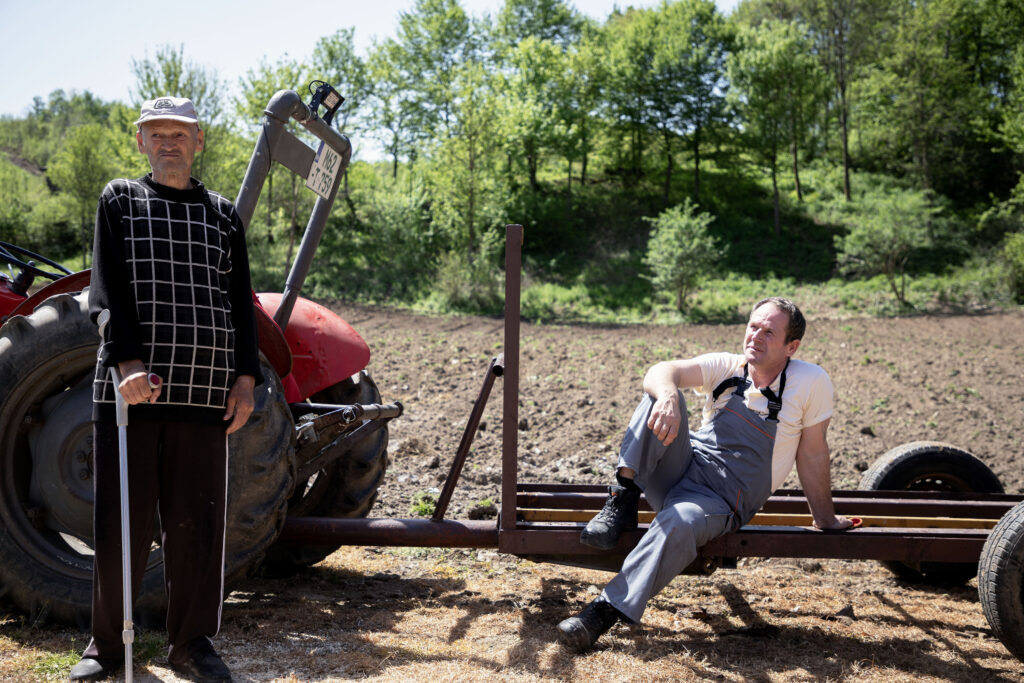
Husejn has his own experience of negotiating perilous borders, having been stranded behind enemy Serb lines in the 1990s with the only way to cross back to base through a minefield. “I thought, either I get out of here, or I’m done.” Thanks to his Yugoslav People’s Army training, he identified the zigzag pattern of the trip wires and gingerly stepped through to safety. When he and his family returned after the war, the farmland was laced with mines. But Husejn took a proactive approach. “I found those mines, put them in the ground, lit a fire, and blew them up,” he chuckles mischievously. “Then the police came around and said, ‘You can’t do that.’”
Husejn is skeptical whether migrants may encounter the same risks, speculating that the landmines around his house may no longer be active after 30 years of rain and snow and being pushed deeper underground, but he worries for other countries where they are being freshly laid. “Countries like Ukraine, they will have to go through what we did.”
In 2023, fueled by raging conflicts in Syria, Afghanistan, and Ukraine, 5,757 casualties of landmines and explosive remnants of war (ERW) were recorded, 84% of them civilians. In 2025, citing security concerns stemming from shared borders with Russia, the governments of Finland, Estonia, Latvia, Lithuania, and Poland announced they would withdraw from the Ottawa Convention, an international treaty that aims to eliminate anti-personnel landmines.
According to officials, at the start of 2025 around 1.6% of Bosnia was deemed “mine suspected,” down from 8.2% in the late 1990s. They estimate that to clear the remaining 800 kilometers (497 miles) in the next decade, around €30 million (around $34.9 million) will be required — a very tall order in the age of competing foreign policy concerns and punishing aid cuts. Meanwhile, Croatian officials say they intend to be declared mine-free in 2026.
Through its military operation EUFOR, the EU supports Bosnia’s armed forces in demining and landmine awareness training. It is also one of the largest international donors for mine action, contributing more than €46 million ($54 million) of support for efforts including mine clearance and victim assistance. Other individual member states have also provided bilateral funding. But the figure is dwarfed by the amount allocated to border migration management, which, according to EU spokesperson Koenig, is nearly €150 million ($176 million) since 2018 alone. Meanwhile, in 2024, the EU recorded approximately one million asylum claims for the second year in a row.
For its part, the Rodriguez family’s second attempt at leaving Bosnia was difficult. “My daughter saw trees and began to cry,” Adriana recalls.
Over a six-week period, the Rodriguezes would walk back and forth across the Bosnian minefields three times. On their fourth try, they made it to Spain, where they now have a third child. But even safely settled, years on, the memories linger.
“If I’m driving at night and all I can see is the countryside, I get very anxious. My chest hurts, my hands tingle, and I have trouble breathing. I feel like I’m on my way to crossing the border all over again,” Adriana says. “But we had no choice. It was that or return to Cuba.”
Donate
Hey there!
You made it to the bottom of the page! That means you must like what we do. In that case, can we ask for your help? Inkstick is changing the face of foreign policy, but we can’t do it without you. If our content is something that you’ve come to rely on, please make a tax-deductible donation today. Even $5 or $10 a month makes a huge difference. Together, we can tell the stories that need to be told.